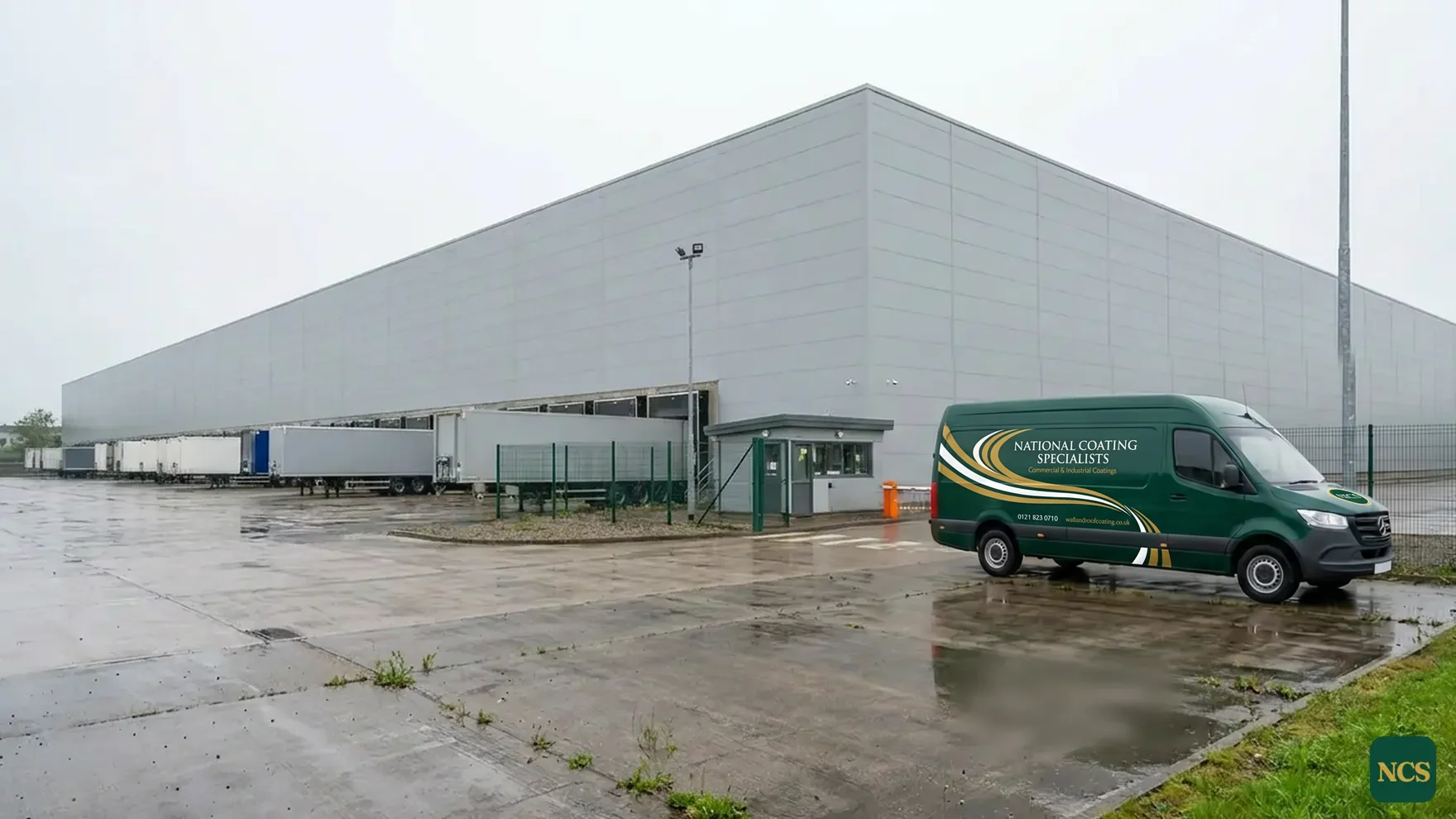




Why industrial building cladding fades and stains
Factory and warehouse cladding faces constant weathering from rain, UV exposure and industrial pollution, making surface condition a key consideration before industrial cladding spraying. The plastisol coatings on profiled steel panels degrade over time, losing their protective qualities. Chalking occurs as the surface breaks down into a powdery residue, while staining comes from dirt accumulation and chemical reactions with airborne contaminants. These issues accelerate on buildings near busy roads or industrial processes where particulates settle on the exterior.
Older buildings suffer most, with original coatings from the sixties and seventies now beyond their intended lifespan. Even modern industrial units show premature wear when subjected to harsh environments or poor initial application. The result is a tired appearance that undermines professional image, plus reduced weatherproofing that risks substrate damage if left untreated.
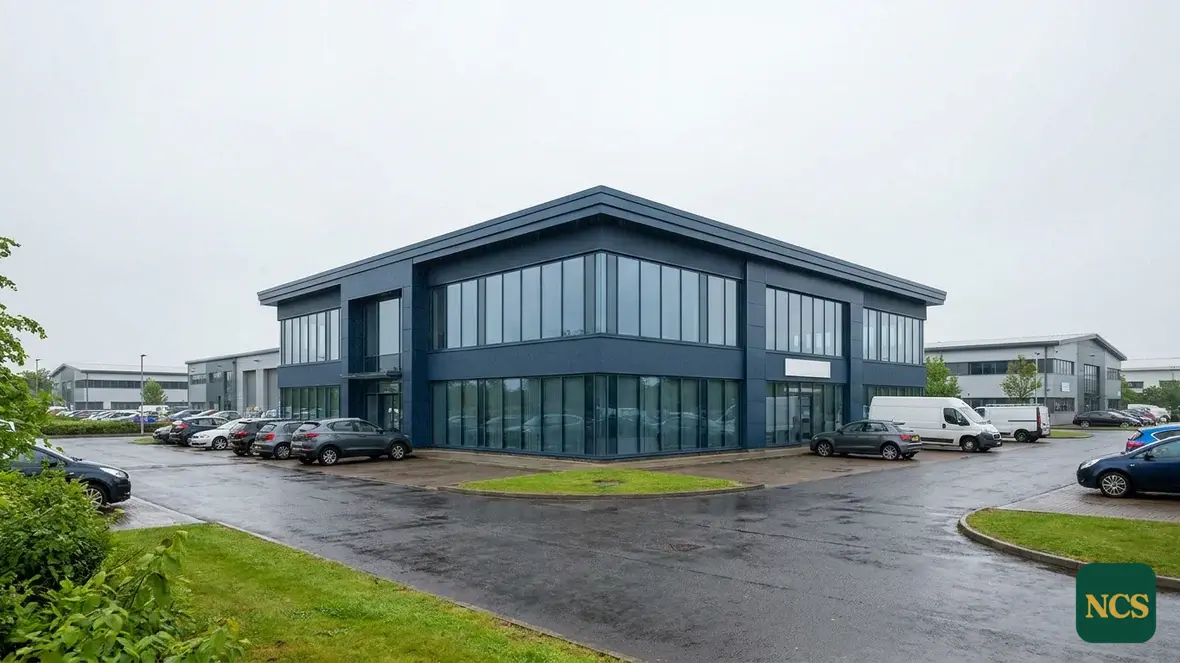
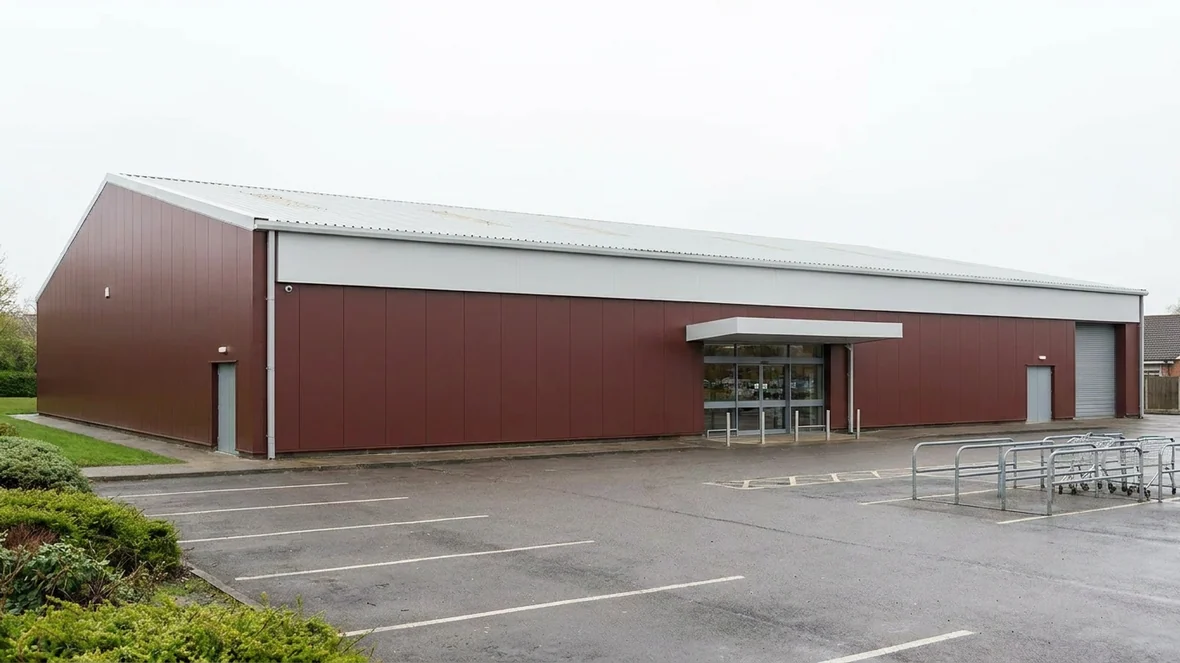
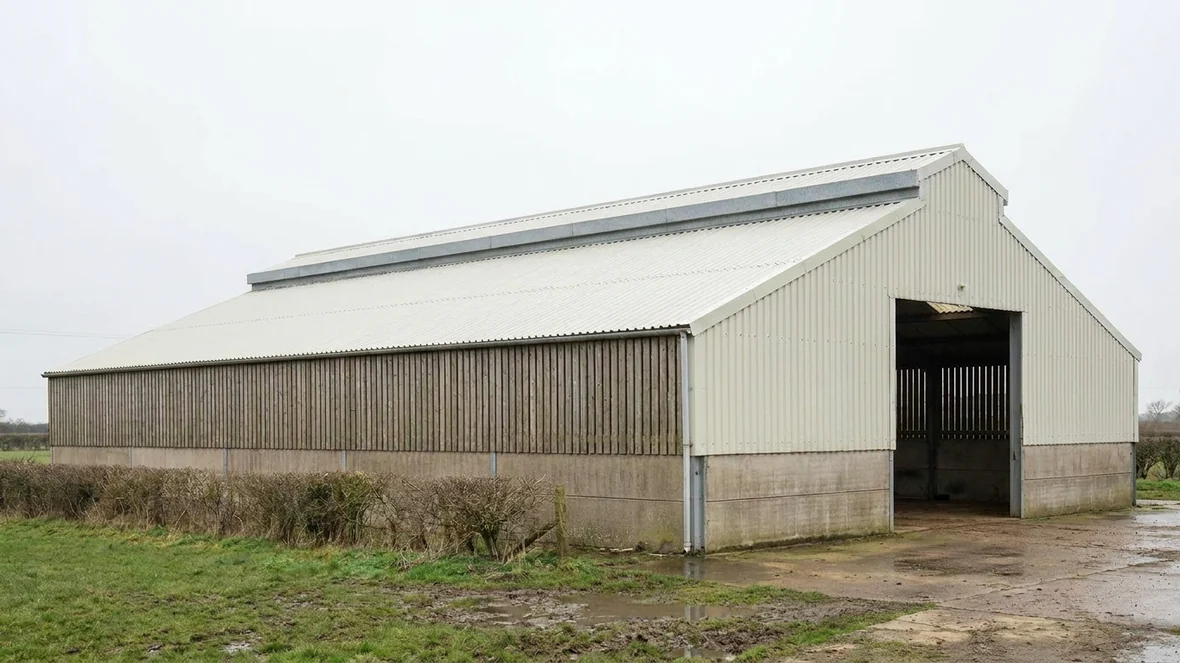
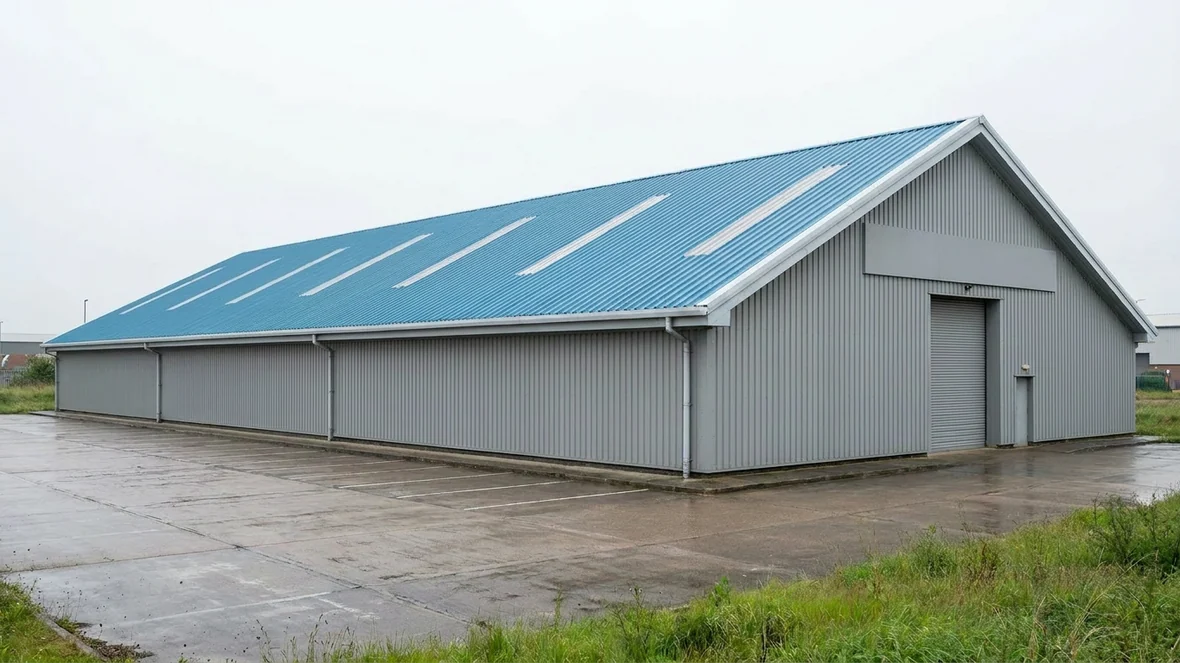
The industrial clad building stock across the UK
Britain’s industrial estates contain generations of clad structures, from small workshops to vast manufacturing plants. The most common are single-skin profiled steel panels with plastisol finishes, installed from the mid-twentieth century onward. Many original sixties and seventies units remain operational, their once-vibrant colours now faded to pastel shades. Later additions through the eighties and nineties often feature thicker gauge steel but similar coating systems.
Modern production sheds use advanced composite panels, yet still rely on sprayed coatings for weather protection. All share the same vulnerability to coating breakdown where daily operations expose them to temperature fluctuations, mechanical abrasion from loading bays, and chemical exposure near processing areas. The uniformity of these buildings makes them ideal candidates for respraying rather than replacement.
On-site industrial cladding spraying
Industrial respraying involves thorough surface preparation followed by application of high-performance coatings by airless spray. Our teams work around production schedules, coordinating with site managers to minimise disruption. The process starts with pressure washing to remove chalk and contaminants, then spot repairs to any damaged panels. Masking protects windows, doors and sensitive equipment before spraying begins.
The result is a uniform factory-fresh finish that restores the building’s appearance and protection. Modern coatings offer superior durability to original systems, with enhanced resistance to UV, chemicals and abrasion. The sprayed application ensures complete coverage even on complex profiles, creating a seamless protective layer that withstands industrial conditions for years.
Industrial cladding spraying brings factories and industrial units back to a sharp finish on site, without the cost and disruption of new panels.
Cut edges, fixings and panel repairs come first
Industrial cladding fails where water gets in. The priority is always the cut edges around openings, the fixings that hold the sheets to the frame, and any damaged panels that have taken impact from plant or vehicles. These are the points where water ingress starts, often hidden behind the outer face of the cladding until the rot is advanced. A proper survey will identify every compromised edge detail, check each fixing for seal failure, and map any panel damage that needs replacing before the coating work begins.
On older industrial buildings, the original edge trims and flashings are often missing or improvised with sealant that has since cracked and failed. Modern production sheds may have factory-fitted trims but suffer from poor installation or movement over time. The coating itself cannot fix these underlying issues – they must be addressed first, with new trims, proper flashings and replacement panels where needed, before any protective coating is applied.
- Every cut edge around doors, windows and penetrations inspected
- All fixings checked for seal failure or corrosion
- Impact damage to panels assessed for repair or replacement
- Missing or failed edge trims identified and specified
- Flashings and junctions examined for water entry points
Planning the work around live industrial operations
The coating process must fit around the building’s use, not the other way round. Factories and production units cannot simply stop operating for the duration of the work. The planning phase establishes shift patterns, delivery schedules, forklift routes and any areas that must remain accessible throughout. Work is sequenced to minimise disruption, often starting with the least critical elevations or working in sections that can be isolated temporarily.
Permit-to-work systems and site inductions are standard in industrial settings. The coating team will need to comply with all site safety protocols, including any restrictions on working hours, noise levels or access to certain areas. On food production or pharmaceutical sites, additional hygiene controls may apply. The key is early consultation with the site manager to understand all operational constraints before finalising the method and programme.
Why the survey comes before specification
No two industrial buildings present the same challenges. The substrate condition, the type of cladding system, the exposure to weather and chemicals, and the building’s operational use all influence the coating specification. Only a thorough survey can determine the right preparation methods, the most suitable coating products, and the application techniques that will deliver lasting protection.
Guessing the specification risks either over-engineering the solution at unnecessary expense or under-specifying and facing premature failure. The survey provides the evidence base for every decision, from the degree of surface preparation required to the choice between silicone, acrylic or polyurethane coatings. It also identifies any ancillary works needed to make the cladding sound before coating begins, ensuring the final result performs as intended for years to come.
Where this sits in our work
This work runs under our cladding spraying service, alongside everything else we do for industrial buildings. If one of these buildings is on your list, book a free survey and a surveyor will walk it before anything is specified.
All access and roof work is planned in line with HSE work-at-height guidance.
Common questions about industrial cladding spraying
Can faded industrial cladding be painted?
Yes, provided the cladding remains sound and the existing finish can accept a new coating system. We first assess adhesion, corrosion, previous repairs, contamination and the condition of cut edges, laps and fixings. Fading alone is usually a finish problem; peeling, perforation or panel failure requires closer investigation.
Can you spray over rust on metal cladding?
Not without preparation. Loose corrosion, failed coating and contaminants must be removed, while firmly adhered areas are prepared to provide a suitable key. Corroded edges, fixings and local defects may need additional treatment. Spraying directly over active rust merely conceals the problem for a while.
Will industrial cladding spraying stop roof or wall leaks?
A coating may help protect weathered surfaces, but it is not a substitute for proper leak diagnosis. Water can enter through failed seals, loose fixings, damaged sheets, defective flashings, blocked gutters or poorly formed junctions. We identify and address relevant defects before coating rather than treating paint as a general waterproofing remedy.
Can cladding spraying be carried out while the building is occupied?
Often, yes. The practical answer depends on access, ventilation, nearby vehicles, pedestrian routes, sensitive processes and the control of spray drift. We plan masking, exclusion areas and working sequences around the building’s normal use. Some operations may still need temporary restrictions or coordination with occupants.
How long does industrial cladding spraying last?
There is no responsible single answer. Service life depends on substrate condition, preparation, coating compatibility, exposure, building orientation, coastal or industrial contamination, drainage and future maintenance. A sound survey and a suitable specification are more useful than a blanket lifespan claim.
Industrial cladding coating or replacement?
Coating and replacement solve different problems. Industrial cladding spraying is generally appropriate where panels remain structurally serviceable but the factory finish has faded, chalked, weathered or developed localised corrosion. It can restore appearance and provide renewed surface protection without removing otherwise usable sheets.
When coating is the sensible option
- The panels are secure, substantially sound and suitable for preparation.
- Deterioration is mainly confined to the surface finish.
- Corrosion is localised and has not significantly weakened the sheets.
- Existing joints, flashings and interfaces can be repaired effectively.
- The required outcome is protection and visual refurbishment rather than a change in the wall or roof construction.
When replacement wins
Replacement is the better course where sheets are perforated, extensively corroded, distorted or no longer securely fixed. It also wins where the panel assembly has failed, water ingress is rooted in the construction itself, or the building requires improvements to insulation, condensation control, fire performance or structural capacity that a surface coating cannot provide.
Replacement may also be preferable where repeated patch repairs would leave a fragmented substrate with doubtful long-term integrity. A coating can protect suitable cladding; it cannot restore lost metal, repair a failed core or correct an unsuitable building envelope design.
The balanced decision may involve both approaches. Unsalvageable sheets and details can be replaced while sound elevations are prepared and coated. We base that recommendation on condition and access rather than assuming that every weathered building needs the same treatment.
Preparation and detailing at laps, edges and fixings
The broad faces of cladding are usually the straightforward part. Failures are more likely to begin at cut edges, overlaps, fasteners, penetrations and areas where water or contamination remains. These details therefore receive separate attention during preparation and application.
Cleaning and surface preparation
We remove dirt, chalking, organic growth, grease and loose coating to expose a stable surface. The preparation method must suit the substrate and avoid forcing water into joints or damaging thin cladding. Adhesion checks and close inspection help determine whether the existing finish can remain or requires more extensive removal.
Corrosion and damaged coating
Loose corrosion is mechanically removed to a firm edge, with surrounding coating feathered rather than left as a sharp ridge. Bare and vulnerable areas are treated in accordance with the selected specification. If preparation reveals deep pitting, perforation or weakened sheets, we stop treating the issue as a painting defect and recommend repair or replacement.
Cut edges, laps and fixings
Cut-edge corrosion often develops where the protective finish has broken down and moisture is retained at the sheet edge. Laps can also move, trap dirt or conceal corrosion. We inspect these areas closely and use brush or roller application where spray alone would not place material accurately. Loose or failed fixings and seals are addressed before the finish coat is applied.
Masking and spray control
Doors, glazing, signs, rooflights, vents, vehicles and adjoining surfaces require deliberate protection. Wind direction and local conditions are monitored throughout the work, and spraying is paused when drift cannot be controlled. Good masking is not cosmetic housekeeping; it is part of competent industrial cladding spraying.
Building a consistent finish
Application is planned to maintain wet edges and avoid dry spray, striping and uneven sheen. Profiles are coated from suitable angles so that crowns, valleys and returns receive an even film. We also allow for weather, surface temperature and drying conditions rather than forcing the programme when the substrate is unsuitable.