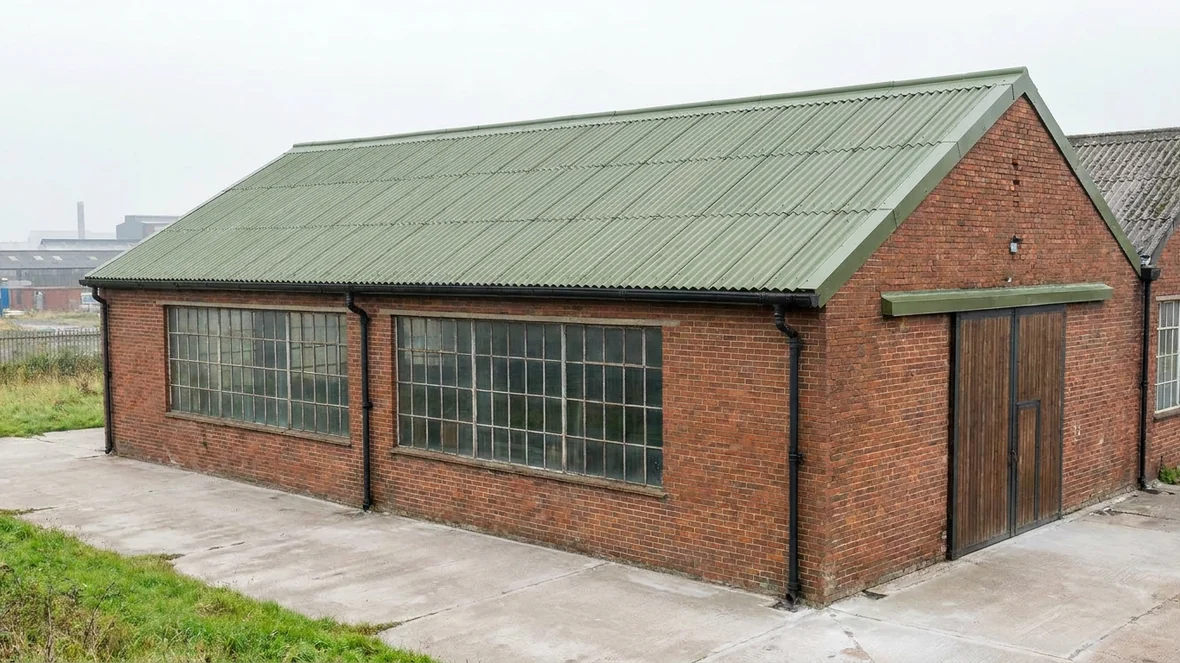
A full asbestos cement roof encapsulation on an engineering works near Sheffield, South Yorkshire, sealing a weathered big-six roof under a continuous Olive Green RAL 6003 membrane after a careful low-pressure clean, with the works in production throughout.
The building and the brief
This engineering works sits in one of the older industrial pockets on the edge of Sheffield, the kind of building that made South Yorkshire’s name, red brick walls, big multi-pane steel windows, a steel truss roof structure, and a duo-pitch roof of asbestos cement sheets in the classic big-six profile. The business inside machines components today just as the building’s first tenants did, and the owner had no intention of moving. What he had was a roof question that a lot of Sheffield building owners will recognise, weathered asbestos cement, still watertight, but visibly ageing and increasingly hard to insure without a plan. Half the older industrial roofline of South Yorkshire is in the same position.
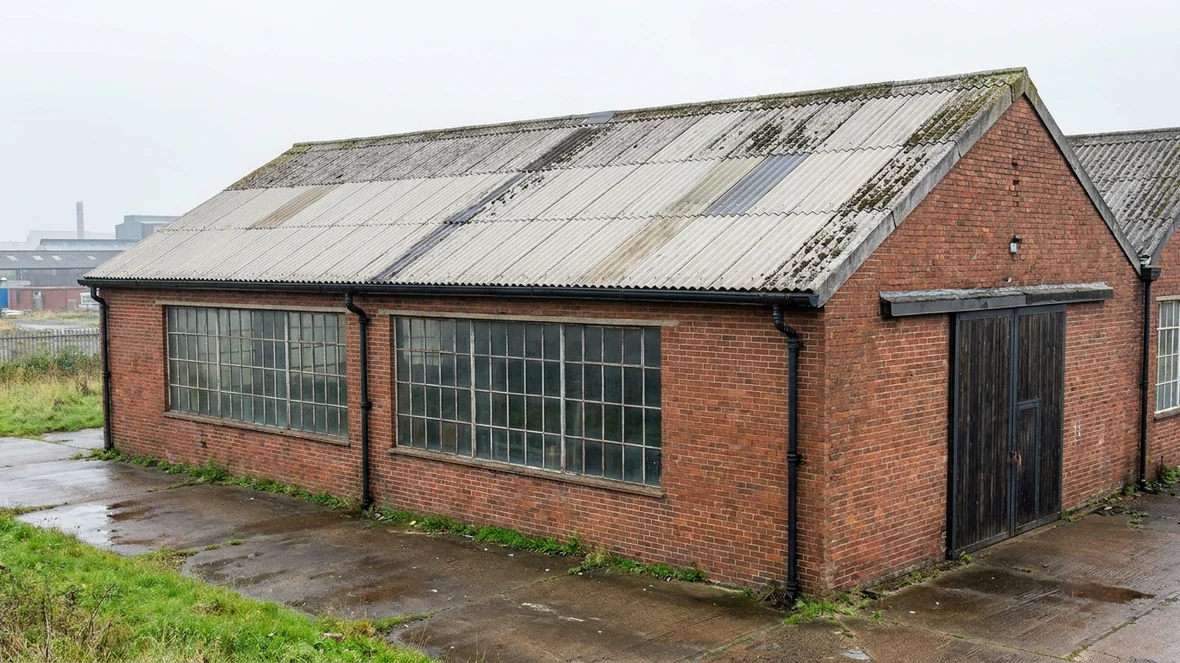
The sheets themselves told the usual story. Asbestos cement weathers from the surface, the cement matrix slowly erodes in the rain and the surface becomes bare and fibrous while moss and lichen colonise the overlaps where water sits longest. This roof carried dark bands of growth along every lap, water staining running down from the ridge, and a handful of older repairs in slightly mismatched sheets, but crucially the sheets were intact, no cracks under load, no holes, no slipped fixings. That distinction decides everything on an asbestos roof, in South Yorkshire’s climate more than most. Sound sheets can be encapsulated. Broken ones change the conversation entirely.
We surveyed, confirmed the roof was a good encapsulation candidate, and specified a full encapsulation system, a careful clean, repairs to the few damaged points, then a liquid-applied coating that seals the whole roof surface, locks down the weathered cement, and stops the erosion cycle. Encapsulating a sound asbestos cement roof keeps the material safely sealed in place and undisturbed, which is consistent with HSE guidance on managing asbestos, and it avoids the cost, disruption and waste burden of removal on a building that does not need it. For the colour the owner chose Olive Green, RAL 6003, from the palette we coat in, the agricultural and heritage standard that sits quietly against the trees behind the works.
What the survey found
Everything about preparing an asbestos cement roof is different from preparing steel, and the survey is where that difference starts. We inspected every sheet from the MEWP before pricing anything, confirmed the laps and fixings were sound, graded the moss and lichen coverage, and identified the few cracked corners and weathered fixing heads that would need repairs before any coating was applied. The rule we work to is simple and non-negotiable. You do not dry-sweep asbestos cement, and you never blast it with an aggressive high-pressure jet, because both release fibres from the weathered surface, exactly the outcome the whole job exists to prevent. Sound sheets, a gentle clean and a sealed membrane, that was the specification, and the building qualified for it.
The work, stage by stage
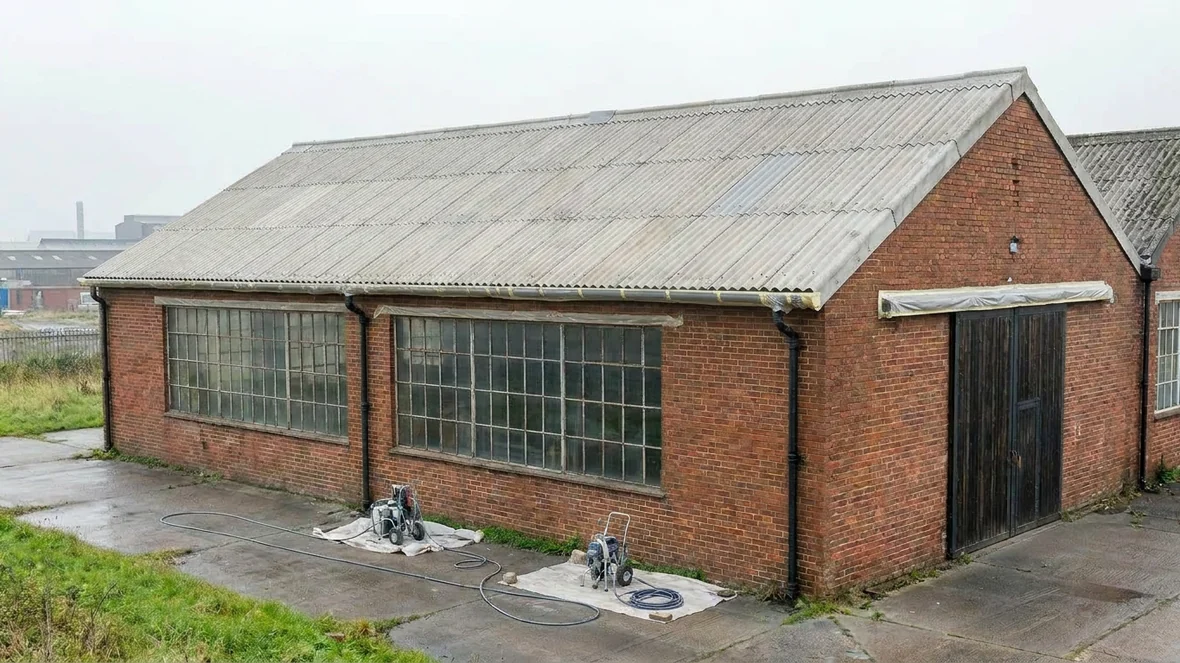
The sequence below follows the roof through the programme, the careful low-pressure clean, repairs and preparation, the encapsulation coat going on, and the sealed roof from the same viewpoint we started at.
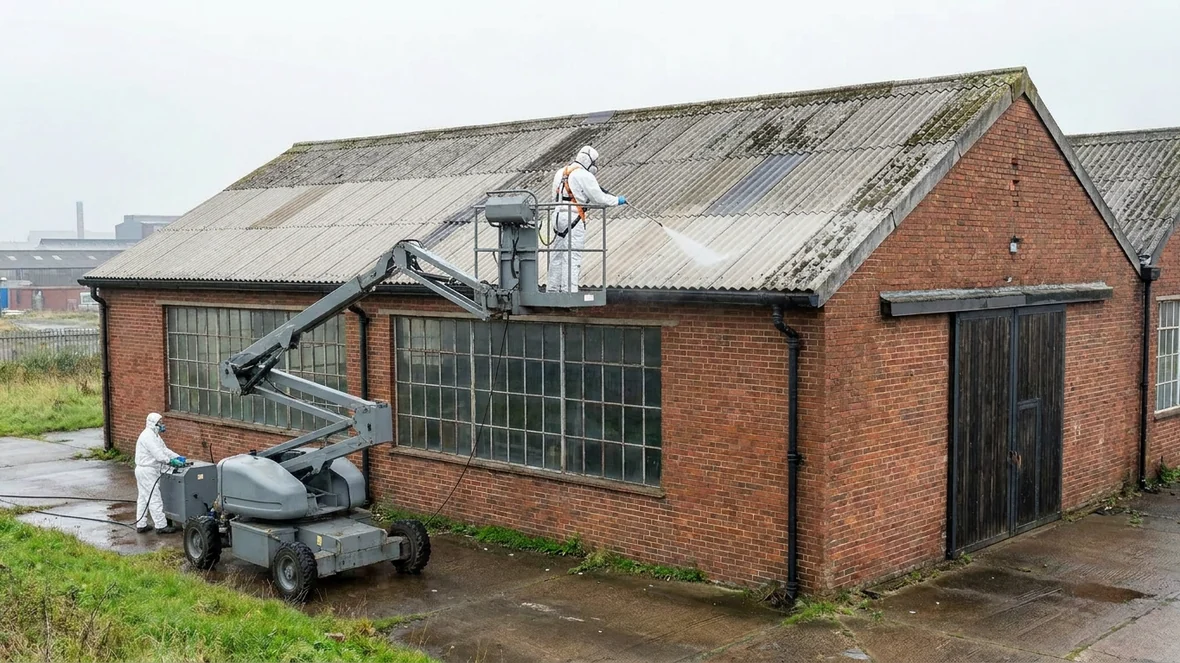
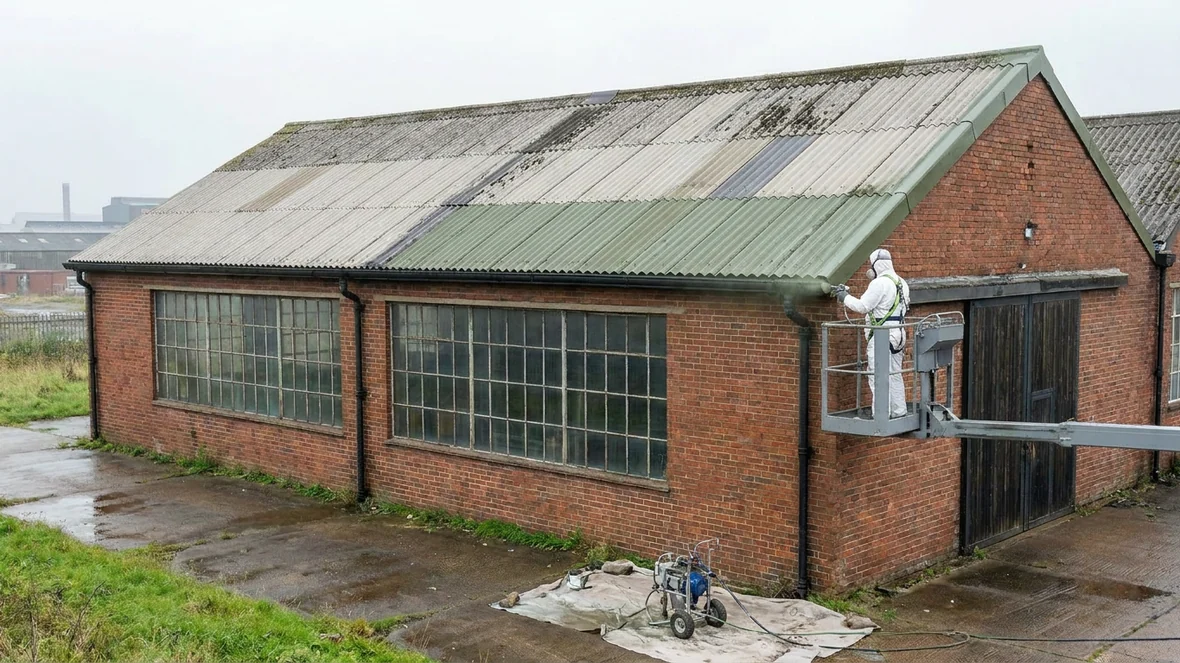

The cleaning method we use on asbestos cement is deliberate and slow, low pressure, controlled water flow, worked gently across the sheets so the moss and lichen release and rinse away without disturbing the cement beneath. Our operatives worked in full coveralls and respirators, one on the lance from the MEWP basket at the eaves, harnessed and clipped on, the other at ground level managing the wash unit and the runoff, which was contained and collected at the gutter rather than allowed to wash over the yard. In the photograph you can see the method reading exactly as it should, a soft fan of water rather than a blast, a visibly cleaner band of bare grey sheets behind the lance, and the moss-patched sheets waiting ahead of it. It is slower than jet washing a steel roof by some margin, and we plan South Yorkshire encapsulation programmes around that from the start. On this substrate, slower is the only defensible way to work, in Sheffield or anywhere else.
Clean, the roof showed us its true condition, and it was good. The few defects the survey had flagged were made right, small cracks bridged with non-asbestos repair patches bonded over the damage, weathered fixing heads sealed, and the older mismatched repair sheets checked and left in place where they were sound. The half-round gutters were cleared of the debris the wash had lifted, then masked along their full run, and the tops of the brick walls and window heads were filmed where they meet the eaves so the encapsulation coat would finish on a clean line. None of this stage is glamorous and all of it matters. An encapsulation coating is only as continuous as the surface under it, and a cracked sheet or a proud fixing left untreated becomes the one point where water gets back underneath the new membrane. The works stayed in production throughout, machining carried on under the roof while we worked across it, the same arrangement we run on occupied sites across South Yorkshire every week.
The encapsulation coat is a thick, elastomeric, liquid-applied system, sprayed as a continuous film that bonds to the cleaned cement and seals the surface, fibres, laps, fixings and all, under one flexible membrane. Our sprayer applied it by airless spray from the MEWP, in full spray kit with hood and respirator, working the Olive Green up the slope from the eaves in overlapping passes with a live wet edge, letting the coating flow around the bold round corrugations of the big-six profile rather than bridging them. Asbestos cement drinks the first pass, the weathered surface is porous, which is why film build is watched constantly and why the system goes on in the coats the surface demands rather than the coats the clock would prefer. The finish that results is not paint on a roof. It is a sealed, continuous membrane with the old roof safely inside it.
The finished engineering works
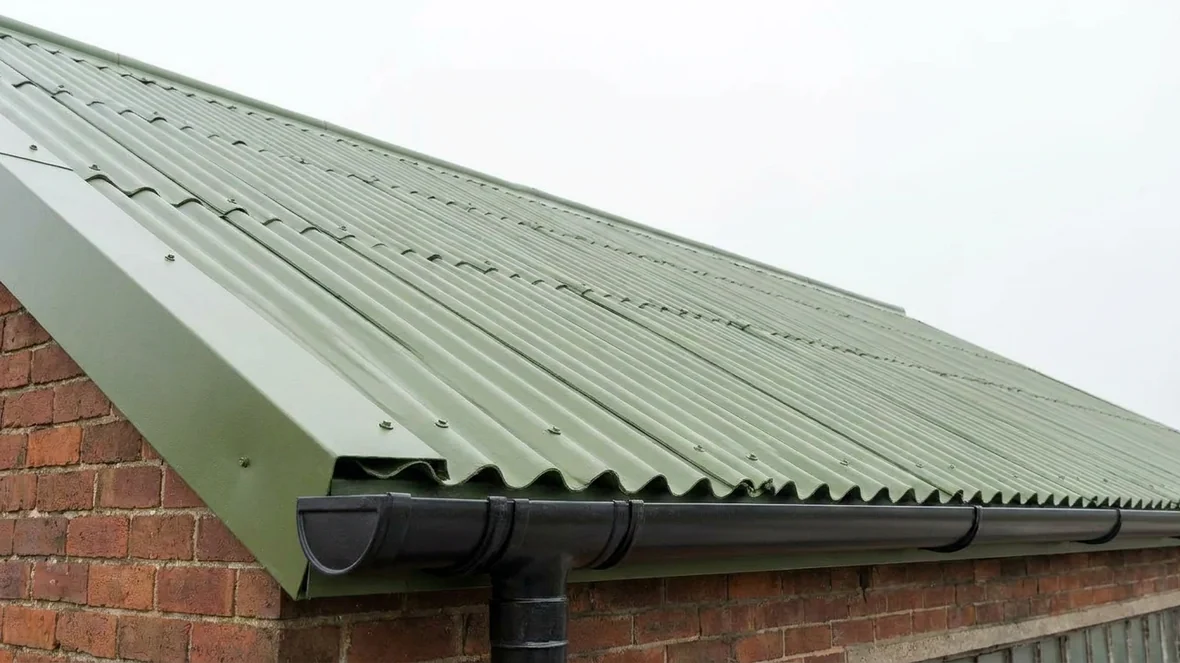
The finished roof reads as one unbroken Olive Green surface from eaves to ridge, with crisp lines at the verges and the gutter edge and the brickwork below completely untouched. The moss, the staining and the bare fibrous surface are sealed away rather than scraped off, which is the whole philosophy of encapsulation compressed into one photograph. Against the red brick and the steel windows, the deep green sits comfortably, an old South Yorkshire building looking after itself rather than apologising for its age.
The close-up shows what a properly encapsulated sheet end looks like, the bold corrugations fully wetted and sealed, the fixing heads locked under the membrane, and the coating finishing on a clean line where the roof meets the cleared gutter. For the owner, the outcome works on every level that matters, the erosion cycle is stopped, the insurer has a documented, sealed roof instead of an open question, the works never lost a day of production, and the asbestos stayed exactly where it is safest, undisturbed and sealed in place.
Project completed in spring 2026.
Asbestos roof encapsulation across South Yorkshire and the UK
South Yorkshire has one of the largest surviving stocks of asbestos cement roofing in the UK, on engineering works, foundry buildings, workshops and warehouses across Sheffield, Rotherham, Barnsley and Doncaster, and on farm buildings in the countryside between them. Most of those roofs are exactly like this one, sound, watertight, slowly weathering, and owned by businesses that need a sensible plan rather than a removal quote. Encapsulation is that plan more often than not across South Yorkshire, and the decision between the two always starts with an honest survey of whether the sheets are intact.
We carry out asbestos roof encapsulation nationwide, we cover asbestos roof encapsulation in Sheffield and the surrounding South Yorkshire towns as standard, and you can see the same job-dossier approach applied to a very different building in our cladding respray on a food processing plant near Swindon.
If you have an asbestos cement roof near Sheffield, or anywhere across South Yorkshire and the UK, book a free site survey. We will inspect the sheets, tell you straight whether encapsulation is right for your roof, and give you a written specification that treats the material with the respect it demands.