Guide
Choosing a New Colour for Your Cladding: RAL and BS Colour Guide
Repainting cladding is a rare chance to change how a whole building reads from the road. Most operators choose a colour once and then live with it for years, so it pays to fix the reference before any spray reaches the panels. Getting a cladding colour right is part practical, part planning, and part matching what is already there.
How RAL and BS 4800 references work
Two systems dominate UK coating specifications. RAL is a German colour standard, and most people mean the RAL Classic range, where each shade carries a four digit code such as RAL 9010 or RAL 7016. BS 4800 is the British Standard for paint colours used on building and construction work, with references like 18 B 25 or 00 E 55. The two systems do not map onto each other exactly. A RAL shade and a BS shade can look close in a fan deck yet cure to a noticeably different tone once sprayed across a full elevation. If the original finish was specified to a BS reference, ask for that reference rather than a RAL near-equivalent, and the other way round.
Matching an existing brand cladding colour
Corporate colours are usually held as a brand guideline, often in a print or screen format that does not translate cleanly to a coating. A logo specified as a Pantone or CMYK value is not the same as a sprayable RAL or BS reference, and a straight conversion can drift. The safer route is to identify the existing coating reference from records, a previous specification, or a physical read of a clean, unfaded panel. Where no record survives, a colour can be read on site against a fan deck in daylight, though weathering means the surviving surface is rarely the original tone. We note the reference on survey so the recoat is measured against a real target rather than a guess.
Why very dark shades behave differently on big elevations
Dark colours carry a genuine trade-off on large metal roofs and elevations. Deep greys, blues and near-blacks absorb more solar heat, so panels run hotter, expand and contract more, and put more movement through fixings and laps. On thin profiled sheet that thermal cycling is worth thinking about before committing. Darker shades can also show fade and chalking more openly than mid tones, because the loss of surface gloss reads as a visible lightening against the original depth of colour. That does not make dark cladding wrong, but it does mean the finish and the maintenance expectation matter more. A mid grey will usually hide gradual weathering better than a deep anthracite over the same period.
Fitting in with neighbours and planning
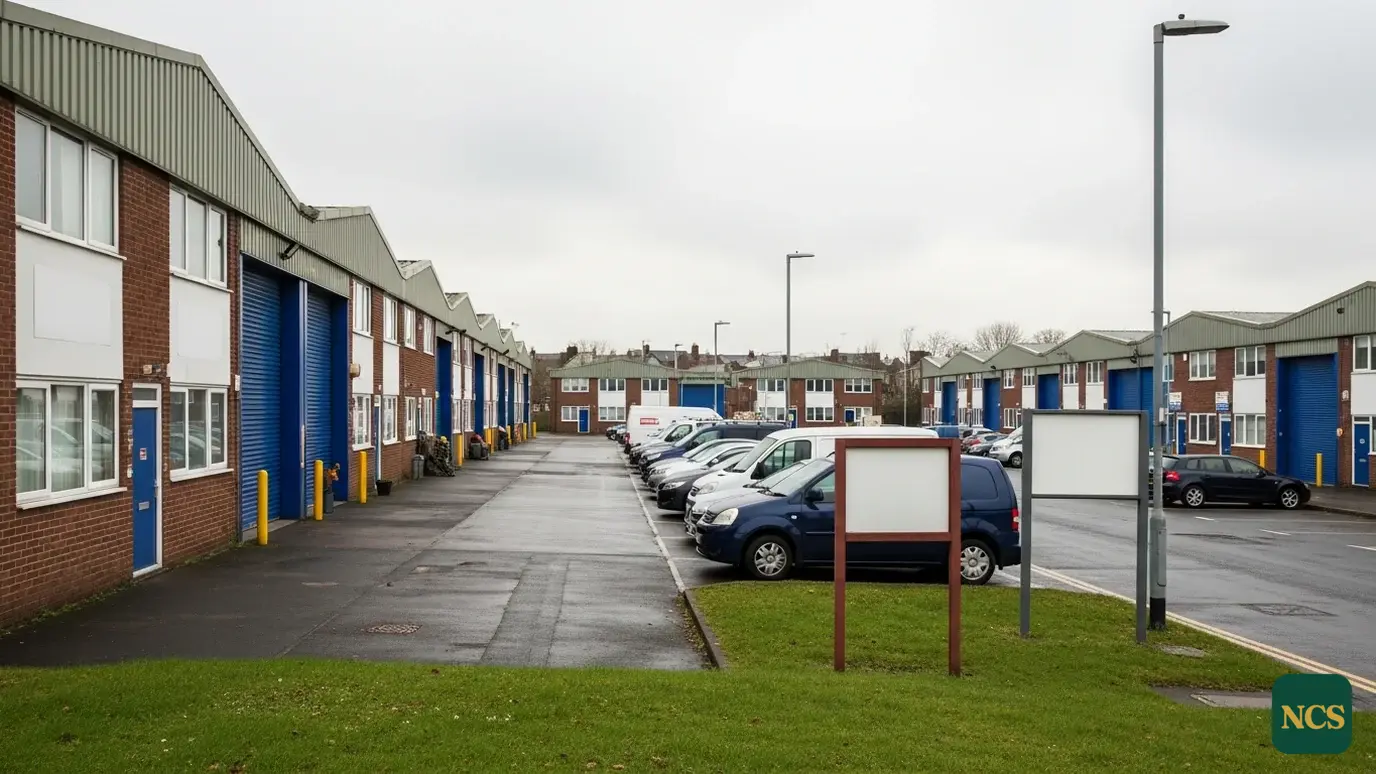
A single unit rarely sits in isolation. On a trading estate or a farm complex, a colour that ignores its neighbours can look out of place, and on some sites the estate management or a lease sets an agreed palette. Where the building is in a conservation area, near a national park, or covered by a planning condition, colour can be a formal matter rather than a free choice. Recolouring an existing coated surface is often outside planning control, but not always, so it is worth checking the local position before you commit to a strong change. Muted greens and greys tend to sit more quietly in rural and agricultural settings than bright primaries.
Approving a sprayed sample panel
No colour decision should be final until it has been sprayed. A fan deck chip is small, held at reading distance, and seen under indoor light. The same reference across a full elevation, under open sky, at a distance, and next to the surrounding materials can read quite differently. A sprayed sample panel, ideally on the actual substrate or a matching offcut, shows the true tone, sheen and coverage before the full job starts. View it on the building, in daylight, at the distance people will actually see it from, and at more than one time of day.
- The exact existing reference, read from a clean unfaded area or from records
- Whether the colour is held as a RAL or a BS number, not a near-equivalent
- Any estate, lease or planning restriction on colour before you decide
- How the shade will behave on the size and orientation of your elevations
- A sprayed sample panel signed off in writing on the building itself
Comparing the common reference systems
| System | Example reference | Often used for | Worth watching |
|---|---|---|---|
| RAL Classic | RAL 7016 | Most common recoat specifications | Not identical to the nearest BS shade |
| RAL Design | RAL 240 40 10 | A wider range of tones | Less commonly stocked than Classic |
| BS 4800 | 18 B 25 | UK building and construction work | Some references are now used less |
| BS 381C | 632 Dark Admiralty Grey | Older and heritage specifications | Limited modern colour range |
| Pantone or brand value | PMS 302 | Sourcing a corporate colour | Needs converting to a coating reference |
- Confirm whether the colour is a RAL or a BS reference and do not swap in a near match
- Match an existing brand colour from the coating reference, not a print or screen value
- Very dark shades run hotter and show weathering more openly on large elevations
- Approve a sprayed sample panel on the building, in daylight, before the full job
Common questions
Can you match my company’s brand colour exactly? We work from a sprayable RAL or BS reference. A brand value from print or screen usually needs converting first, and we confirm the result on a sample panel.
Is a RAL colour the same as the nearest BS number? No. They can look close on a chip but cure to different tones across a full elevation, so we hold to whichever system the original was specified in.
Will a dark colour fade faster? Dark shades tend to show fade and chalking more visibly than mid tones and absorb more heat, which is why we flag the trade-off on large sheet before you decide.
Do I need planning permission to change the colour? Often not for a recolour of existing coated cladding, but conservation areas and planning conditions can change that, so check the local position first.
If you are planning a recolour, our cladding spraying team can read the existing reference on survey and spray a sample panel for sign-off, and you can request a free quote to have the work scoped.
Published by National Coating Specialists • survey-led commercial, industrial & agricultural coatings across the UK.
Accredited, insured & nationwide



Where we work
Sectors and buildings we coat
Survey-led coating, spraying and exterior refurbishment across commercial, industrial and agricultural property in the UK.
Get a free site survey, no obligation
One of our surveyors walks the building, photographs the condition and quotes only what it actually needs. Send us the details and we'll come back with a clear, practical route, not a hard sell.
Book your free site surveyWhat does your building need?
Pick the surface, then the problem. We will point you to the right service.