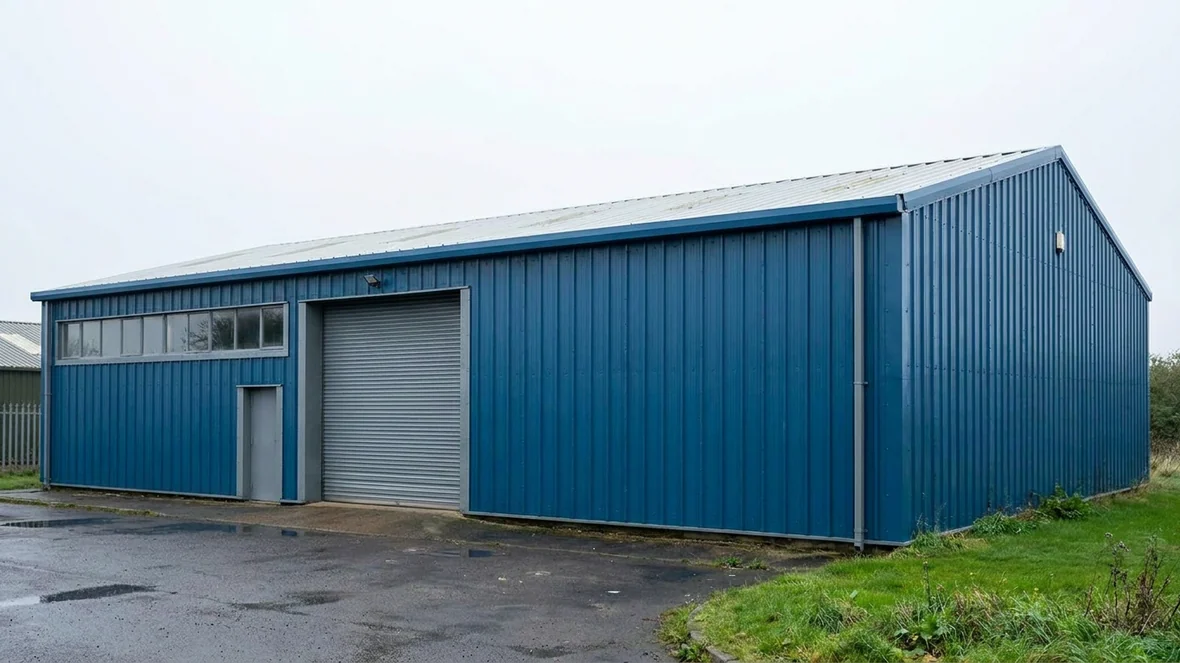
A full cladding respray on a steel portal industrial unit near Warrington, taking weathered grey-blue profiled steel back to a fresh Gentian Blue RAL 5010 finish for a Cheshire managing agent preparing the building for re-letting.
The building and the brief
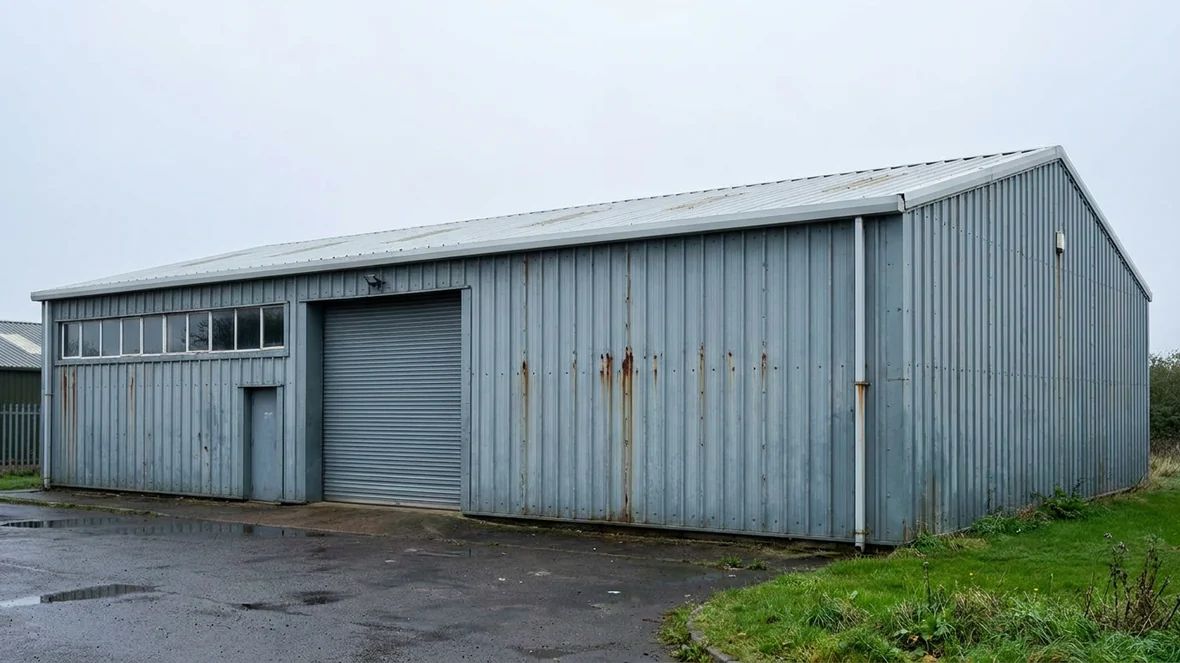
The managing agent of a small industrial estate near Warrington asked us to look at a mid-size unit that was coming up for re-letting. The estate sits in the belt of workshops and distribution yards between Warrington and the Manchester Ship Canal, the working heart of north Cheshire. It is a typical Cheshire estate building, a steel portal frame carcass with profiled steel wall cladding, a single roller shutter loading door, a personnel door and a run of high-level windows along the front elevation. The original plastisol coating on the cladding had done its job for a long time and was now visibly at the end of its life. The whole elevation had faded to a tired grey-blue, the surface chalked when you ran a hand across it, and rust staining tracked down the sheets from the fixings and laps.
Nothing about the building was structurally wrong. The frame was sound, the sheets were straight and the roof was watertight. The problem was entirely cosmetic, and it was costing the agent money, because prospective tenants were walking the estate and reading the worst unit as a sign of how the whole site was run. Recladding was priced and quickly ruled out. Stripping and replacing sound profiled steel to fix a faded surface is a slow, disruptive and expensive way to solve a paint problem. A full cladding respray gave the agent the same visual result for a fraction of the disruption, with the unit kept available throughout.
We agreed a colour change at the same time. Rather than matching the original washed-out grey-blue, the agent chose Gentian Blue from the palette we coat in, RAL 5010, a deep corporate blue that suits trade and industrial units and hides everyday grime far better than pale colours do.
What the survey found
Our surveyor walked the unit with the agent before we priced anything. On a job like this the survey is about the substrate, not the colour, and on Cheshire estates of this age the substrate usually tells the same story. We checked every elevation for cut-edge corrosion at the sheet ends, probed the worst of the rust staining to confirm it was surface staining rather than perforation, and noted which fixings needed replacing before any coating went near the wall. The yard was clear on two sides, which meant the whole front elevation and gable could be reached from a mobile elevating work platform without scaffolding. That kept the programme short and kept costs down for the client.
The work, stage by stage
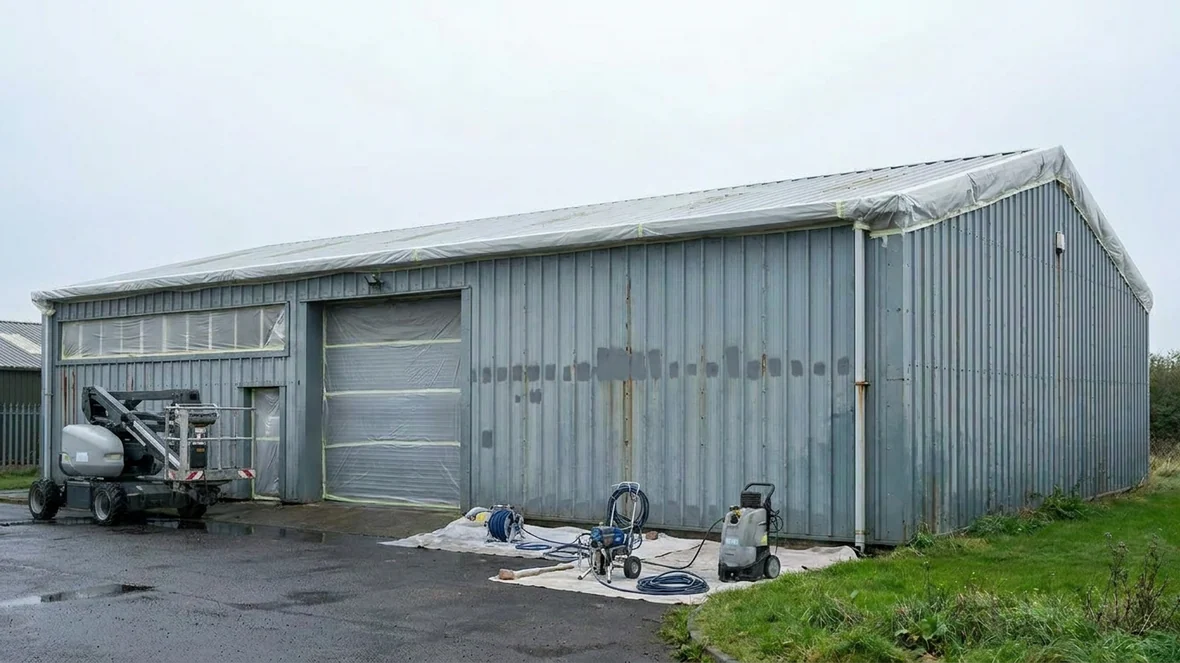
The sequence below follows the job from the first photograph to the last, wash-down, masking and priming, spraying, and the finished building from the same viewpoint we started at.
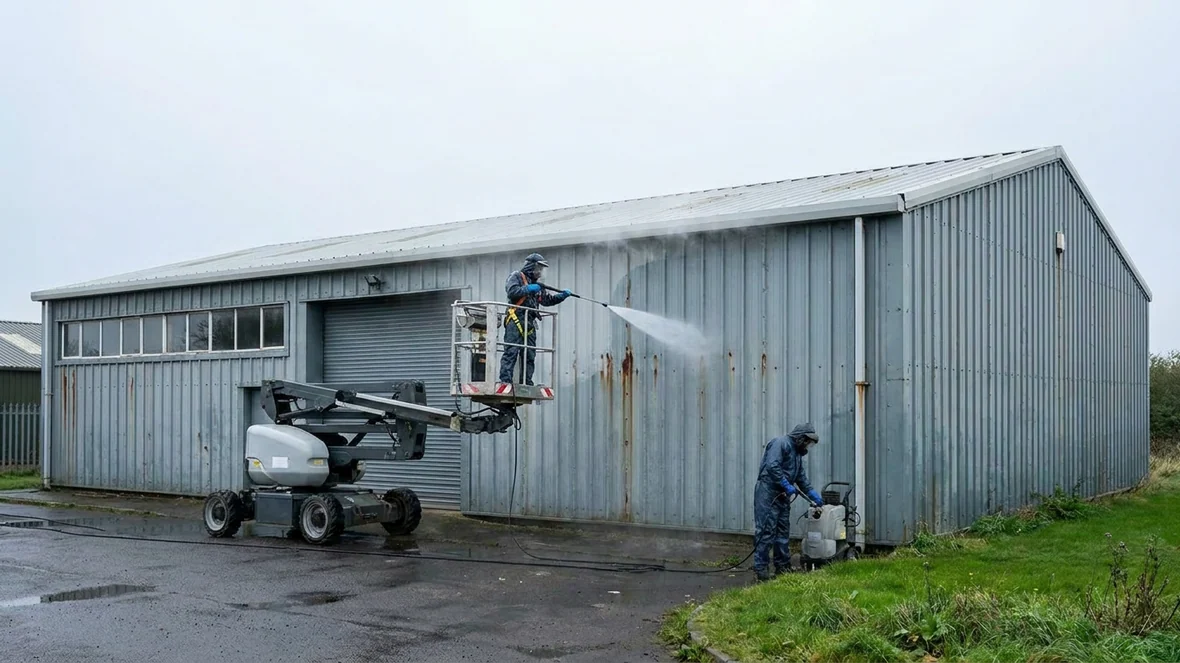

Preparation started with a full wash-down. One of our operatives worked the lance from the MEWP basket, harnessed and clipped on, while a second managed the washer and runoff at ground level. The damp Cheshire climate had done half the washing for us over the winter, but chalked plastisol still sheds a surprising amount of residue, and every trace of it has to come off, because a coating applied over chalk is a coating applied to dust. Once the elevations were clean we treated the rust staining, mechanically prepared the corroded fixing heads and sheet edges back to sound bright metal, and replaced the fixings that were past saving.
Airless spraying puts coating exactly where you point it, but overspray drifts, so masking is where a spray job is won or lost. We filmed and taped the high-level windows, the roller shutter, the personnel door and the gutter line, and sheeted the roofline so the roof kept its original grey. Every repaired fixing and treated rust spot was then spot-primed with an anti-corrosion primer, which is the step that stops old corrosion telegraphing back through a new topcoat within a couple of winters. The estate stayed live around us the whole time. Neighbouring tenants near Warrington kept their deliveries running, and we timed the messiest work away from the estate’s busiest hours. A tidy site is not a nicety on occupied estates in Cheshire, it is the difference between being asked back and not.
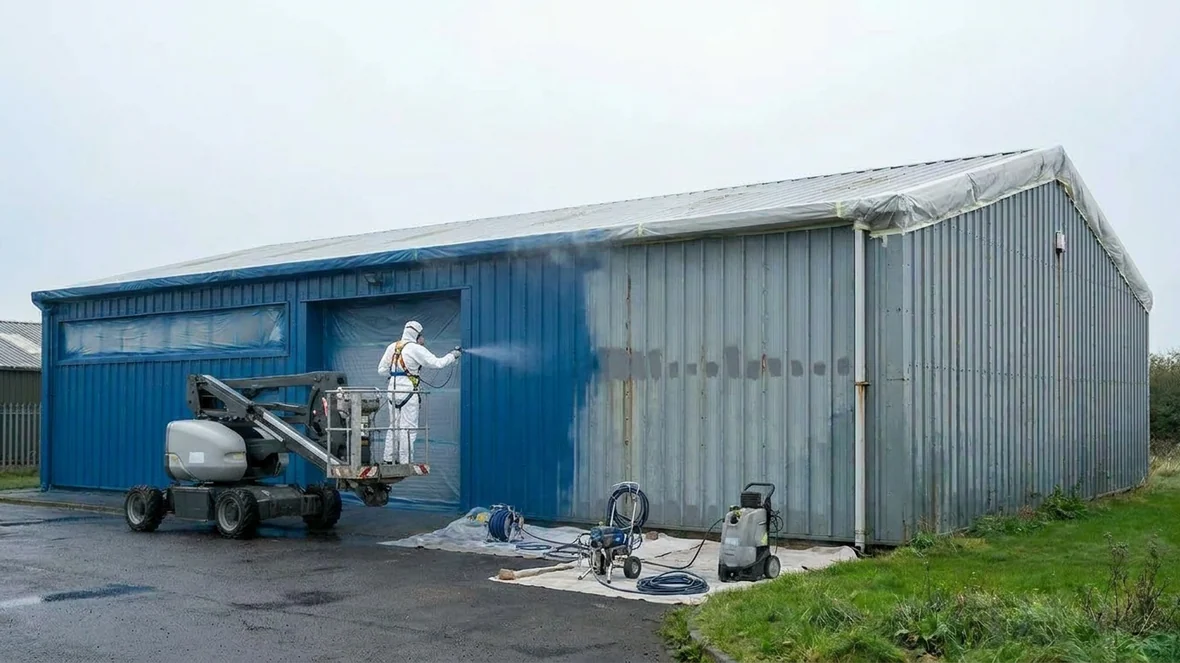
With the building prepped, our sprayer worked the elevations from the MEWP in full spray kit, hood and airfed respirator, applying the Gentian Blue coating system by airless spray. The technique matters more than the equipment. Each pass has to overlap the last while the previous stripe is still wet, keeping a live wet edge moving across the corrugations in the short dry windows Cheshire weather allows, so the finish lays down as one film rather than a series of visible passes. On profiled steel that means working the rib faces and the troughs separately in rhythm, because a single straight pass coats the peaks and starves the valleys. The mid-job photograph shows what a controlled application should look like, a hard edge where the masking is, a feathered wet edge where the next pass lands, and no drips, runs or dry spray anywhere.
The finished industrial unit
The after photograph is taken from the same spot as the before. The change reads like a rebuild, but every sheet on that wall is the sheet that was there when we arrived. The cladding is now a uniform, even Gentian Blue with a satin sheen, the doors are finished in a clean complementary grey, and the rust staining, chalking and fade are gone entirely rather than painted over. The roofline, gutter trim and window surrounds all carry straight, crisp colour lines because the masking was done properly before a drop of coating went on.
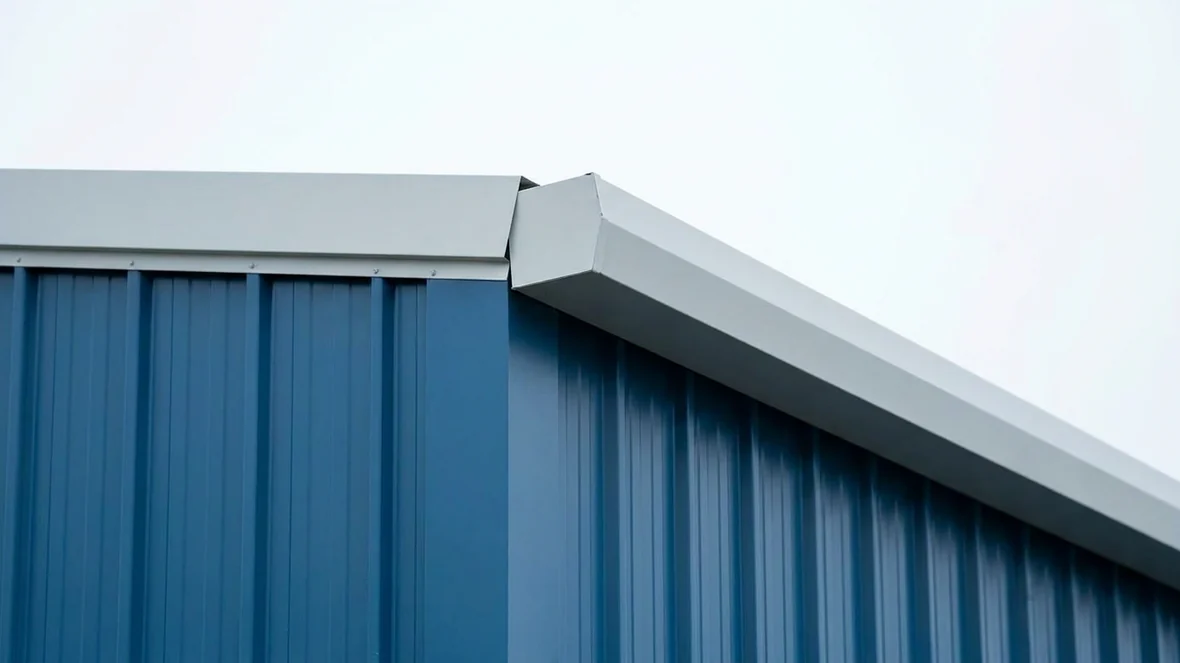
The close-up shows the part of the job most people never look at until it goes wrong, the junction at the eaves where the fresh cladding colour meets the gutter line. Sharp corrugation ribs, an even film across faces and troughs, and a clean break of colour at the trim. For the agent, the commercial result was the point. The unit went back onto the Cheshire market looking like the best building on the estate instead of the worst, and the treated fixings and sealed edges mean the substrate underneath is better protected than it has been since the sheets were rolled.
Project completed in spring 2026.
Cladding spraying across Cheshire and the UK
This job sat a few minutes off the motorway junctions near Warrington, and it is representative of the work we carry out across Cheshire every month. The county has one of the densest concentrations of industrial estates in the UK, from the chemical and logistics corridors around Runcorn and Widnes to the trade parks around Northwich and Winsford, and most of that stock is profiled steel of exactly this era. Chester, Crewe and Macclesfield all carry the same building types, and the same weathering. If your building has reached the same point, sound structure under a tired coating, a respray is nearly always the sensible answer, and we cover cladding spraying in Runcorn and the surrounding Cheshire towns as standard.
The same crews carry out cladding spraying nationwide, working from local bases so a unit in Cheshire gets the same specification, preparation standard and finish as a job anywhere else in the UK. You can see another example of the same approach on a larger building in our write-up of a roof coating on a distribution warehouse near Huddersfield.
If you manage an industrial unit or estate near Warrington, or anywhere in Cheshire and the North West, the next step is simple. Book a free site survey and we will inspect the cladding, tell you honestly whether it needs coating, repair or nothing at all, and put a written specification in front of you.