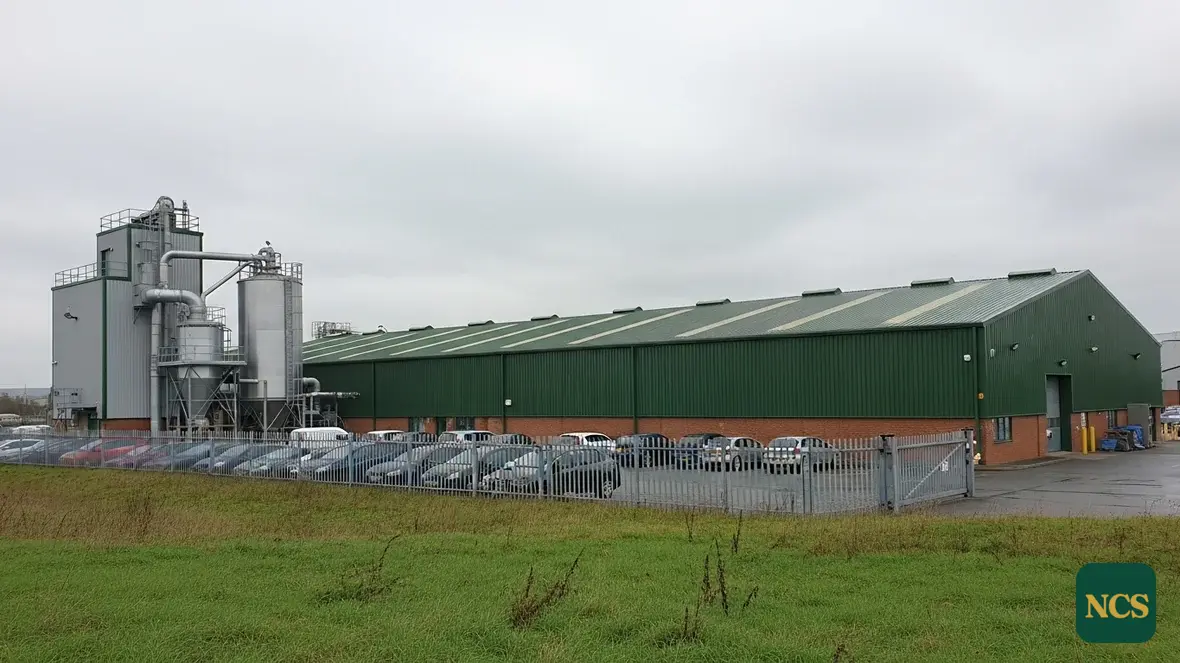
Ipswich sits at the eastern end of the A14 freight corridor, and the industrial stock around the town reflects it: distribution units near the docks, manufacturing space on the established trading estates, and larger logistics sheds on the edges. Most of it is roofed in profiled metal, and much of that metal is now decades old. If you look after one of these buildings, the question is rarely whether the roof is ageing. It is whether industrial roof coatings make more sense than replacing it, and that is exactly what our surveys are designed to answer.
Why profiled metal roofs reach this point
Profiled steel is a sound roofing material, but its weak points show with age. The factory finish chalks and fades, fixings loosen and their washers perish, and laps that stayed watertight for twenty years begin to weep in driven rain. East Anglia is drier than much of England, yet long UV exposure and damp air moving up the Orwell estuary still degrade roof finishes steadily. None of this means the sheet itself is finished. In most cases the steel underneath has years of life left, provided the surface is protected before corrosion gets properly established.
Cut-edge corrosion: the usual starting point
The defect we find most often on warehouse and factory roofs is cut-edge corrosion. Wherever a sheet was cut, at the rolling works or on site, the exposed steel edge carries no protective layer. Moisture sits in the overlaps and gutters, rust creeps back from the edge, and over time it lifts the finish and thins the metal. Caught early, it is treatable: edges are prepared, primed and sealed before a full roof coating goes on. Ignored, it perforates the sheet and turns a coating project into a strip-and-replace project at far greater cost.

Keeping an Ipswich site operational while we work
For facilities and estates teams, disruption usually matters as much as price. Coating works from the roof, not inside the building. There is no strip-off, so the building stays watertight throughout, and there are no skips of old sheeting moving through a busy yard. Work can be phased bay by bay or elevation by elevation, fitted around deliveries and shift patterns. On multi-let estates, tenants typically carry on trading with little more than a notification letter and some parking management beneath the access points.
If the honest answer for a Ipswich roof is replacement rather than painting, the survey report says exactly that.
When coating is not the right answer
We would rather lose a job than coat a roof that should be replaced. If sheets are perforated across wide areas, if corrosion has reached purlins or fixings throughout, or if the insulation in a built-up system is saturated, a coating only hides the problem and wastes the budget. The same applies to fibre cement that has gone brittle and friable. Our survey establishes which side of that line your roof sits on, and we put the recommendation in writing either way, including when the honest answer is that coating buys you nothing.
What the survey covers
Every job starts with a survey rather than a price off the back of photographs. On a typical Ipswich unit we will examine:
- Cut edges, laps and end overlaps for the spread of corrosion
- Fixings and washers, the most common source of drips reported by tenants
- Gutters, outlets and rooflights, which fail more often than the sheets around them
- Adhesion of the existing finish, so the new system bonds properly
- Any signs of internal moisture or deck damage that point towards replacement instead
From there you get a clear scope: what needs repairing, what needs coating, what should simply be monitored, and what the work means for your operation day to day. If you manage industrial buildings in or around Ipswich and the roof is on your risk register, a survey is the cheapest way to find out what you are actually dealing with.