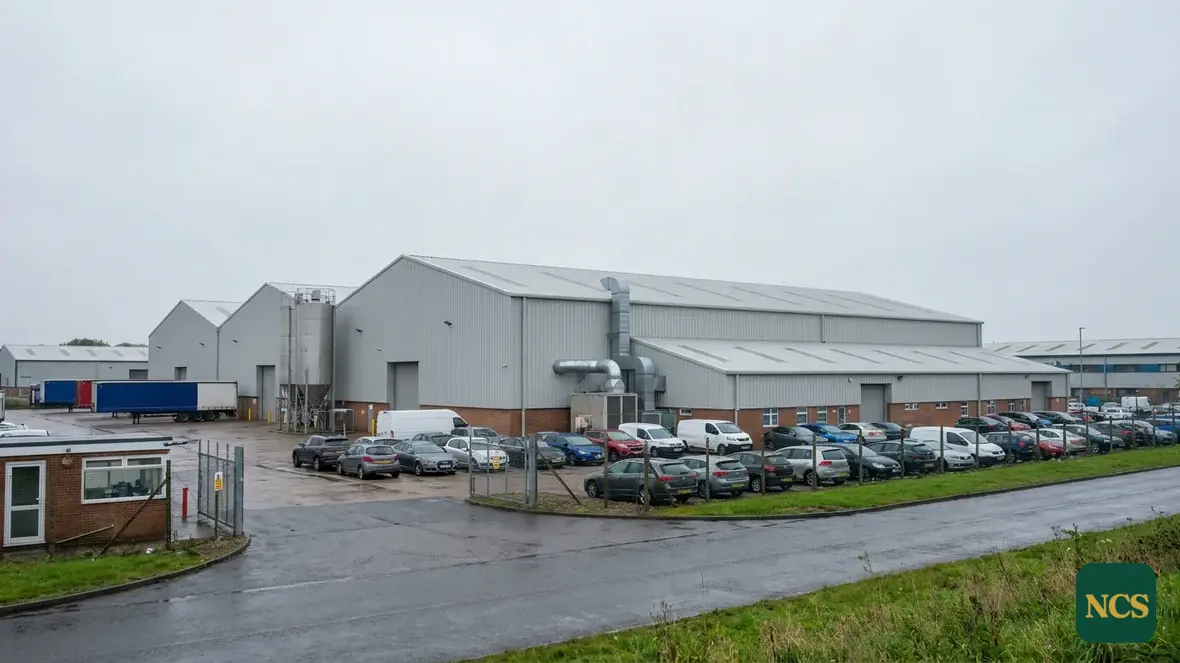
For the estates and facilities teams looking after Nottingham’s industrial units, the roof is usually the item on the maintenance plan everyone hopes will hold on for one more budget year. Sometimes it will. Often, on profiled metal roofs dating from the 1980s to the early 2000s, deferral is the expensive choice, because corrosion that starts at the cut edges accelerates sharply once it takes hold. National Coating Specialists give Nottingham facilities teams a third option between patch repairs and full replacement: a surveyed, prepared and properly applied industrial roof coating system that adds years of service to a sound roof.
The common picture on Nottingham’s industrial estates
The units around Nottingham’s ring road and motorway junctions, the light manufacturing sites, the trade counters and older warehousing, they all tend to be steel portal frame under profiled sheet. The defects we find follow the age of the buildings rather than their use. Chalked and faded factory finishes, rust blooming at end laps and eaves, loose or weeping fixings, brittle rooflights, gutter joints that have given up. Individually these look like small jobs. Together they are how a watertight roof becomes a leaking one, and the slide is faster than most maintenance plans assume.
What a coating system actually does, and what it cannot
A coating system is not paint and it is not magic. It is a maintenance intervention that works in a specific set of circumstances:
- The sheets are structurally sound, with corrosion confined to cut edges, laps and fixings
- Leaks trace back to laps, fixings, rooflights or gutter joints rather than failed sheet
- The insulation beneath is dry
- The frame and purlins show no significant movement or decay
- The budget favours planned maintenance over capital replacement
Where those conditions hold, coating restores the weatherproof envelope and stops the corrosion in its tracks. Where they do not, it papers over a failure, which is why we survey before we price.

Cut-edge corrosion, treated properly
Cut-edge corrosion appears on almost every roof of this era we survey in Nottingham. The cut ends of each sheet carry no factory protection, so rust starts there and works back beneath the finish. Proper treatment means grinding the affected edges back to clean steel, priming with an anti-corrosive system, sealing the end laps and then overcoating the roof as a whole. Anything less, and the rust simply continues its journey under the new coating. It is slow, unglamorous preparation work, and it is the difference between a system that lasts and one that fails early.
Minimal disruption for occupied and round-the-clock units
We apply coatings from outside, with the roof staying closed and the building staying in use. There is no strip-off, no temporary roof and no period when the operation underneath is exposed to the weather. We plan working hours, access and exclusion zones with your team in advance, sequence sections to suit shift patterns and dispatch schedules, and keep yards and loading doors clear. For sites running around the clock, that planning matters more than the coating itself, so we treat it as part of the job rather than an afterthought.
The roofs we will not coat
If a survey shows widespread perforation, saturated insulation or a deck past the point of rescue, we will tell you the roof needs replacement or overcladding and we will put that in writing. Coating a failed roof wastes your budget and our reputation, and we decline that work. We are a South-East based contractor working across the UK, and the East Midlands, Nottingham included, is firmly within our normal operating area.