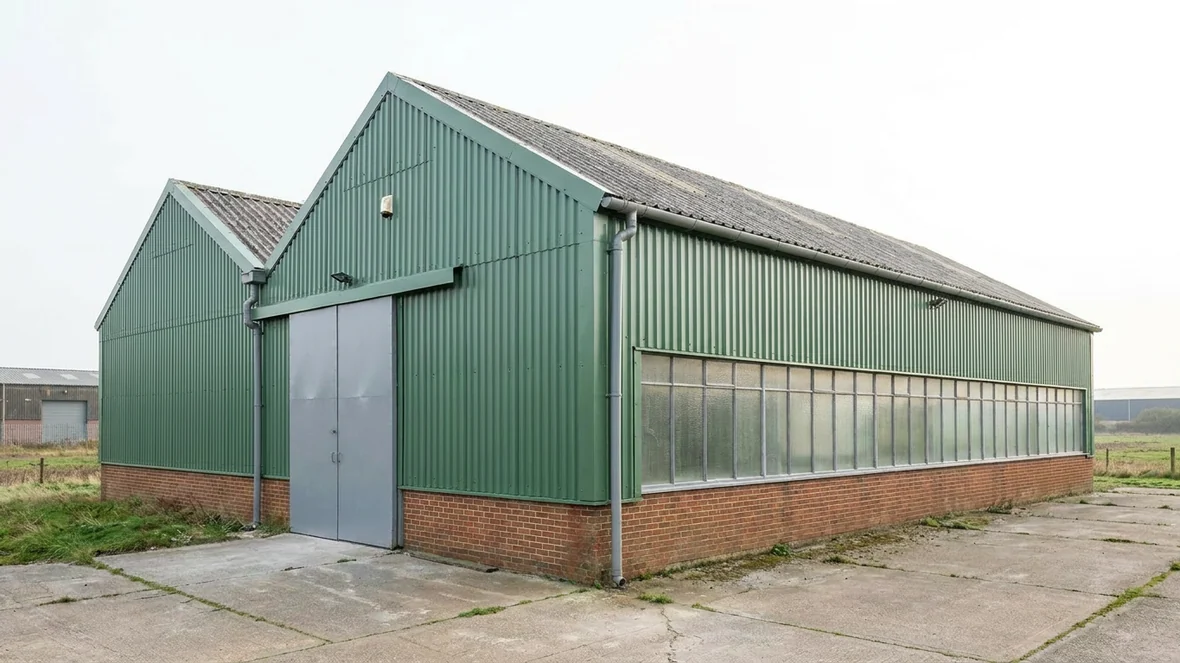
A cladding respray and box gutter lining on a twin-bay factory near Carlisle, Cumbria, taking faded off-white profiled steel to a deep Juniper Green BS 12B29 finish and putting a continuous new liner through the valley gutter that had been letting water into the production floor.
The building and the brief
This factory sits on the industrial fringe of Carlisle, a mid-century steel truss building with two parallel pitched bays, a twin-gable roofline and a central valley box gutter running the full depth of the building between them. The walls are profiled steel cladding above a red brick plinth, with a strip of steel-framed windows along the working elevation and a large sliding door into the near bay. It is a common Cumbria building type, older than the portal frame sheds on the newer estates, solidly built, and usually carrying decades of weathering by the time anyone thinks about the envelope.
The owner, a manufacturing business that has run the site for a long time, came to us with two problems that usually arrive together on twin-bay factories. The first was cosmetic, the cladding had faded from its original off-white to a chalky, streaked beige, with rust staining bleeding down from the fixings and sheet laps and grime tracking under the gutter outlets. The second was practical, the central box gutter between the bays had reached the end of its serviceable life, with corroded joints that let water track into the building during heavy Cumbria rain. The production floor below had the buckets to prove it.
The brief was to solve both in one visit, reline the valley gutter so the building was dry, and respray the cladding so the factory stopped looking like a liability on the company’s own site photographs. For the colour, the owner moved away from the tired off-white entirely and chose Juniper Green, BS 12B29, from the palette we coat in, a deep green that planners and neighbours tend to like where industrial buildings sit close to open Cumbria countryside.
What the survey found
Our survey covered both workstreams. On the walls we checked the cladding for cut-edge corrosion at the sheet ends, confirmed the rust staining was surface-level rather than perforation, and logged the fixings that needed replacing. In the valley we inspected the box gutter along its full run, sounding the joints, checking the falls and photographing the corroded sections. A box gutter between two pitched bays collects the rain from both roof slopes, so when it fails it fails into the middle of the building, which is why we treat a corroded valley gutter as the urgent half of any job like this one near Carlisle.
The work, stage by stage
The sequence below follows the building through the programme, wash-down, masking and priming, the Juniper Green going on, and the finished factory with the relined gutter at the eaves.
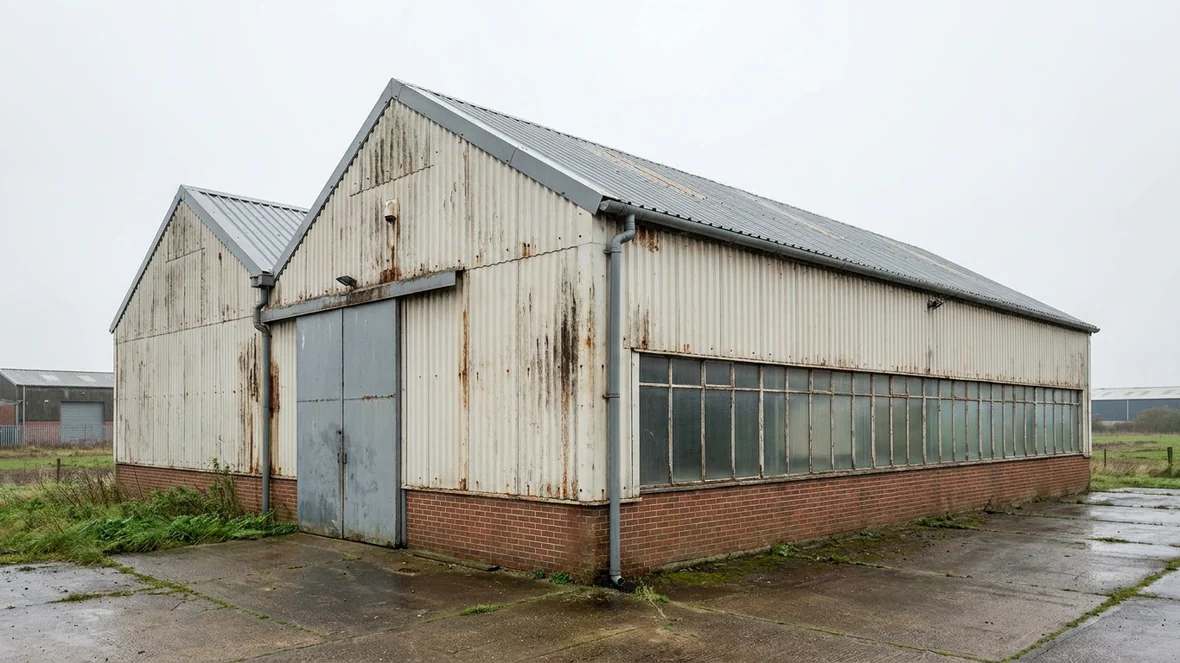
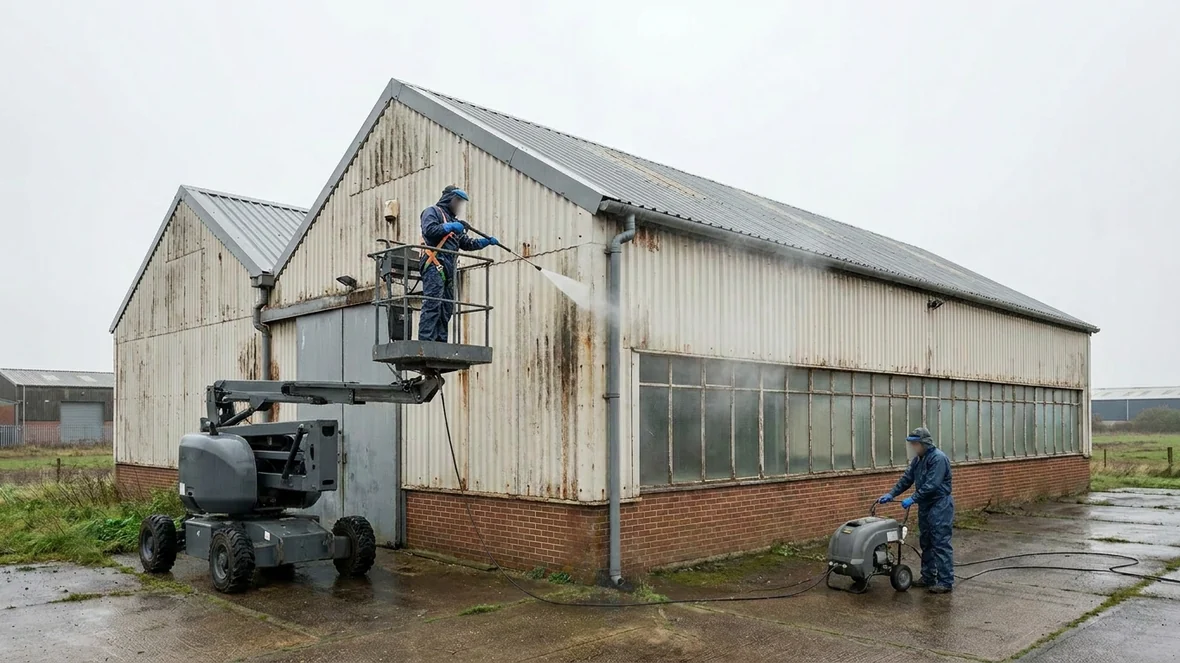
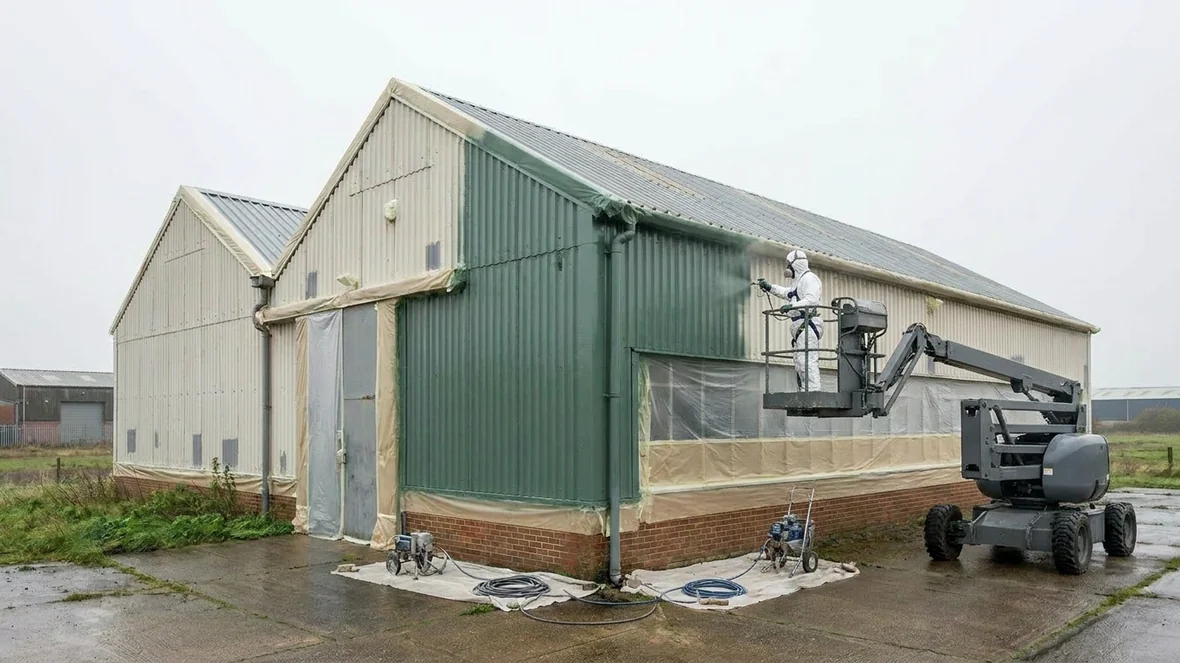

Preparation started with a full wash-down of every elevation. One operative worked the lance from the MEWP basket, harnessed and clipped to the anchor point, while a second managed the washer and runoff at ground level. The wash stripped years of chalk, algae and grime off the profiled sheets, and the difference between the washed band and the untouched cladding beside it was stark enough that the client came out to photograph it. Once the walls were clean we mechanically prepared the rust-affected fixings and sheet edges back to sound metal and replaced the fasteners that were beyond saving, the same discipline we apply on every Cumbria respray.
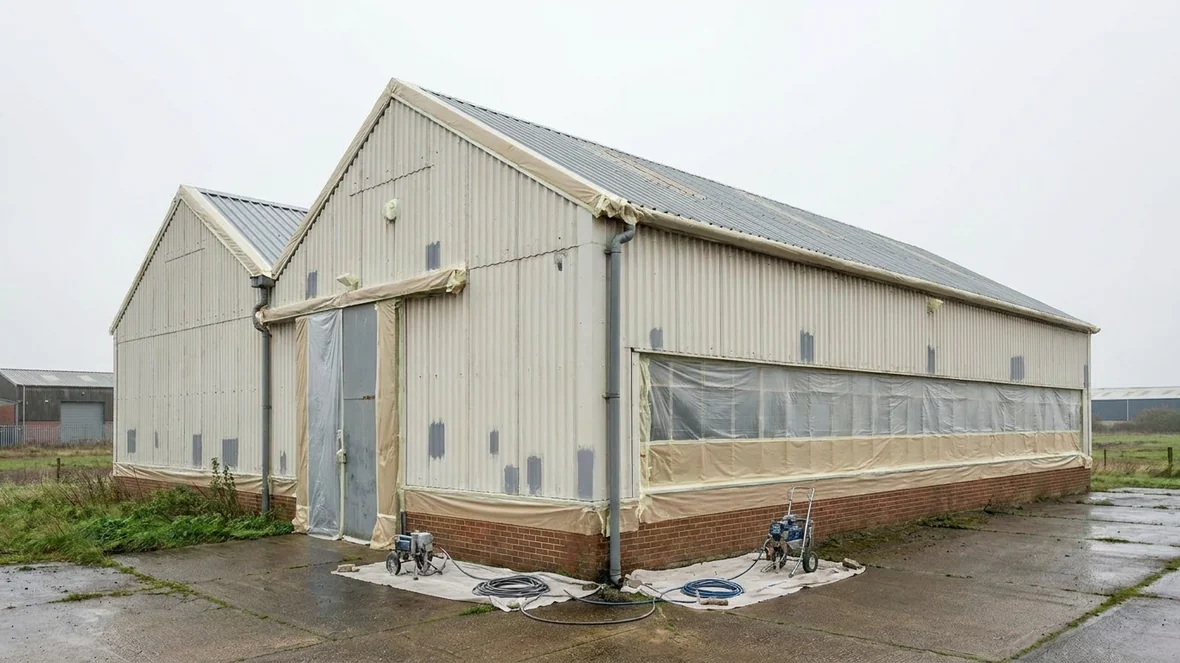
Masking on this building took longer than on a plain shed, and it needed to. The steel-framed window strip, the sliding door and the brick plinth were filmed and taped, because a respray that flecks green overspray onto original brickwork has failed no matter how good the cladding looks. The gutter lines and roof edges were sheeted so both roofs kept their weathered grey, and every repaired fixing and treated rust spot across the two gable elevations was spot-primed with an anti-corrosion primer so old corrosion cannot bleed back through the new colour. The box gutter was relined in the same phase. The valley run was cleaned back to sound metal, the corroded joints prepared, and a continuous liner system installed along the full length so the gutter now sheds water as a single unbroken channel rather than a chain of ageing joints. Lining the existing steel gutter avoided the crane hire, roof opening and downtime a replacement valley would have forced on the business, which is exactly the argument for industrial gutter lining on buildings of this age. Throughout, the factory kept working, deliveries used the far bay while we masked and primed the near one, the usual sequencing on occupied factories around Carlisle.
With the building prepped and the valley dry, our sprayer applied the Juniper Green coating system by airless spray, working the elevations from the MEWP in full spray kit with hood and respirator. Twin-gable buildings punish lazy spraying, because the two bays meet the eye together and any variation in film build between them reads immediately. The answer is the same as on any profiled steel, a live wet edge kept moving across the corrugations, passes feathered into each other while the film is wet, and the ribs and troughs worked in rhythm so the coating sits evenly across the profile rather than piling on the peaks. By the end of the phase both bays and all the visible elevations carried the same even film, cut cleanly at every trim, corner flashing and opening.
The finished factory
The after photograph is taken from the same position as the before, and the building reads as a different site. The cladding is a uniform, deep Juniper Green with an even satin sheen across both bays, the sliding door sits in a clean complementary grey, and the brick plinth runs along the base exactly as it did the day the factory was built, clean and unpainted. The fade, the chalk, the streaks and the rust staining are gone because the causes were treated, not overpainted. Against the green, the original brickwork looks deliberate rather than dated, which is the quiet trick of a well-chosen dark colour on a building of this age.
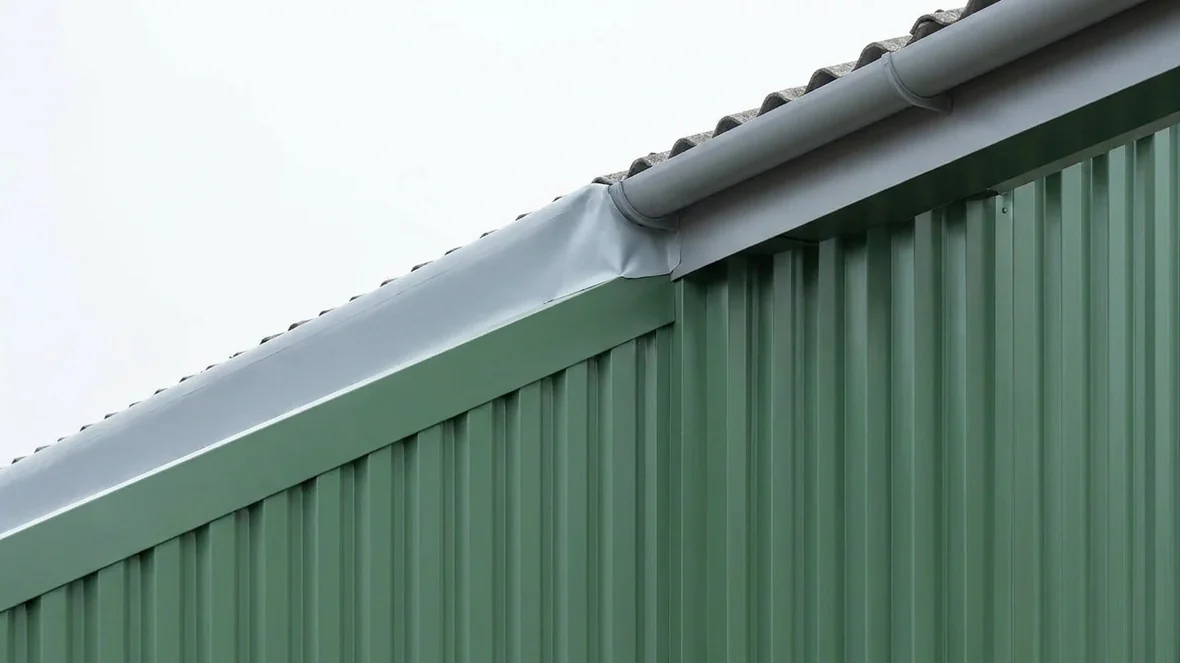
The close-up shows the two halves of the job meeting, the fresh green cladding cutting cleanly against the grey eaves trim with the new liner membrane just visible where it turns over the gutter edge. For the owner, the outcome is a factory that is dry through a Cumbria winter for the first time in years of patching, wrapped in an envelope that finally matches the standard of the work done inside it.
Project completed in spring 2026.
Cladding spraying across Cumbria and the UK
Carlisle and the surrounding Cumbria towns carry a lot of this exact building stock, twin-bay steel truss factories and workshops from the middle of the last century, still structurally excellent and still earning their keep, but weathered by some of the wettest working weather in the UK. We respray and refurbish them regularly, around Carlisle itself, down through Penrith and Wigton, and across to the industrial estates on the west Cumbria coast around Workington. The combination in this write-up, walls resprayed and the valley gutter relined in one programme, is the single most common package we quote for buildings of this era.
We cover cladding spraying in Carlisle and the wider county as standard, with the same crews carrying out cladding spraying nationwide to the same specification. For a roof-side example of the same thinking, read our roof coating on a distribution warehouse near Huddersfield.
If you run a factory near Carlisle, or anywhere in Cumbria and the north of the UK, book a free site survey. We will inspect the cladding and the gutters together, tell you plainly which needs attention first, and put a written specification in front of you before you commit to anything.


