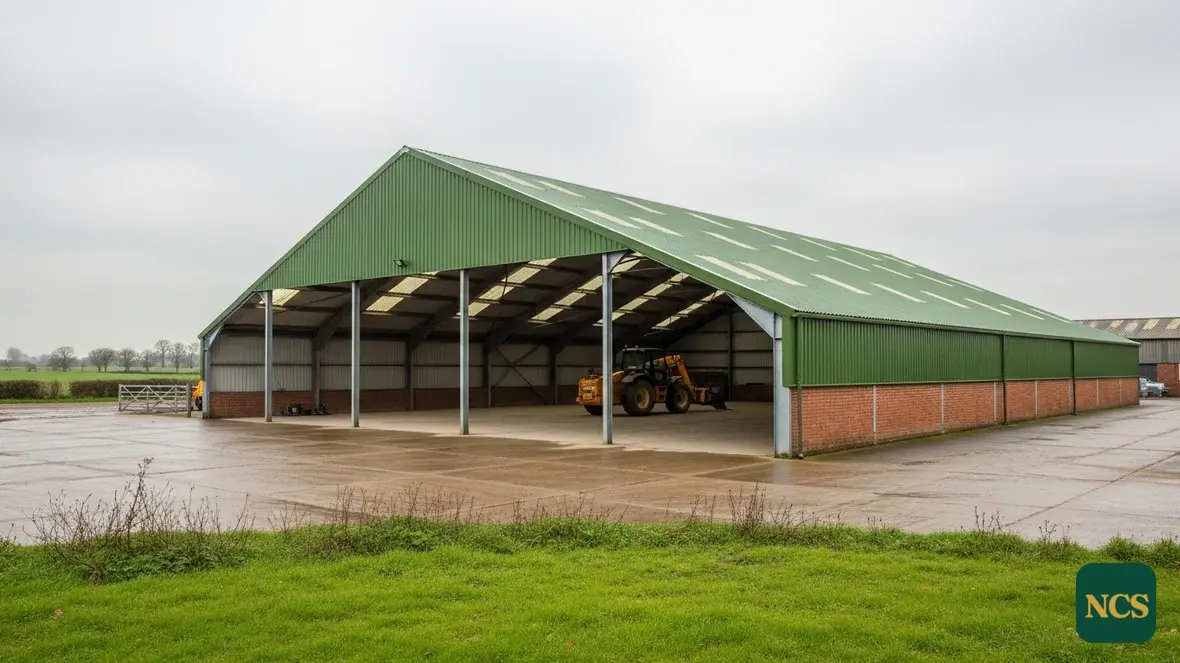
Why farm cladding fades and chalks
Agricultural steel-framed buildings take the brunt of British weather. Constant exposure to sunlight, rain and farmyard contaminants degrades cladding’s protective coatings over time. Ultra-violet rays break down the molecular bonds in plastisol coatings through photo-oxidation. Repeated wetting and drying cycles wash out pigments and binders. Atmospheric pollution, bird droppings, ammonia from slurry pits and diesel exhaust particulates stain surfaces. Together, these forces cause cladding to fade, chalk, stain and in extreme cases, corrode.
Working farm environments accelerate these natural processes. Dust from grain stores, feedlots and field operations abrades surfaces. Machinery exhaust deposits carbon particles. Ammonia vapour from slurry pits attacks coatings chemically. Dairy washdown spray creates persistent moisture. Without maintenance, cladding progressively loses its protective and aesthetic qualities.
Farm building types and cladding ages
Most modern UK farms use steel-framed buildings clad in profiled steel sheeting with plastisol surface coatings. Steel provides structural strength and spans large spaces cost-effectively. Typical farm buildings include livestock sheds, milking parlours, feed stores, grain silos, machinery housing and general-purpose barns.
Cladding originates from various eras. Many buildings date from the agricultural expansion decades between the nineteen-sixties and nineteen-eighties. Earlier asbestos-cement sheeted structures often now require recladding. More recent constructions use plastisol-coated steel sheeting in standard profiles. Even modern cladding deteriorates over time, especially in demanding farmyard conditions.
The quick overpaint is where cladding work on farm buildings goes wrong. Wash, treat, repair, then spray is the sequence we quote.
What cladding spraying involves
Cladding spraying applies new surface coatings directly over existing steel sheeting. First, surfaces undergo thorough preparation. Power washing removes dirt, grease and loose material. Degreasing eliminates contaminants. Rust repairs address any corrosion. Specialist primers promote paint adhesion.
The spraying process coats panels with durable, weather-resistant finishes in standard or farm-specific colours. Multiple layers build film thickness. Specialist polymers provide gloss, flexibility and UV stabilisation. The result restores cladding’s protective qualities and appearance while preserving the underlying steel structure. Spraying suits various building types, from simple open-sided sheds to enclosed milking parlours and feed stores.
Cut edges, fixings and panel repairs that come first
Steel cladding on farm buildings fails first at the cut edges and fixings. Exposed edges where sheets meet or overlap lose their protective coating fastest, letting moisture creep under the remaining finish. Rivets and screws work loose over time, especially where livestock rub against panels or where high-pressure washing drives water behind the fixings. Any repair work starts here – resealing edges, replacing corroded fasteners, and addressing panel damage from impacts or weathering before the main respray begins.
Older asbestos-cement roofs and walls need particular care. While the material itself is stable if undamaged, broken edges or drilled holes compromise the surface. Any repair work on these buildings follows strict control measures to prevent fibre release during handling. The priority is stabilising the existing structure before considering overcoating.
- Reseal all cut edges and overlaps
- Replace corroded or loose fixings
- Repair dented or holed panels
- Stabilise asbestos-cement surfaces
- Address any substrate corrosion
Planning around the farm’s working year
Spray work schedules around milking times, feeding routines and livestock movements. Dairy parlours cannot be out of action during milking, while cattle sheds need access for feeding. The ideal window for internal work is often between morning and evening milking, with external work continuing around these constraints. In winter months when cattle are housed full-time, temporary pens may be needed to keep animals clear of work areas without disrupting their routine.
Harvest and lambing seasons dictate the agricultural calendar. Grain stores must be empty and clean before work begins, which typically means late winter or early spring after the last harvest has been sold. Lambing sheds need to be fully operational in spring, pushing any coating work to summer or autumn. The survey identifies these pressure points upfront so the work plan respects the farm’s operational needs.
Why the survey comes before specification
Every farm building has unique exposure conditions that dictate the coating choice. Dairy buildings face constant humidity and wash-down chemicals, while grain stores deal with dust and condensation. Livestock sheds combine ammonia from urine with abrasion from animal movement. Only a physical survey can assess these factors properly, checking for substrate condition, existing coating failures, and environmental exposure.
The survey also maps access constraints – narrow farmyards, low doorways, and overhead power lines all affect how equipment reaches the building. Spraying a forty-metre barn with one narrow access point requires different planning to an open-sided cattle shelter. There is no standard farm coating specification because no two farms face identical conditions. The survey ensures the solution matches the building’s actual needs rather than applying an assumed standard.
The next step
You can read more about the wider cladding spraying service, or see how we approach agricultural buildings as a whole. When you are ready, request a free survey and we will look at the building itself before recommending anything.
See a recent example of this work in our case study: Cladding Respray on a Poultry Shed near Lincoln, Lincolnshire.