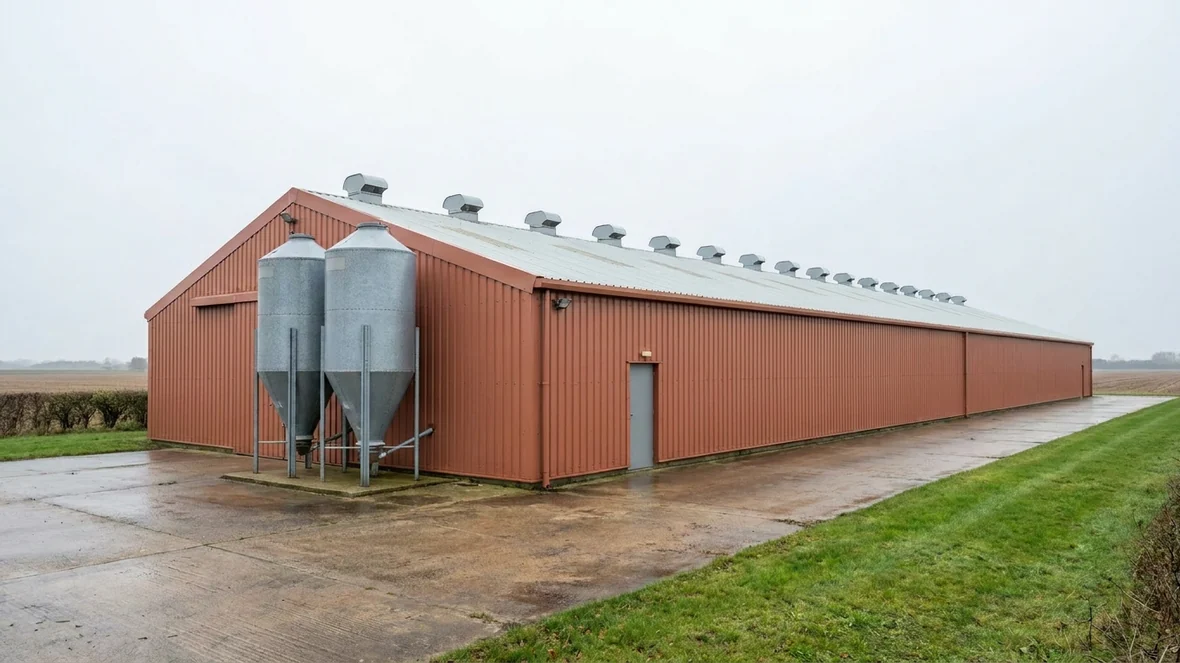
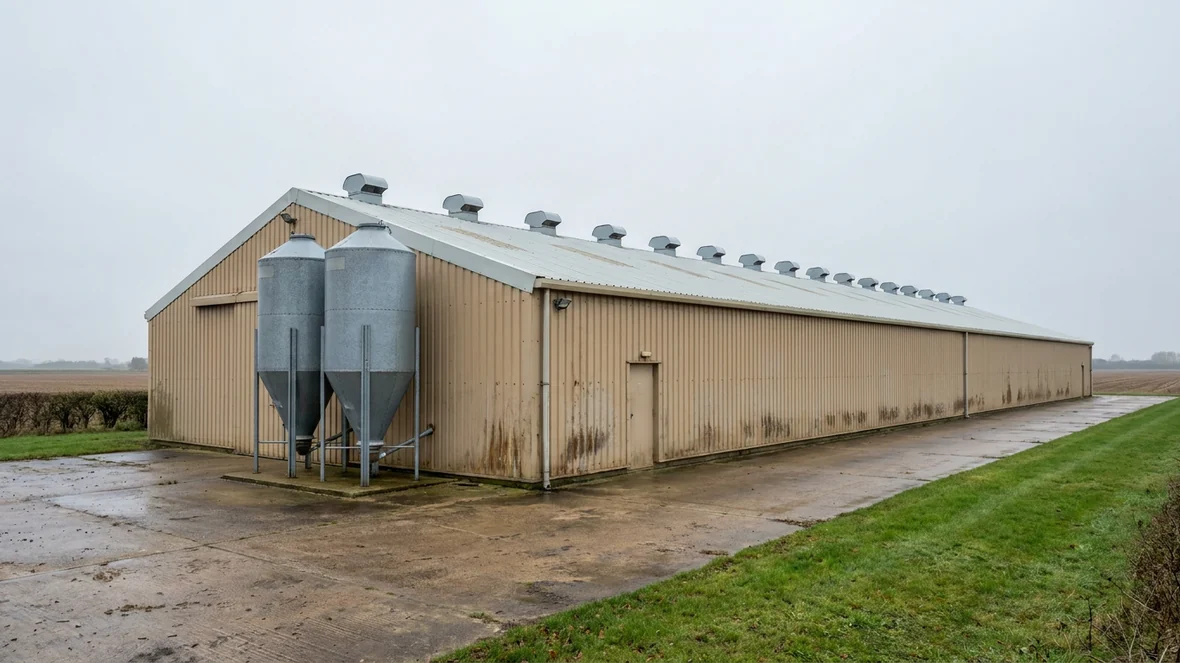
Poultry buildings age in a particular way. They are long, low and almost windowless, they run flat out for most of the year, and the narrow gaps between flocks leave little time for anything cosmetic. The broiler shed we resprayed on an arable and poultry holding a few miles from Lincoln had reached the point where the deferred jobs were showing. The box profile wall cladding, originally a tan buff colour, had chalked and faded along its whole length, with dirt streaking below the eaves and rust creeping from the fixings. The frame, the roof and the ventilation were all in good order. The walls just looked, in the farmer’s own words, like a building nobody owned. One respray inside one turnaround window put that right.
A hard working poultry shed in the Lincolnshire flatlands
Lincolnshire grows grain and Lincolnshire grows poultry, and the two often share a yard, as they do here. The shed is a modern steel portal frame broiler unit: a long, shallow pitched roof carrying a row of extraction fans along the ridge, feed bins standing at the gable, a single personnel door in a run of otherwise unbroken cladding, and a concrete apron the length of the building. Everything about the design is practical, which is exactly why the state of the cladding mattered. Processors and assurance schemes walk these sites, and the outside of a poultry building is the first thing an auditor sees from the car.
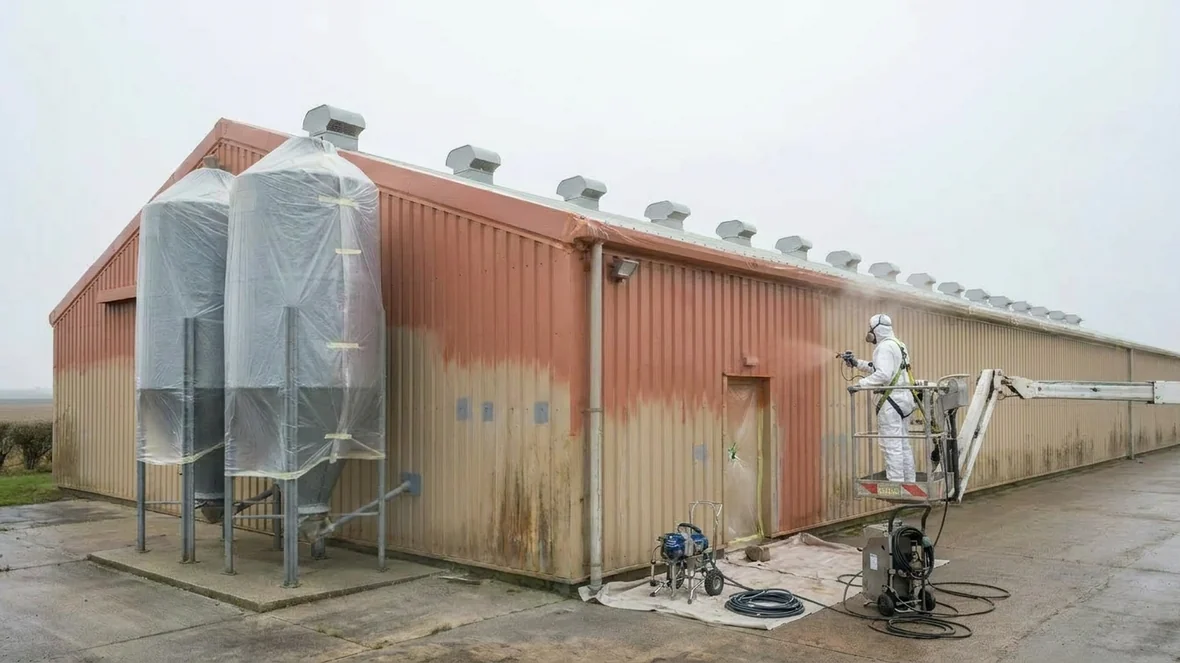
The cladding itself was structurally fine. Box profile steel sheet keeps its strength long after it loses its colour, and there was no corrosion beyond the surface staining around fixings and cut edges. Recladding a shed of this length would have been a large bill for what was, underneath the chalk, a sound envelope. Cladding painting by airless spray does the same visual job at a fraction of the disruption, seals the fixings and cut edges that were starting to stain, and, critically on a poultry site, can be programmed to fit inside the empty window between one flock leaving and the next arriving.
There is also a scale point that anyone who farms in Lincolnshire will recognise. Poultry enterprises here rarely stop at one shed; this holding has plans for a second unit on the same apron, and whatever finish went on the first building would set the standard for everything that follows. That pushed the decision away from a quick patch-up and towards a properly washed, repaired and sprayed finish that a second Lincolnshire shed could be matched to exactly, panel profile, colour and sheen, whenever it goes up.
The farm chose Terracotta from our palette, a muted, earthy red brown. It is a warmer choice than the greys that dominate industrial work, it sits comfortably against brick farmhouses and the red pantile tradition that runs right through Lincolnshire’s villages, and on a working Lincolnshire poultry site it hides everyday dirt far better than the pale buff it replaced. It also photographs well for the farm’s own assurance records, which sounds trivial until an auditor asks for elevation photos two flocks from now.
What the survey found between flocks on the Lincolnshire farm
Biosecurity shaped this job from the first visit. Nothing moves onto a poultry site casually: our surveyor booked in ahead, parked where the farm directed, and worked in site boots and coveralls with dips at the door, the same discipline the farm applies to everyone. From the MEWP we mapped the elevations, confirmed the cladding was sound, logged the fixings that needed replacing, and agreed the one detail that ruled everything else: the work had to happen while the shed stood empty between flocks, and it had to be finished, cured and cleared before the next chicks arrived. Miss the window on a Lincolnshire broiler site and the job waits a whole crop cycle for another chance.
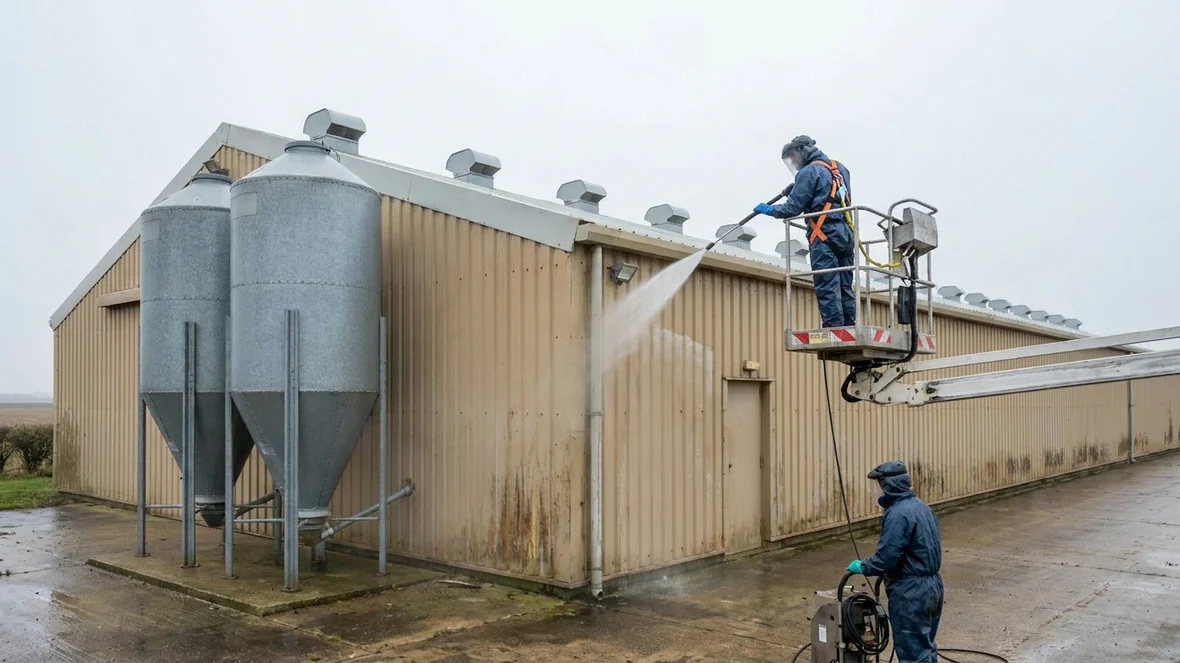
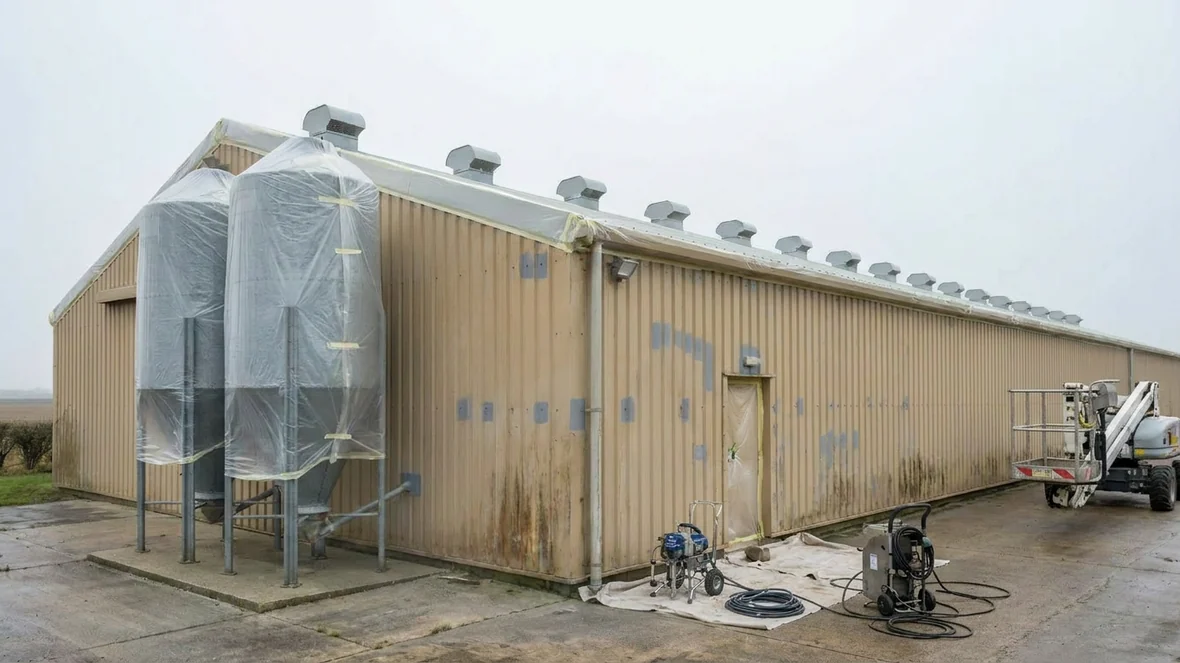
That window is short, so the whole programme was drawn to fit it. Washing on day one, repairs and masking on day two, spraying across the next two, curing while the farm deep cleaned the inside of the shed on its own schedule. The two programmes, ours on the outside and the farm’s on the inside, never once queued for the same space, which is what a proper turnaround plan looks like. Housekeeping stayed tight throughout: equipment lived on dust sheets on the apron, hoses were coiled at the end of every shift, and everything that came onto the site was logged so it could be walked off again before the shed was restocked. A tidy site is good practice anywhere; on a poultry unit it is part of the biosecurity plan.
The work, stage by stage
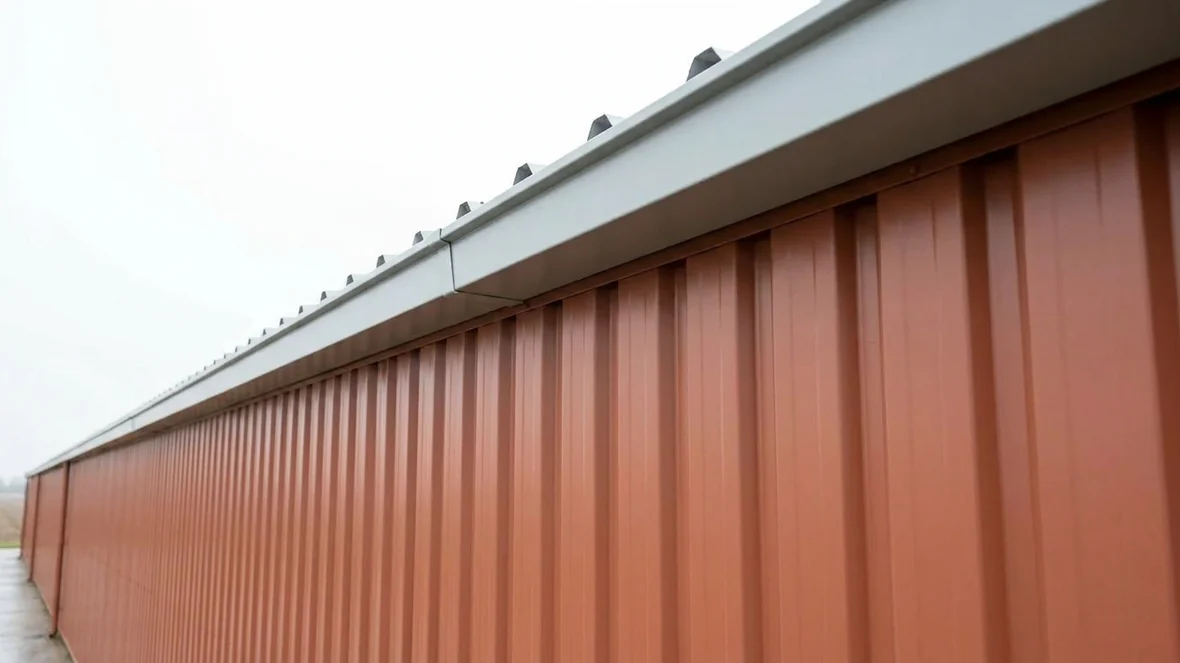
The sequence below follows the same run of the shed through the turnaround window, from chalked tan buff to a continuous Terracotta under the untouched grey roof.

The finished poultry shed
The stages carry the story, but a few details are worth pulling out. The masking stage on this shed had an unusual star: the feed bins. They stand hard against the gable, they were staying in use, and overspray on a feed system is not acceptable, so both bins were sheeted and taped down to the cone before any spraying started. The fan housings at the ridge were checked and covered, the gutter line and roof edge were masked so the grey roof would stay untouched, and every treated rust spot and sealed cut edge was spot primed. The Terracotta then went on in top to bottom passes, working from the gable along the elevation with a live wet edge, the way a long building has to be sprayed if the finish is going to read as one colour rather than a patchwork of sessions.
The transformation runs the full hundred paces of the building. Where the elevation was a tired, streaked buff, it is now a single unbroken run of satin Terracotta, crisp at every trim, with the feed bins gleaming against it and the grey roof clean above. The fixings are sealed, the cut edges are protected, and the shed was handed back inside the turnaround window, cured, cleared and ready for the next flock. By the time the disinfection sign off was done and the bedding was going in, our masking was off, our kit was gone and the apron had been washed down behind us. Project completed between crops, which on a broiler site is the only schedule that counts.
Agricultural cladding spraying and painting across Lincolnshire and the UK
Poultry sheds, grain stores and general purpose farm buildings across Lincolnshire share the same box profile cladding and the same slow fade, and our agricultural painters respray them across the county. Our crews work around Lincoln itself and out through the poultry and arable country towards Sleaford, Market Rasen, Horncastle and Gainsborough, and across the Trent into Nottinghamshire around Newark. Lincolnshire’s flat, open sites are kind to sprayed work, and the county’s concentration of poultry units means we are used to planning around flock cycles, assurance visits and the biosecurity rules that come with them. Away from the poultry belt, the same crews handle grain stores on the Lincolnshire Wolds and vegetable packing sheds in the south of the county, because box profile steel does not care what a building holds. The same teams cover the UK nationwide.
If you run a poultry site near Lincoln, or anywhere in Lincolnshire, and your cladding has gone chalky and streaked, the empty week between flocks is exactly long enough to fix it. Our agricultural cladding spraying service covers the washing, the repairs and the coating, and our cladding spraying in Lincoln page covers the local detail. The full colour range, including the Terracotta used here, is on our coating colours page, and there is a companion job on a very different building in our case study of a dairy unit in Carmarthenshire. To fit a survey into your next turnaround, get in touch.