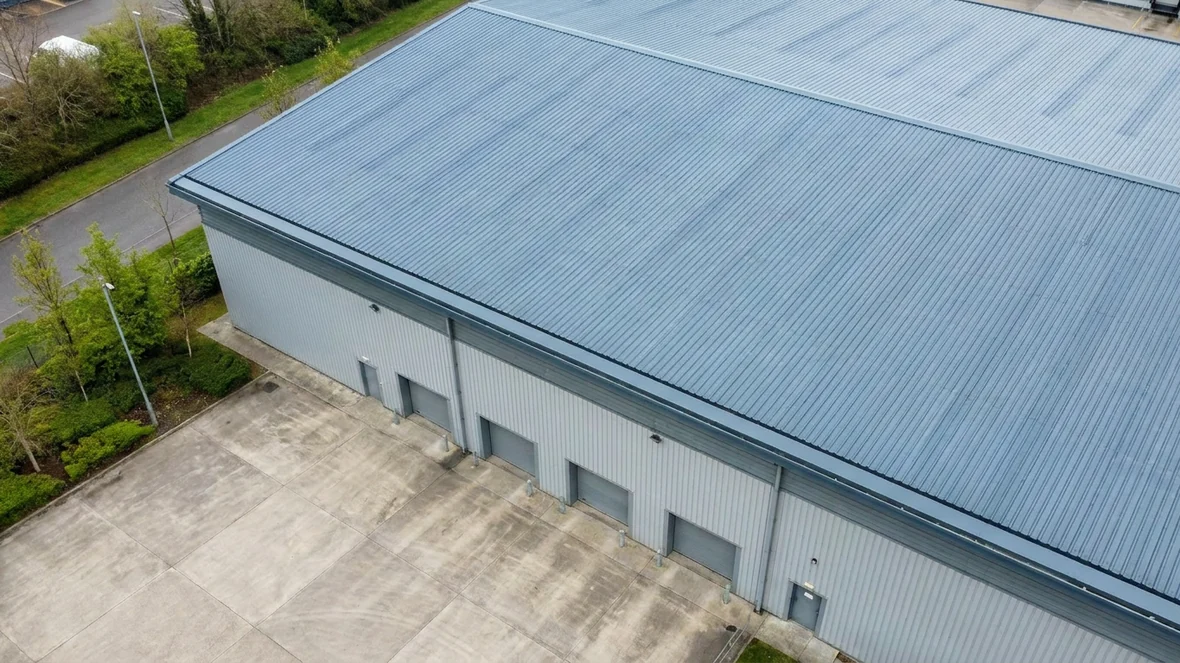
A full roof coating with cut-edge corrosion treatment on a distribution warehouse near Huddersfield, West Yorkshire, taking a chalked and rust-lined profiled steel roof to a continuous Slate Blue RAL 5008 finish over a live distribution operation.
The building and the brief
The facilities manager of a distribution business near Huddersfield called us about a roof his insurers had started asking questions about. The building is a large modern warehouse on the edge of the M62 corridor, a long single-storey steel portal frame shed with a shallow duo-pitch roof of plastisol coated profiled steel, light grey microrib walls and a run of dock doors down one elevation. From the yard the building looked fine. From the roof it did not, and it is a roof we could have photographed on fifty other West Yorkshire sheds.
The problem was cut-edge corrosion, which is the most common failure mode on profiled steel roofs of this generation across West Yorkshire. When roof sheets are cut to length at the factory, the cut ends expose bare steel that the plastisol coating never covered. Those exposed edges sit at every end lap and along the eaves, exactly where rainwater lingers longest, and over time the coating peels back from the edge while rust creeps under it. On this roof the corrosion showed as orange-brown lines tracking across the slope at every lap and a heavier band along the gutter edge. Left alone, cut-edge corrosion eventually perforates the sheet ends and the laps start letting water into the building below.
Replacement was the comparison quote on the table, and for a footprint this size it was a number the business did not want to entertain, quite apart from the disruption of stripping a roof over a live distribution operation. Our recommendation was the standard one for a roof at this stage, treat the cut edges properly, then coat the whole roof so the entire surface starts again as one continuous protected film. The client chose Slate Blue, RAL 5008, from the palette we coat in, a deep grey-blue that reads more considered than the default greys on the neighbouring units.
What the survey found
We surveyed the roof before pricing the work, walking the laps and photographing every elevation and slope. The point of the survey on a cut-edge job is to grade the corrosion honestly. Edges where the plastisol has lifted but the steel is sound need a different treatment from edges where rust has started to eat the sheet end, and any sheet too far gone has to be identified before coating is even discussed. On this West Yorkshire roof the corrosion was advanced but nothing was perforated, which meant every sheet could be saved. The gutters were serviceable, the rooflights had been replaced in a previous refurbishment, and the yard gave us clean MEWP access along the full eaves line.
The work, stage by stage
The sequence below follows the roof from the day we arrived to the finished surface, washing, cut-edge treatment and priming, topcoating, and the completed building from the same viewpoint.
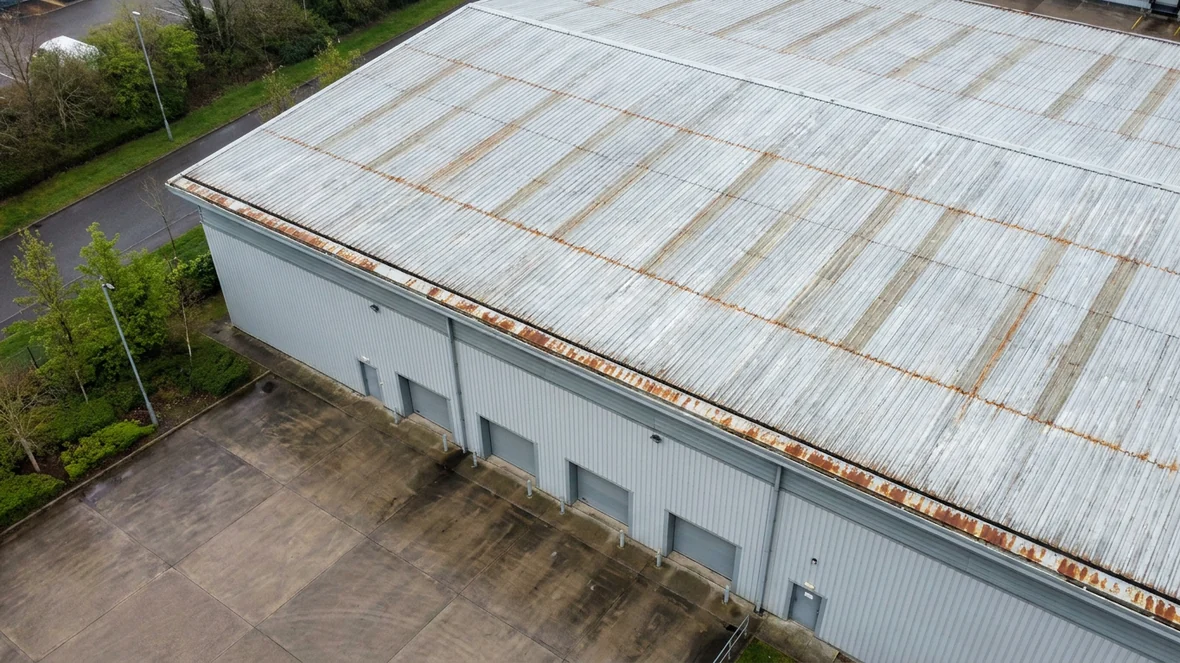
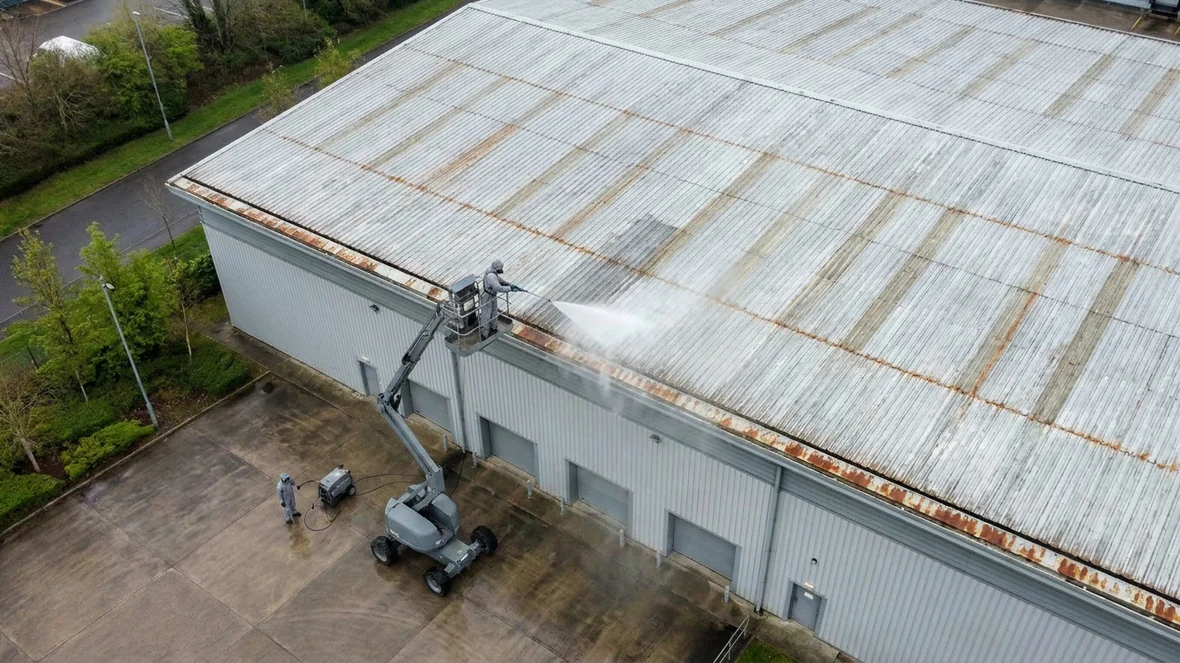
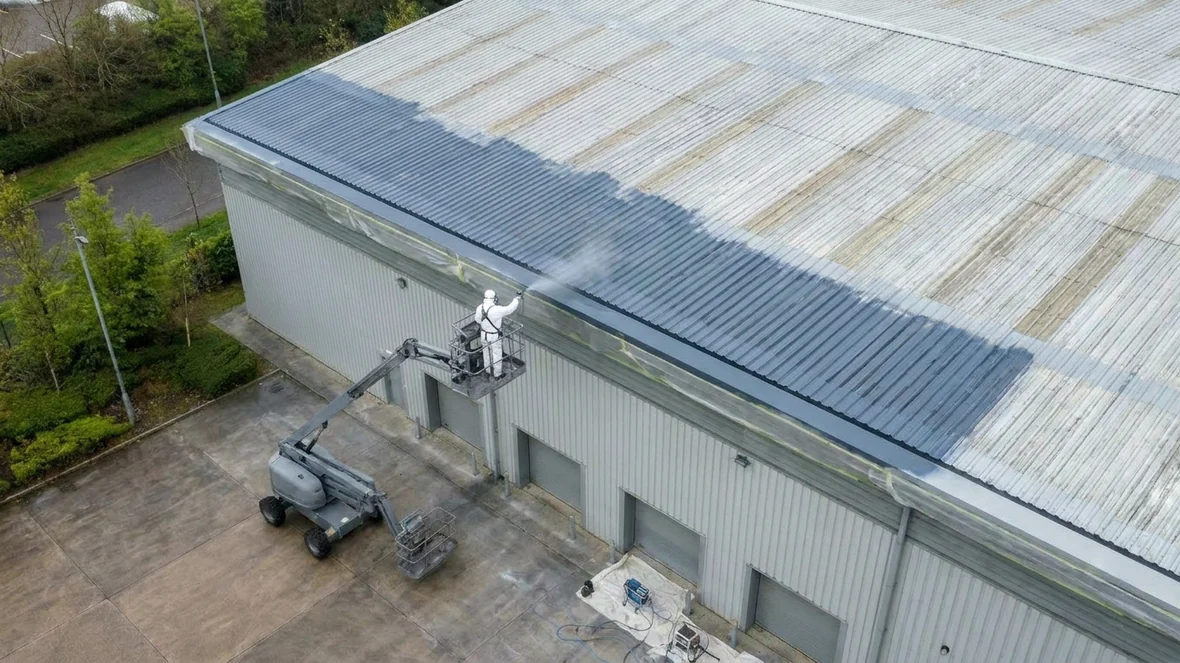

Preparation began with a full wash of the roof to strip the chalk, grime and organic growth off the plastisol. One operative worked the lance from the MEWP basket at the eaves, harnessed and clipped on, with a second at ground level managing the washer and the runoff. A coating is only as good as what it is applied to, and on a chalked roof that means washing until the rinse water runs clean. West Yorkshire weather did its usual thing during the programme, so the work was sequenced slope by slope between showers rather than fighting the whole roof at once.
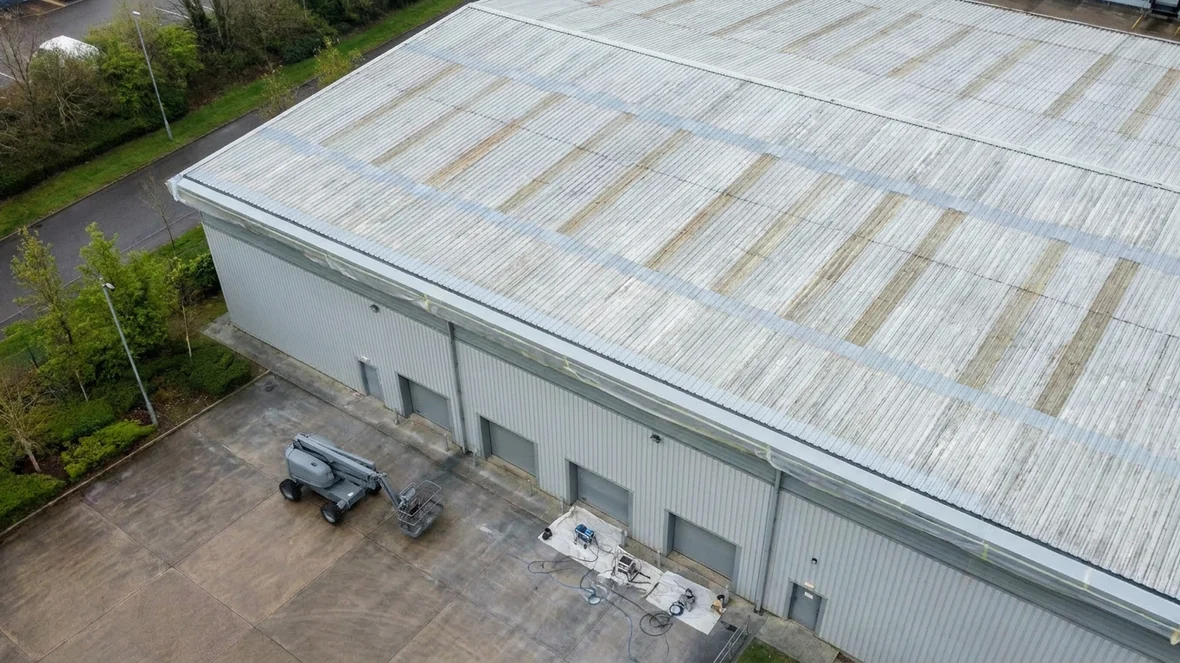
With the roof clean, the real work of the job started. Every affected cut edge was mechanically prepared, taking the lifted coating and surface rust back to sound bright steel along each lap line. The prepared edges and fixing heads were then primed with an anti-corrosion primer, and the end laps sealed so water can no longer be drawn up between the sheets. At that stage the treatment reads as runs and patches of light grey primer across the washed sheets wherever the old coating had failed, with the heaviest attention on the eaves edge where the corrosion was worst. That patched, primed stage is what a properly treated roof looks like before topcoating, and it is the stage that separates a corrosion treatment from a cosmetic paint job. It is also the stage most West Yorkshire building owners never see, because it only exists for a day or two before the topcoat covers it. The gutter run was masked with taped sheeting, and the warehouse below stayed fully operational, with the eaves work sequenced around the dock schedule. On distribution sites around Huddersfield, downtime costs more than coating, so the programme is built around the operation rather than the other way round.
Topcoating followed the primer. Our sprayer applied the Slate Blue coating system by airless spray, working from the MEWP in full spray kit with the gun feathering each pass into the last while the film was still wet. On a shallow pitch roof the coating wants to sit in the profile troughs, so the passes run with the corrugations, keeping the film build even across rib and valley. Getting a crisp junction at the gutter matters as much on a roof as clean window lines do on a wall job. The masked gutter trim gave us a hard, straight colour break at the eaves, and the ridge and verge trims were cut in the same way as each slope was completed. The dock doors, walls and yard below the work zone stayed clean because the masking and the weather windows were managed properly, not because we were lucky.
The finished distribution warehouse
The finished roof is a single, uniform Slate Blue plane from eaves to ridge, and the comparison with the first photograph tells the story better than the description does. The rust lines at the laps are gone because the corrosion underneath them was removed and sealed, not hidden. The chalked patchwork of weathered sheets now reads as one continuous coated surface with crisp colour lines at the ridge, the verges and the gutter edge. The walls and dock doors were never touched, which was the plan, the light grey elevations already suited the estate and the budget belonged on the roof where the risk was.
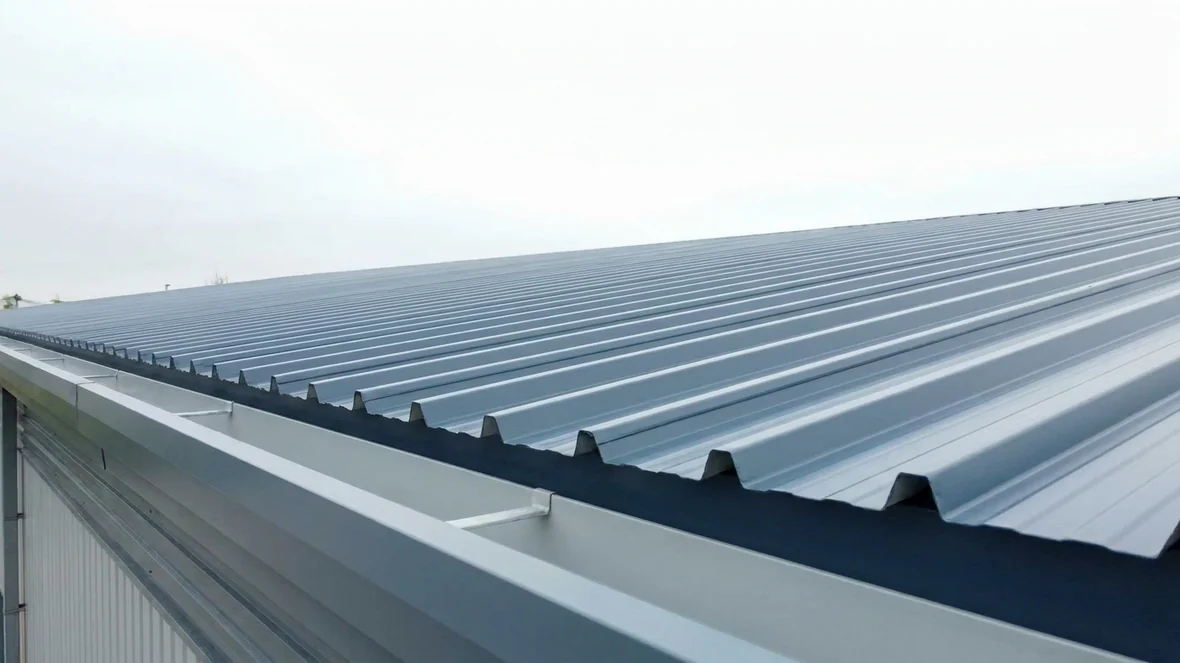
The close-up shows where the job was really won, the sheet ends at the eaves. Edges that were rusting and lifting are now prepared, primed, sealed and coated as part of one continuous film that turns cleanly into the gutter line. For the facilities manager, the outcome is a roof taken off the insurer’s worry list and a building that no longer advertises its age to every passing motorway bridge on the West Yorkshire stretch of the M62. Because the corrosion was treated at the right point, before perforation, the business kept its existing roof instead of funding a replacement.
Project completed in spring 2026.
Warehouse roof coating across West Yorkshire and the UK
Distribution stock along the M62 through West Yorkshire is dominated by exactly this kind of building, big shallow-pitch profiled steel roofs from the same era, weathering in the same Pennine climate, and most of them are somewhere on the same cut-edge corrosion curve. We coat warehouse roofs around Huddersfield, Halifax, Brighouse and Wakefield regularly, and the pattern barely changes from site to site, sound structure, tired coating, corroding laps, and a client weighing a coating programme against a replacement quote. If that is where your building is, the honest answer is usually the one we gave here.
You can read about our approach to cut-edge corrosion treatment on warehouses, and we cover commercial roof coating in Huddersfield and the surrounding West Yorkshire towns as standard, with the same crews working nationwide. For a wall-side example of the same respray discipline, see our cladding respray on an industrial unit near Warrington.
If you look after a warehouse near Huddersfield, or anywhere across West Yorkshire and the UK, book a free site survey. We will inspect the roof, grade the cut edges honestly and give you a written specification for exactly what it needs, and nothing it does not.