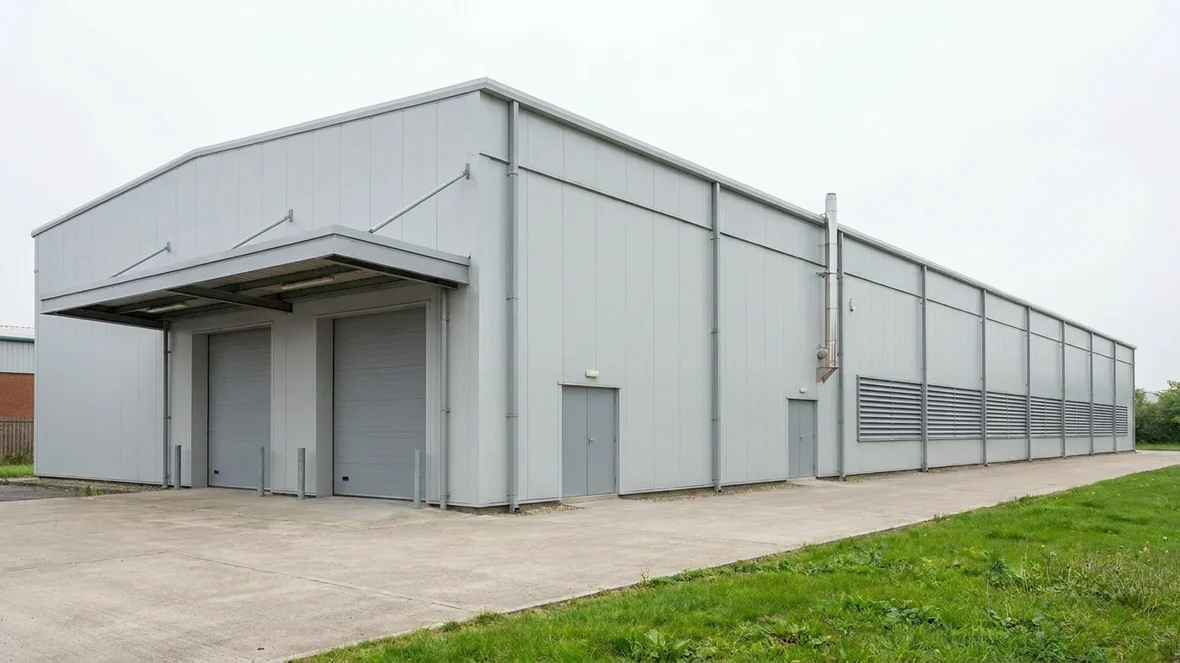
A hygiene-driven cladding respray on a live food processing plant near Swindon, Wiltshire, taking yellowed composite panel walls back to a clean Goosewing Grey BS 10A05 finish without a single break in production.
The building and the brief
This job came to us from the site manager of a food processing plant near Swindon, and the conversation started with hygiene rather than looks. The building is a modern single-volume production facility on a Wiltshire business park, tall composite panel walls with a parapet roofline, a loading canopy with two docks at one end, and the usual food-factory furniture of stainless flues, louvre banks and personnel doors along the elevations. Composite panel is the standard envelope for food production for good reason, the smooth faces wash down easily and the joints are tight, but the coating on the panel face still weathers like any other factory finish, and the Wiltshire weather gives it plenty to work with.
These panels had been white when the plant was fitted out. By the time we surveyed them they were a dull, uneven yellow-grey, streaked with grime running down from the parapet capping, shadowed around every panel joint, and greening with algae where the downpipes and gutter outlets kept the surface damp. None of it affected the panels structurally, but for a food business the outside of the building is part of the audit trail. Customers and auditors form a view in the car park, and a stained envelope invites questions about everything behind it. The site manager wanted the plant to present the way the production floor actually runs, and to hold its own against the newer units going up around it on the same Wiltshire park.
Recladding a live food factory was never seriously on the table, the cost is one thing, but opening the envelope of a production facility means dust, weather risk and downtime that food manufacturing cannot casually absorb. A respray does the same visual job without breaking the skin of the building. The colour chosen was Goosewing Grey, BS 10A05, from the palette we coat in, a bright, light, neutral grey that is the default for modern industrial cladding, stays smart between washdowns far better than white, and suits the clean lines of a panel building.
What the survey found
The survey walked every elevation with the site manager and the hygiene lead together, because on a food site the method statement matters as much as the specification. We checked the panel faces for coating failure and impact damage, logged the joints where sealant needed renewing, confirmed the staining was surface contamination rather than delamination, and mapped the flues, louvres and door surrounds that would need masking. Just as importantly, we agreed the operational rules, which elevations could be worked on which days, where the MEWP could stand without blocking vehicle routes, and how washdown runoff would be contained and disposed of away from the yard drainage the plant uses.
The work, stage by stage
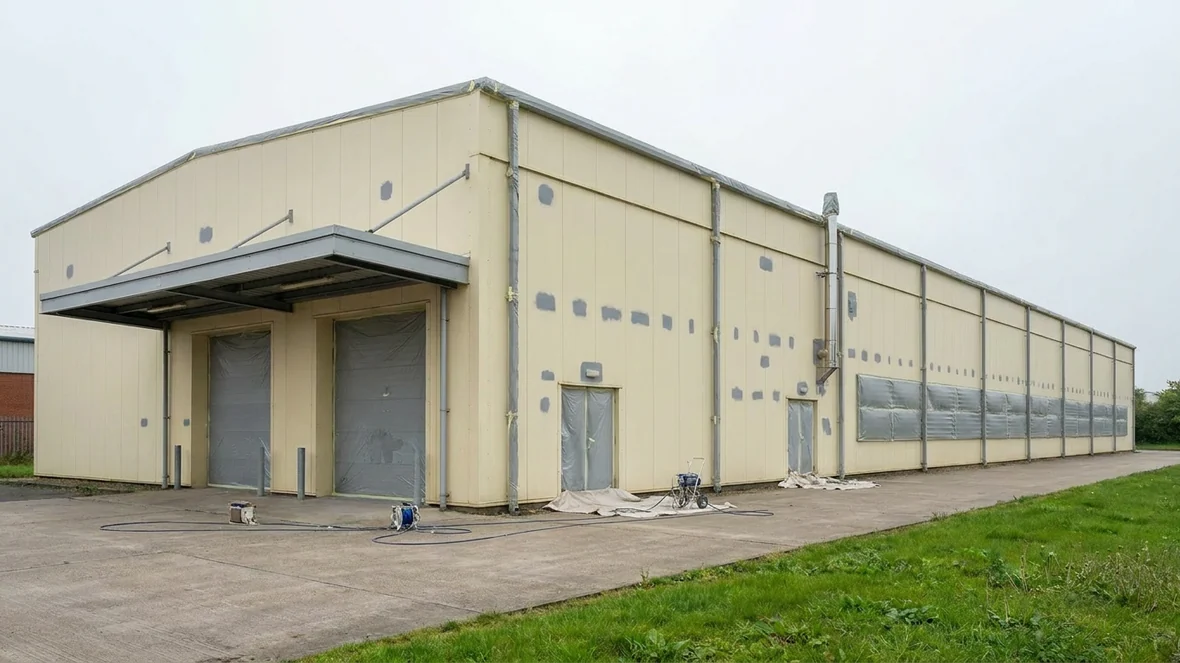
The sequence below follows the envelope through the programme, the detergent wash, masking around the intakes, the Goosewing Grey going onto the flat panels, and the finished plant from the same viewpoint.
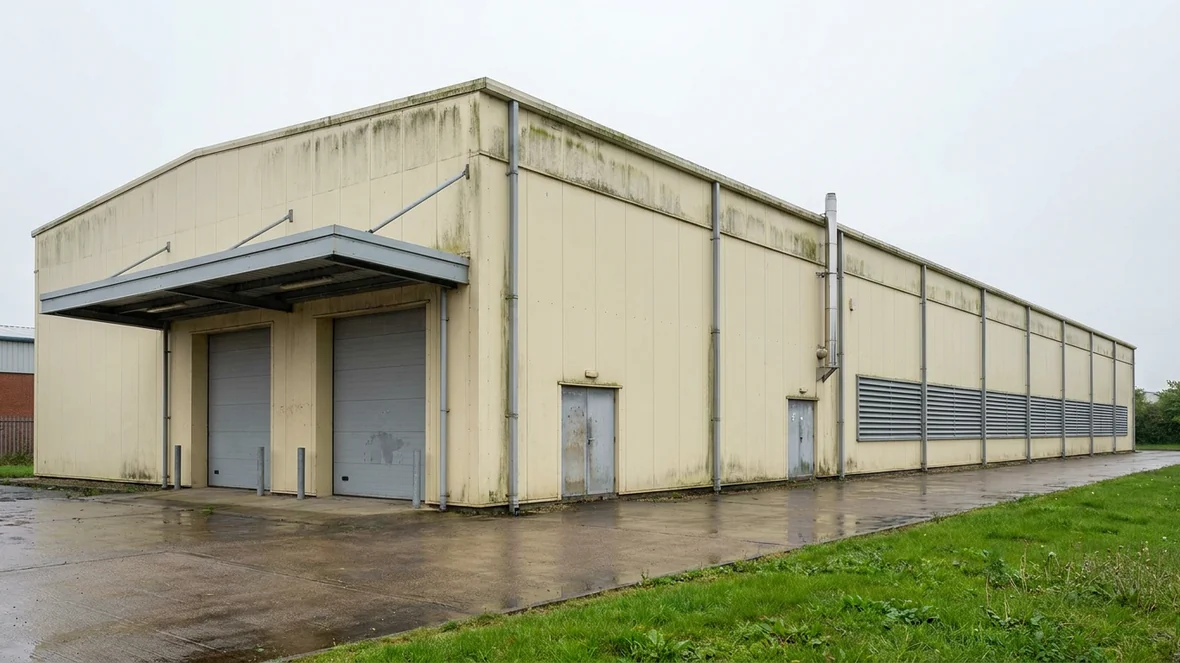
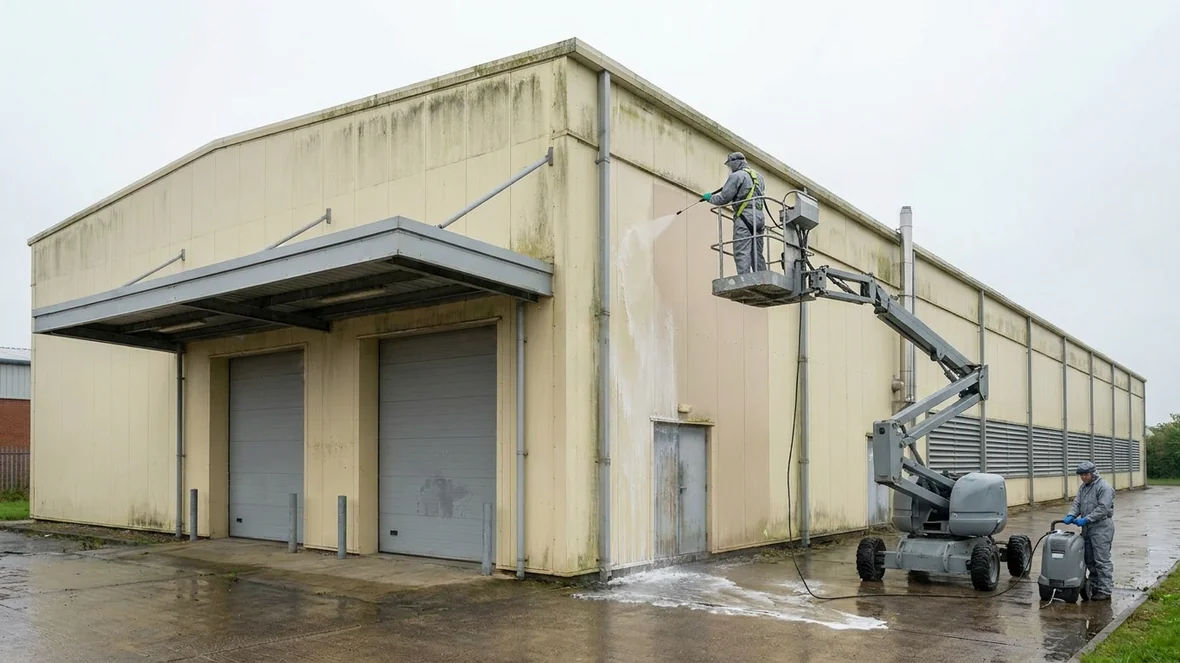
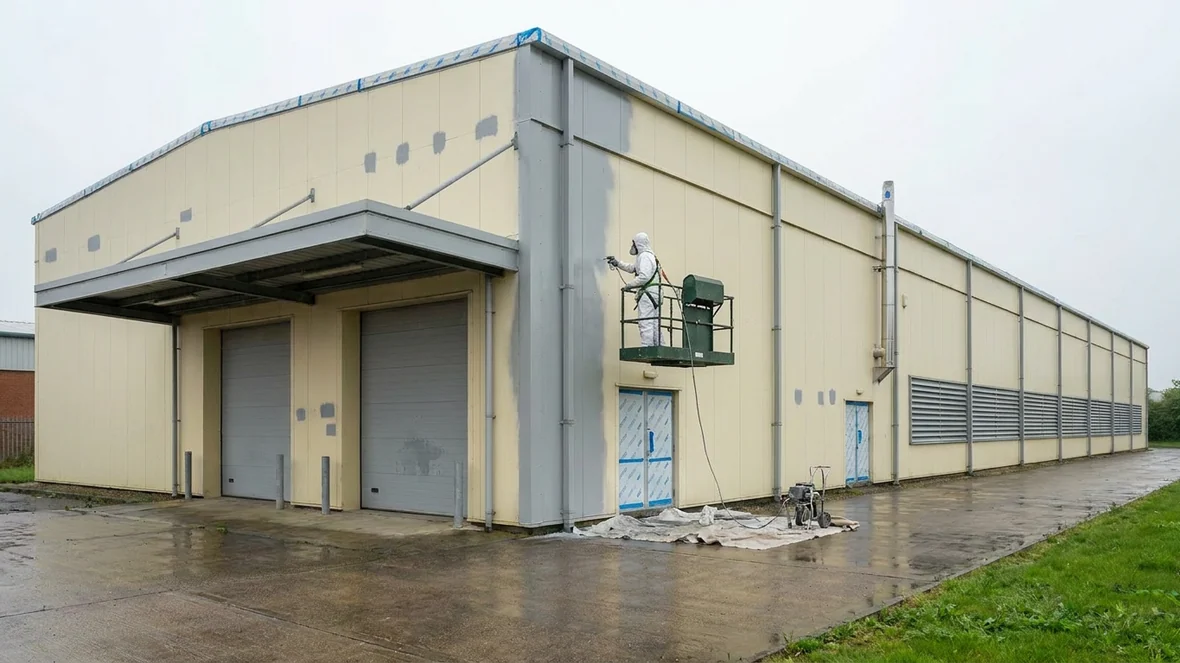

Preparation began with a detergent wash of the full envelope, worked from the MEWP with one operative on the lance, harnessed and clipped on, and a second at ground level managing the wash unit and the runoff containment. Composite panel rewards careful washing, the flat faces come up quickly, but the joint lines and the sheltered strips under the parapet hold dirt that has to be worked out rather than blasted at. The cleaned band reads close to the original panel colour against the yellowed surface beside it. We wash a lot of panel buildings across Wiltshire, and the state of the rinse water still surprises clients every time.
Masking on a food factory is about more than crisp lines. Every louvre bank was sealed over so no overspray could be drawn towards air intakes, the dock doors, personnel doors and downpipes were filmed and taped, the stainless flue was wrapped, and the parapet capping was masked to keep the roofline break clean. We coordinated each day’s masking with the plant so that ventilation and access were never compromised on a production day, and the panels that had taken repairs, renewed sealant joints and treated scuffs, were spot-primed ready for the topcoat. Housekeeping stayed tight throughout, dust sheets under the rig, hoses run along agreed routes, kit cleared from the apron every evening. On a food site near Swindon or anywhere else in Wiltshire, the contractor’s tidiness is read as a proxy for their competence, and rightly so.
Flat composite panel is the most honest surface we spray, and Wiltshire’s food and drink estates are full of it. Corrugated cladding forgives small variations in technique because the profile breaks up the light, but a flat panel face shows every dry edge, every heavy pass and every speck that lands in the wet film. Our sprayer applied the Goosewing Grey system by airless spray from the MEWP, in full spray kit with hood and respirator, keeping a live wet edge moving across each panel run so the finish laid down as one continuous film, panel joint to panel joint, with no banding and no texture change across the elevation. Production carried on inside the whole time. Coating an operating food plant is a sequencing exercise as much as a spraying one, and the programme we agreed at survey held through the job.
The finished food processing plant
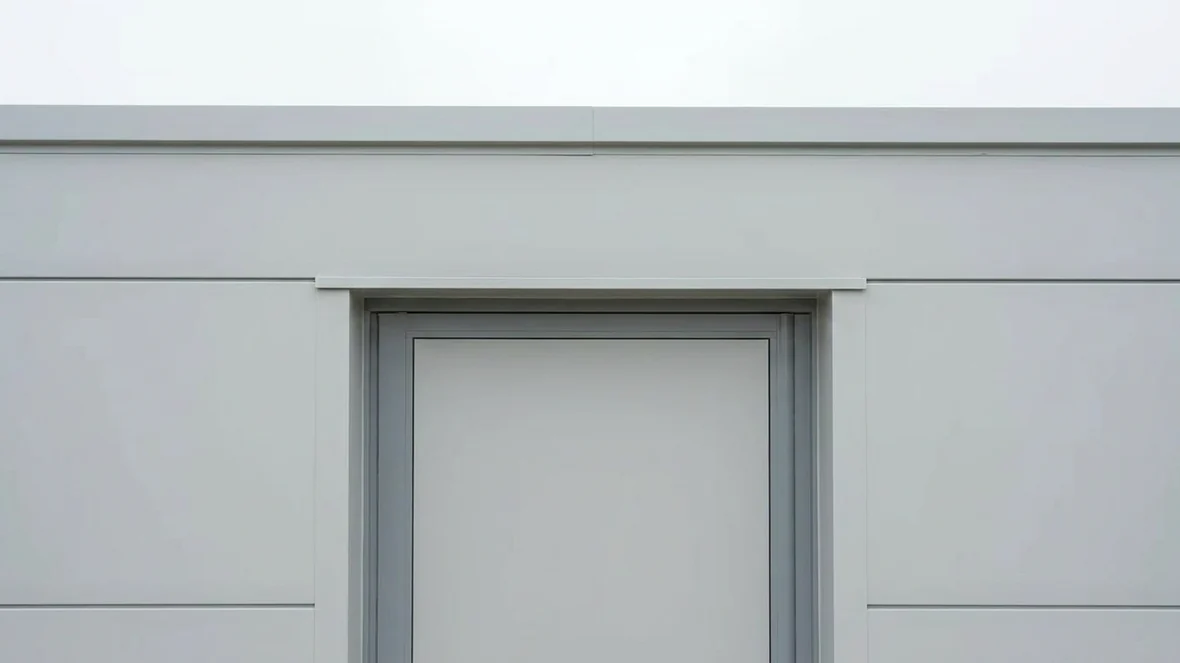
The finished building reads like new-build panel, which is precisely the point of Goosewing Grey on a food facility. The envelope is one clean, even, light grey surface, the shadow-gap joints run straight and true, the door frames and dock surrounds sit a deliberate shade darker, and the staining that made the plant look tired is gone along with the biological growth that caused half of it. The parapet line breaks cleanly against the sky, and the stainless flue and louvres came out of their wrapping untouched.
The close-up shows the standard the whole job was held to, a crisp masked line where the panel face meets the door frame, clean joints, and an even satin finish across the flat face with no orange peel and no dry spray. For the site manager, the win lands on the next audit day, a building whose outside now makes the same statement as the process discipline inside it. Because we coated rather than reclad, the plant achieved that without a single break in production near Swindon’s tightest delivery schedules.
Project completed in spring 2026.
Cladding spraying across Wiltshire and the UK
Swindon anchors one of the busiest concentrations of food, logistics and light manufacturing in the south west, and the business parks around the town, and down through the Wiltshire towns of Chippenham, Marlborough and Salisbury, carry a large stock of composite panel and profiled steel buildings now old enough to look it. Food and beverage sites are a growing share of our work across Wiltshire, partly because so many were built in the same wave, and partly because the sector understands better than most that the building is part of the brand.
We cover commercial wall coating across Wiltshire as standard, our crews carry out cladding spraying nationwide, and you can read more about how we work on food production and cold storage sites specifically. For a heavier industrial example of the same respray discipline, see our cladding respray and box gutter lining on a factory near Carlisle.
If you run a food facility near Swindon, or any production site across Wiltshire and the UK, book a free site survey. We will inspect the envelope, agree a method that respects your production and hygiene rules, and give you a written specification with no surprises in it.