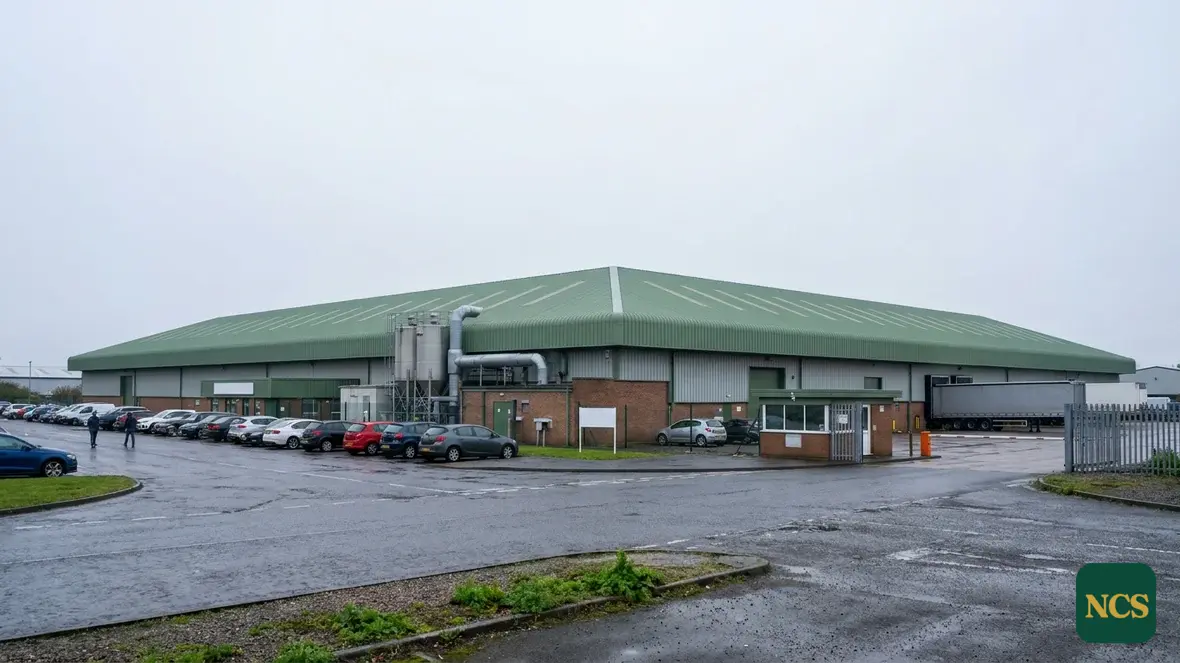
Carlisle weather is no joke for industrial roofs. It’s one of the wettest spots in England, and those big profiled metal roofs over the distribution centres, storage units and production buildings take a real beating year after year. We see roofs here showing their age faster than in drier places. Things like corroding cut edges, lifting finishes and rusting gutters just get worse quicker once they start.
Why logistics and production sites suit coating works
Carlisle’s a hub for logistics and food production, and those are exactly the kind of buildings where ripping off a roof causes the most pain. Strip-off means exposure, a risk of contamination and downtime that some operations just can’t stomach. Then there are weeks of sorting out access, schedules and weather windows. A coating system avoids almost all of it: the existing roof stays put and watertight, we work up on the roof, and your operation keeps running below. For facilities teams, that turns a major capital disruption into a maintenance job, and a much smaller bill.
Cut-edge corrosion in a wet climate
On profiled metal sheets, the factory finish doesn’t cover the cut edges. In a climate like Carlisle’s, the exposed steel at laps, eaves and gutter lines barely gets a chance to dry out. Corrosion starts creeping back under the finish, lifting it, and eventually punching holes in the sheet. The wetter it is, the quicker that first rust line turns into real damage. That’s why an early survey in Cumbria is worth its weight in gold. We prepare the edges, prime them and seal them as part of the coating programme. That stops the creep while the sheets are still sound. That’s the whole point: get in there while the steel’s still worth saving.
If the honest answer for a Carlisle roof is replacement rather than painting, the survey report says exactly that.
Where coating stops making sense
We’re straight with you about what a coating can and can’t do. It won’t fix a roof that’s riddled with holes already, or corroding from the underside, or if the insulation in a built-up system is soaking wet, or if the fixings and purlins are failing. On those roofs, our report will tell you to repair or replace it, and we’ll explain why. Putting a coating over that lot would just be throwing money away, hiding a problem instead of fixing it. A good chunk of the survey’s value is figuring out which side of that line your roof sits on before anyone even talks about quotes.

How we keep works low-impact
Every job we do is planned so your site stays up and running:
- We survey it first, with a written report and photos of what we find.
- All the work happens from roof level; no stripping anything off.
- For bigger sites or multi-let units, we’ll phase the work area by area.
- Access, timings and site rules are all agreed with your facilities team beforehand.
- If you need gutters or rooflights done, we’ll roll that into the same visit.
We’re based in the South-East, but we work all over the UK. For Carlisle projects, we make sure the travel distance is our problem, not yours. If you’ve got rust showing on your roof sheets, the smart move is to get a survey done before another winter bites.