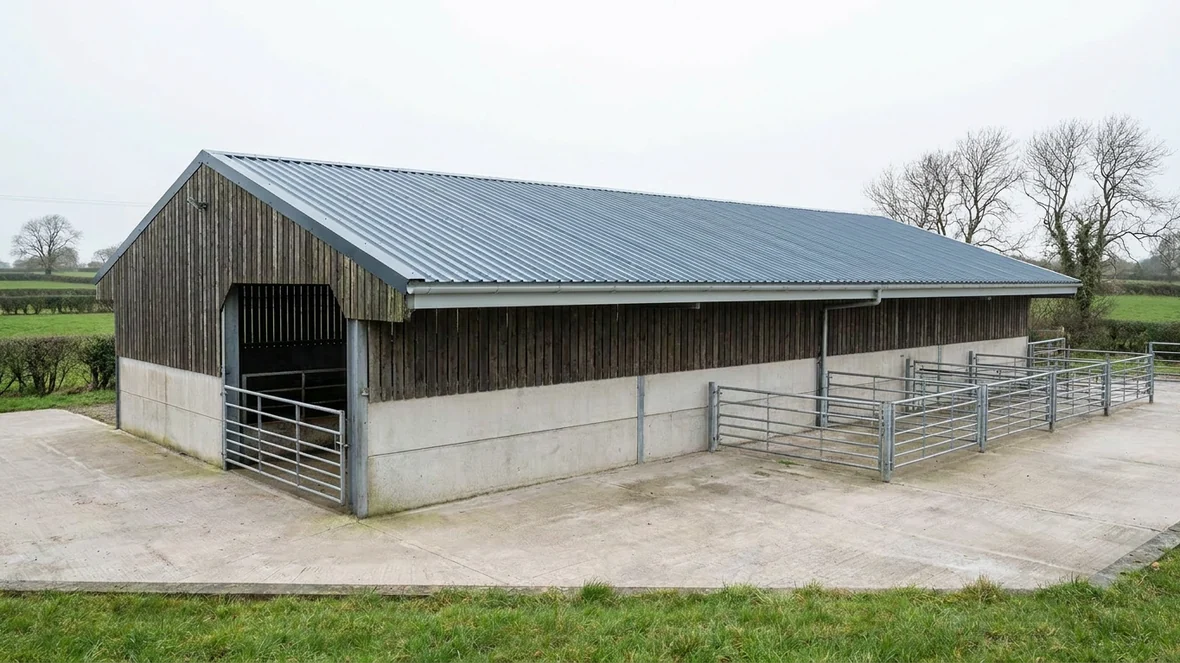
The call about this building was really a call about a gutter. A beef farmer north of York had a steel portal stock shed with a box gutter that had started weeping along its seams every time it rained, and in the Vale of York it rains enough for that to matter. Water tracking down inside a livestock building wets bedding, and wet bedding costs money in straw and in the health of the cattle standing on it. When our surveyor got on the roof, the gutter turned out to be the loudest symptom of a quieter problem: the whole roof was at the end of its original finish, patchy, rust stained at the laps and growing moss along the eaves. The farm needed the gutter relined and the roof painted with a proper coating system, and it needed both done without emptying the shed.
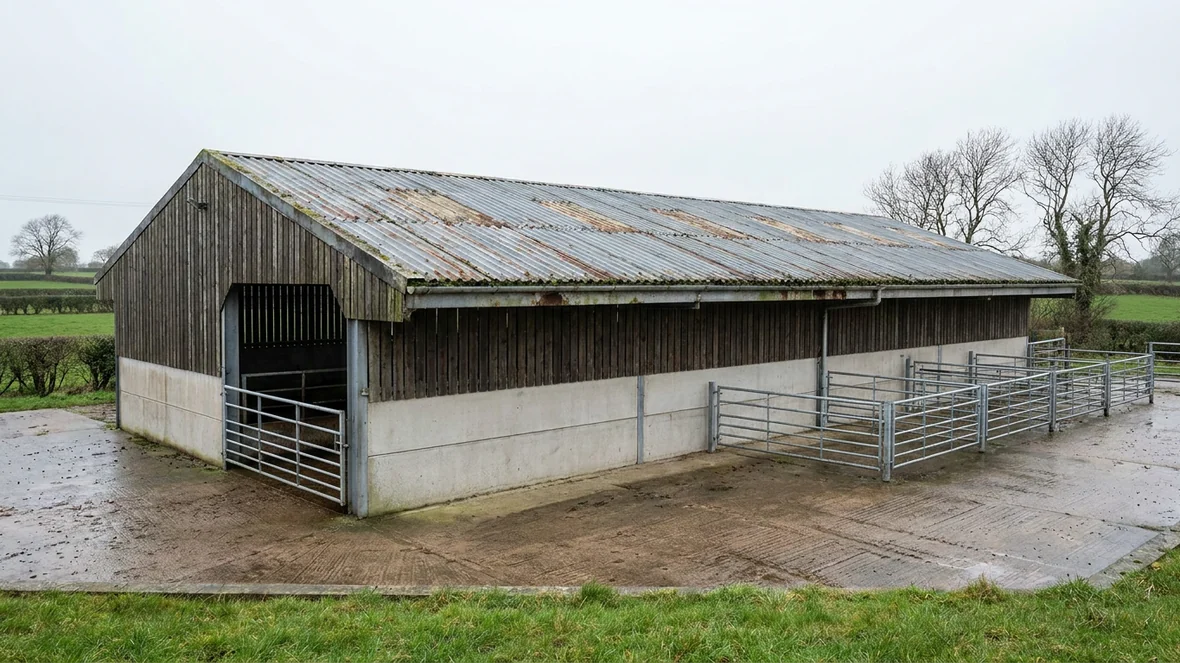
A tired roof over a working North Yorkshire stock shed
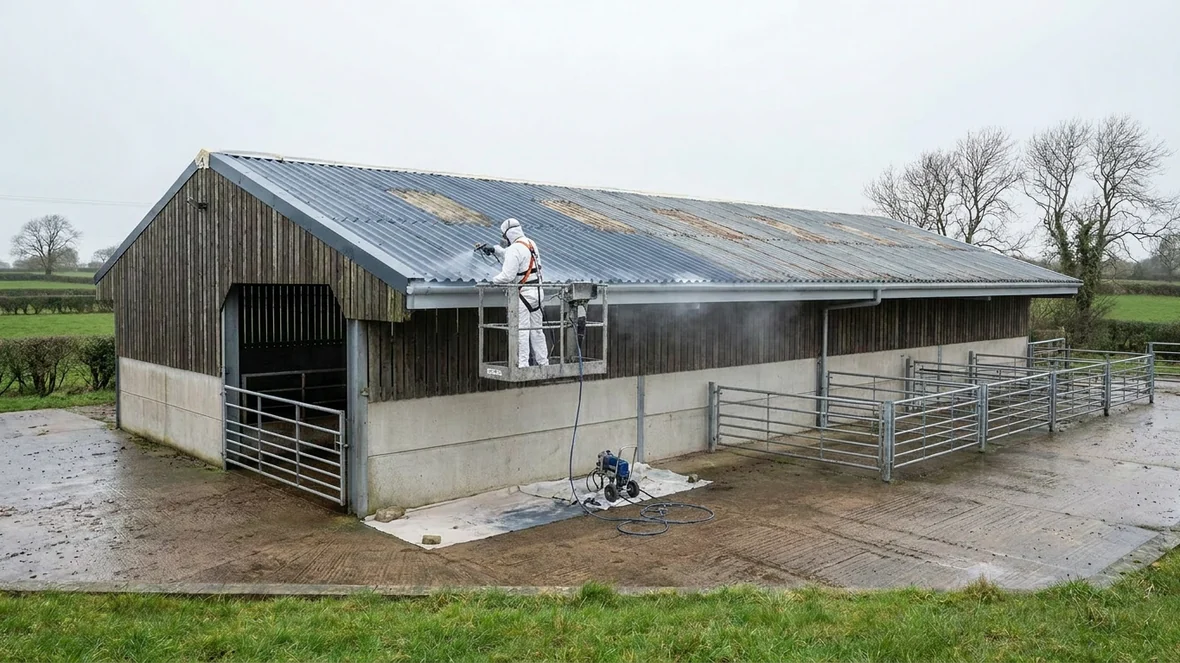
The building is a typical North Yorkshire cattle shed, and by North Yorkshire standards a good one. A steel portal frame carries a profiled steel roof with a ventilated ridge, the upper walls are spaced vertical timber, the Yorkshire boarding that keeps air moving over housed stock without letting the weather in, and concrete panels take the wear at floor level. Galvanised handling pens run off one side of the yard. Buildings like this hold cattle through the North Yorkshire winter and shrug off most of what the weather does, but the roof sheet finish is the one part that ages in plain sight.
Steel sheet roofs fail from the surface down. The factory colour coat chalks and thins, rust blooms at the fixings and along the cut edges of the laps, and moss finds the damp northern eaves. None of it was structural here, and that is the point of catching a roof at this stage. Coated now, the sheets are sealed and the decline stops. Left a few more winters, the corrosion at the laps starts eating sheet edges, and the conversation turns to replacement, with cattle decanted and a shed stood open. The farmer had seen that movie on a neighbour’s farm and had no interest in a remake.
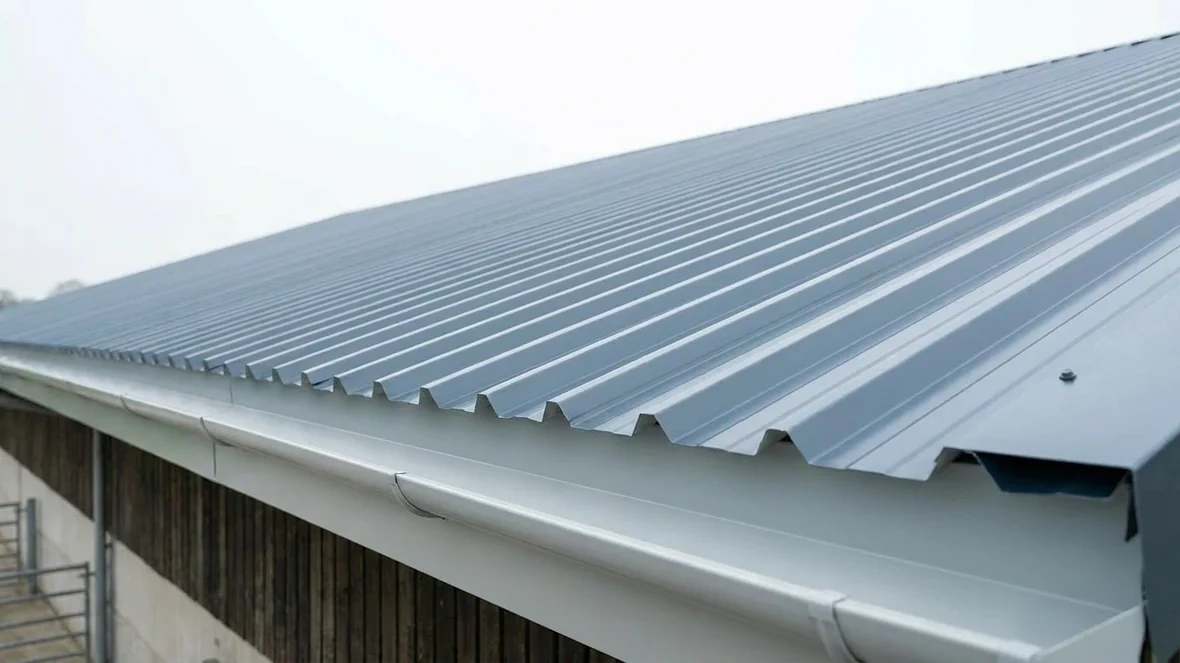
The colour choice was Slate Blue, RAL 5008, a very deep, grey toned blue that reads almost as slate from a distance, a nod to the roofscape North Yorkshire’s older farm buildings have always carried. Against dark timber boarding it is one of the best combinations in the palette, and on a roof this size it looks deliberate in a way that mid greys sometimes do not.
What the survey found on the North Yorkshire farm
Roof and gutter had aged together, which is the usual North Yorkshire pattern: the same weather that wears the sheet finish is the weather the gutter has been carrying away the whole time. Treating them as one programme, lining first and coating second, meant one access setup, one set of masking, one disruption to the farm instead of two, and a roofline where every component starts its next stretch of service on the same day.
The survey mapped both problems properly before we priced either. The box gutter was sound in section but failing at its joints, which is the classic case for lining rather than replacement: a lined gutter keeps the existing steel as its structure and gains a new continuous waterproof skin, with no crane, no dismantling and no open roofline while it happens. The roof sheets were weathered but solid, with repairs needed at a couple of dozen fixings. We agreed a plan that put the gutter first, the roof second, and the cattle’s routine above both.
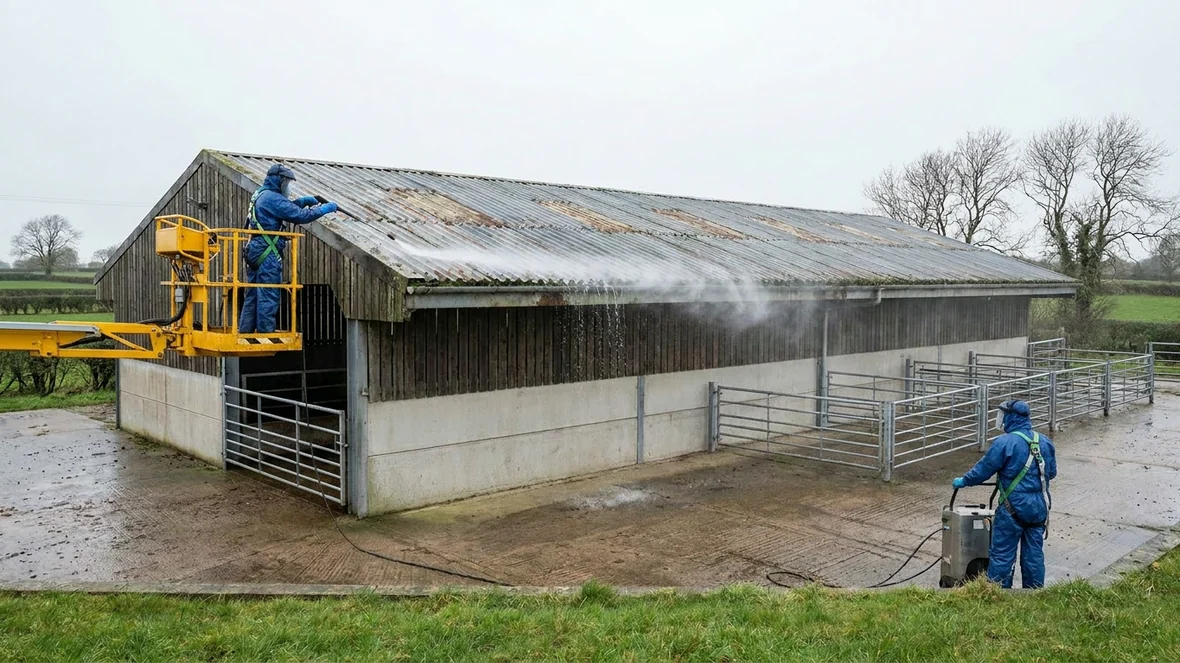
The shed had young stock housed in one end throughout the job, so everything was sequenced around them. Washing started at the far gable and worked towards the occupied bays, the crew kept feeding and bedding access clear at all times, and the noisiest work was timed away from the morning feed. Pressure washing a stock shed roof is standard work, the moss and chalk stripping back to clean sheet, but the runoff was managed so nothing reached the pens or the yard drains the cattle cross. Livestock in situ is not a complication on farm work; it is the normal condition of the job, and the programme has to respect it.
The work, stage by stage
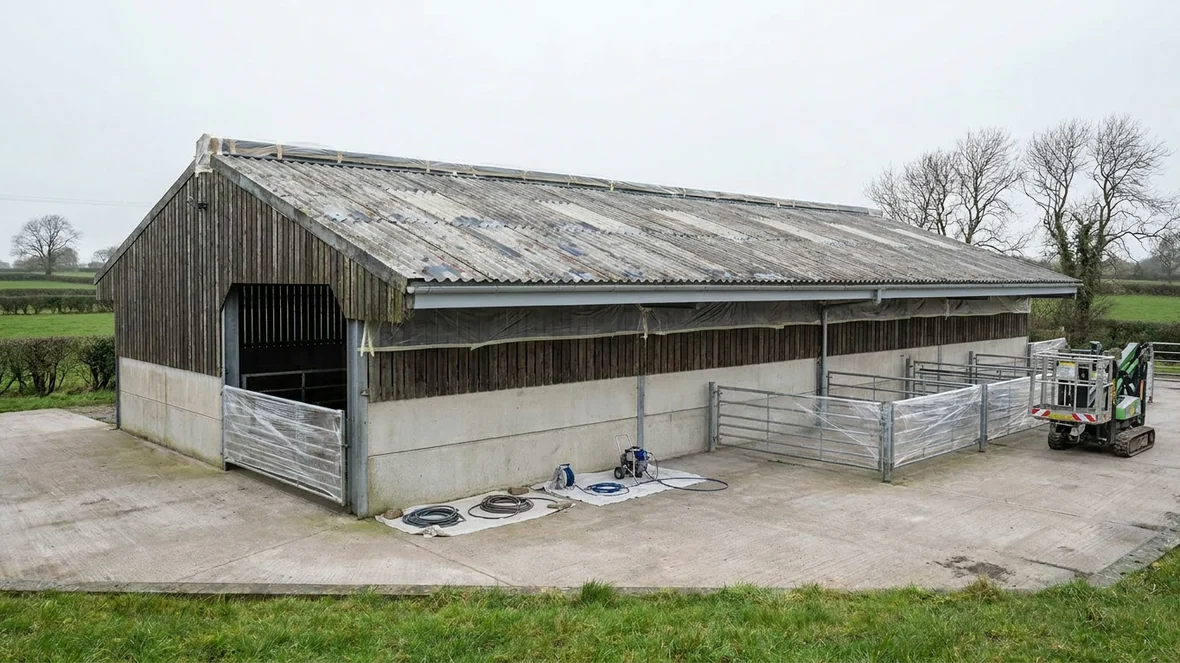
The sequence below follows the same elevation of the stock shed from first visit to handover, from a patchy, stained roof and weeping gutter to a deep Slate Blue roof over a newly lined gutter.

The finished North Yorkshire livestock building
A few of those stages deserve a closer look. The gutter was lined first: the cleared box gutter was prepared and primed along its full length, then the lining system was laid as a continuous membrane through the sole and up both faces, sealing every joint that had been weeping, curing into a single trough with no seams to open again. The masking protected the ventilated ridge and the top course of the timber boarding, because Slate Blue overspray on Yorkshire boarding would be a crime against a handsome wall. Then the roof painting itself, by airless spray from the MEWP in overlapping passes with a live wet edge. Slate Blue is unforgiving of thin spots precisely because it is so dark, so coverage was checked pass by pass along every sheet; the reward for that discipline is a roof that reads as one solid, deep colour with the corrugations drawing clean lines through it.
The gutter got its first proper test before we had even left North Yorkshire. A band of rain came through overnight between the final coat and the handover walk round, and the farmer, understandably, went straight to the bedding the next morning. Dry. The lined gutter had carried everything the sky sent at it, the new roof shed the rest, and the inside of the shed stayed exactly as a North Yorkshire cattle shed in the wet should be but so rarely is. The finished shed is the sort of before and after that makes neighbours ring up: a roof that was patchy grey, brown and green is now a single plane of deep Slate Blue above the dark timber boarding. The cattle never left the building. Project completed while the shed was housing stock, which is exactly how farm work should be planned.
Agricultural roof painting across North Yorkshire and the UK
Stock sheds like this one stand on every road out of York, and North Yorkshire has more farm roofscape than almost any county in the UK. Our agricultural roof painters coat and line across the whole of it: the Vale of York holdings around Easingwold, the pig and arable country towards Malton, the dales edge farms past Thirsk, and south towards Wetherby and the East Riding border. North Yorkshire’s mix of cattle, sheep and arable means the buildings vary enormously, but the roofs fail the same way everywhere, and catching them at the coating stage rather than the replacement stage is where the money is saved. Our teams cover the rest of the UK nationwide from the same playbook.
If you have a livestock building near York with a stained roof or a gutter that weeps through its joints, have both looked at together, because they are usually the same age and the same fix window. Our agricultural roof coating and agricultural gutter lining services cover the survey, repairs, lining and coating as one programme, and the local detail is on our agricultural building coatings in York page. The full palette, including Slate Blue, is on the coating colours page, and a very different farm building gets the same treatment in our case study of a poultry shed respray near Lincoln. To book a survey anywhere in North Yorkshire or beyond, contact us.