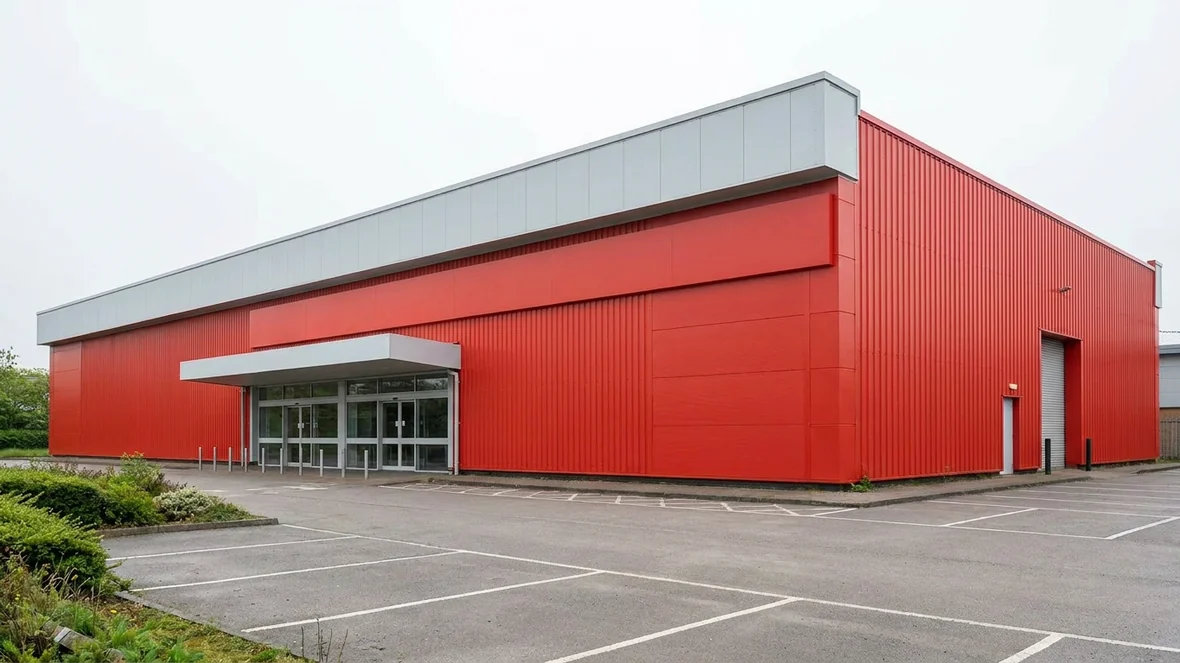
The managing agent of a retail park on the edge of Reading asked us to look at one of the larger units between lettings. The incoming tenant trades in a strong red and wanted the whole building brought over to their identity colour before fit out began. The outgoing signage had already been stripped, which left a tired cream box with a pale ghost line where the fascia lettering used to sit. Rather than reclad the building, the agent chose a full cladding respray in poppy red, completed while the rest of the Berkshire retail park stayed open and trading around us.
The building and the brief: a retail unit near Reading
The unit is a single storey steel portal frame building of the type found on retail parks across Berkshire and the wider South East. The walls are a mix of flat composite panel and micro rib profiled steel cladding, finished from the factory in a cream plastisol coating that had been on the building since it was first clad. A tall parapet hides the roof from the car park, a projecting canopy covers the glazed customer entrance, and a roller shutter serves the rear loading position.
Two decades of UV and weather had done what they always do to plastisol. The surface had chalked, so the colour wiped off on your hand, and the panel joints carried long grime streaks fed by rainwater tracking down from the parapet capping. None of it was structural. The cladding itself was sound, square and dry. That is exactly the situation where our retail park cladding spraying service earns its keep: the building did not need new skin, it needed the skin it had cleaned, repaired and recoated in the tenant’s colour.
Recladding a unit this size means weeks of scaffold, skips full of serviceable steel going to waste and a hole in the retail park’s trading week. A respray took a fraction of the time, kept every panel on the building and gave the tenant the exact colour they asked for. For a managing agent balancing an incoming lease against a live retail park near Reading, that argument makes itself.
What the survey found
Our surveyor walked the building with the agent before we priced the work, checking every elevation, the parapet capping, the sealant joints and the fixings. The survey found what the visual condition suggested: sound panels, a handful of fixings with early corrosion bleed, and sealant at the end of its life around two openings. All of it went into the report with photographs, so the agent could see exactly what the respray covered before anyone lifted a spray gun.
The work, stage by stage
The sequence below follows the same elevation from first wash to finished detail, which is the honest way to show a respray: the building never changes, only its condition does.
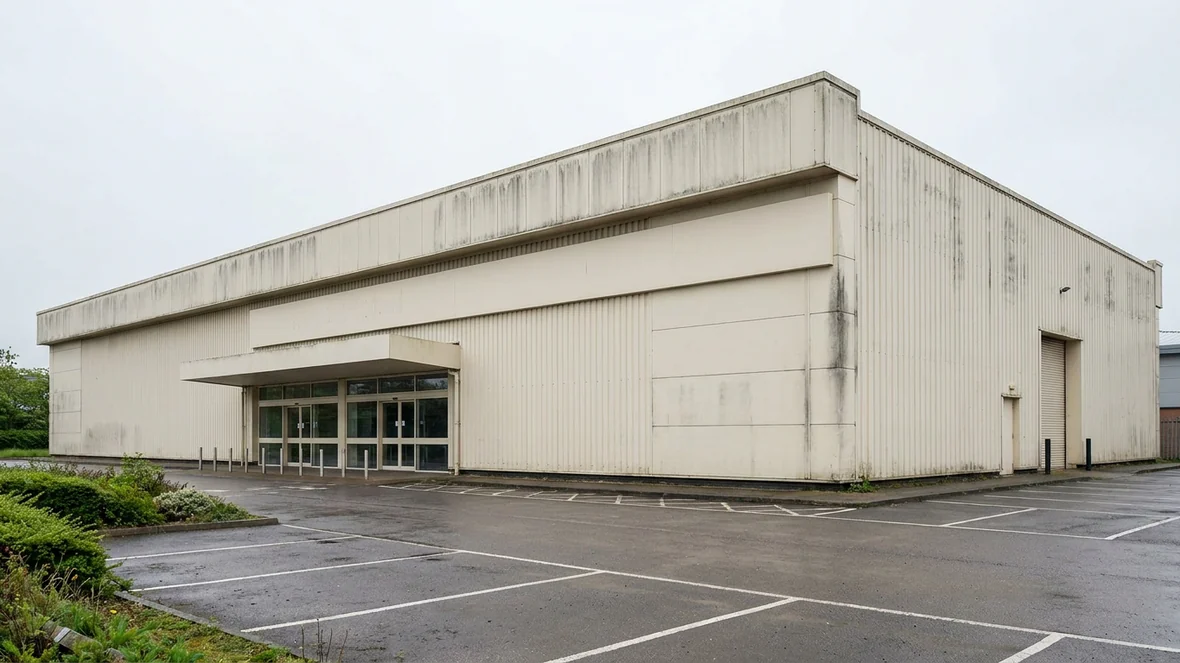
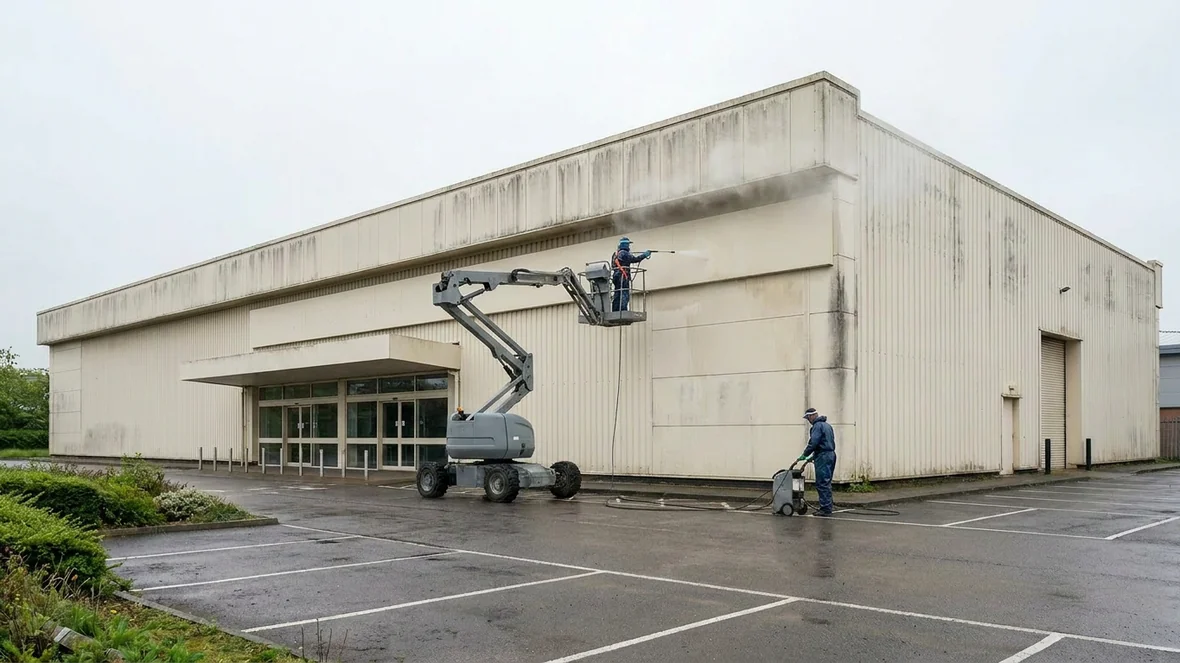
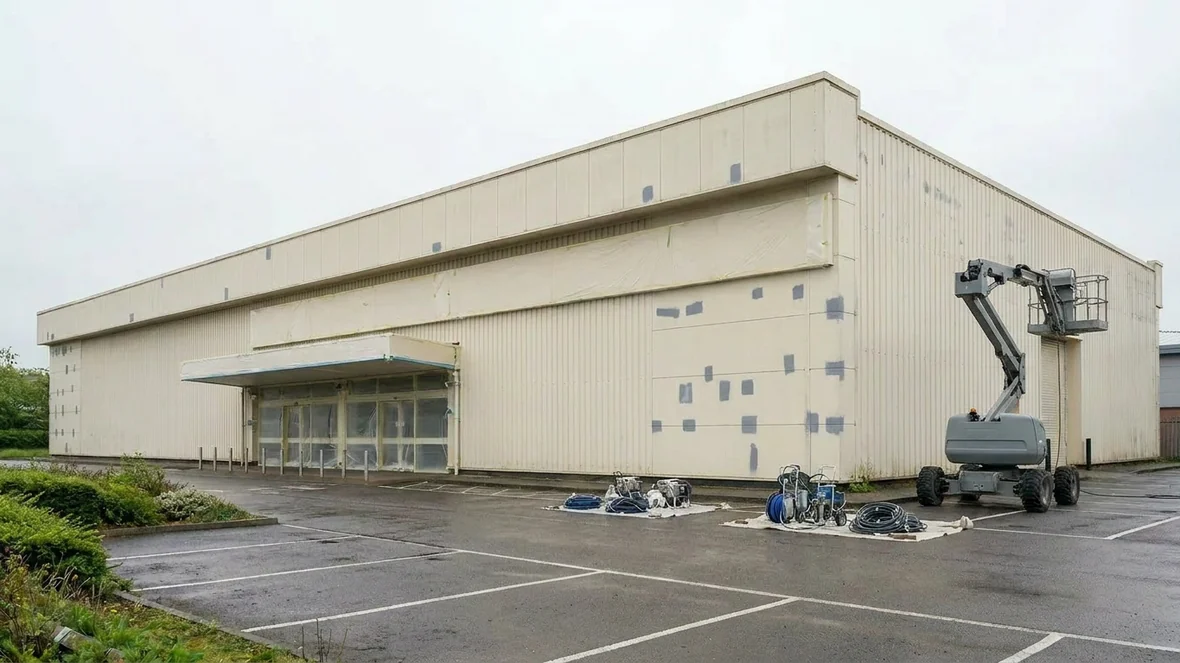
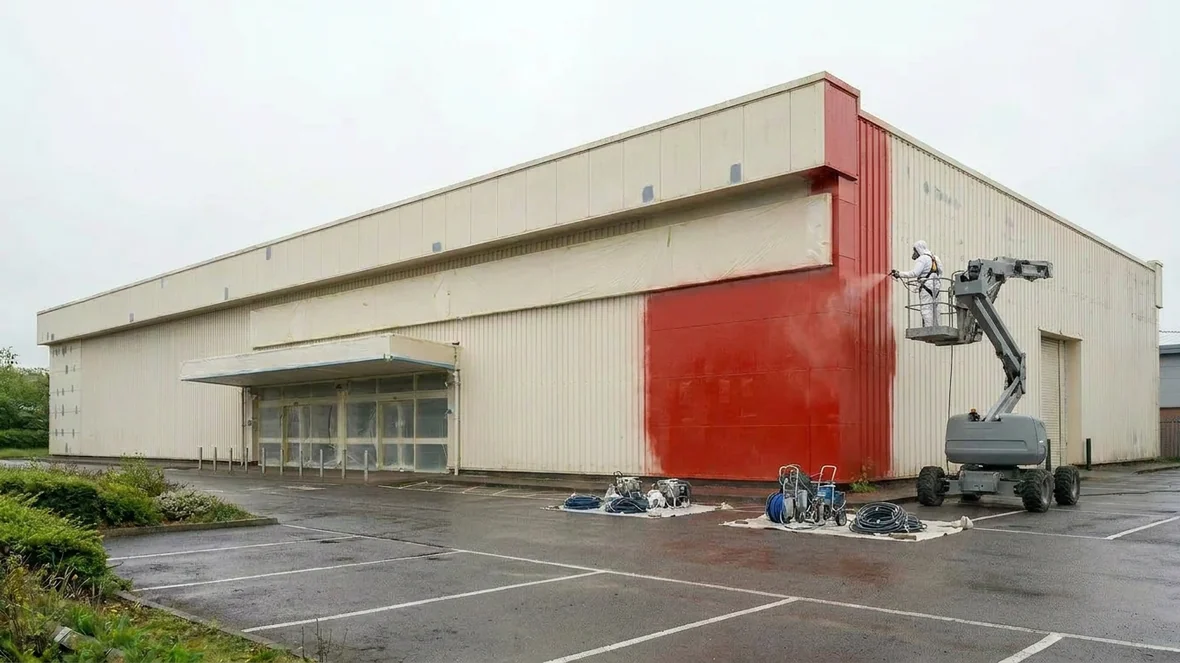


Preparation started with a full wash down. Working from a mobile elevated work platform, the team pressure washed every panel from parapet to plinth, stripping off the chalked pigment, the grime streaks and the traffic film that builds up on any building sitting beside a busy Berkshire junction. Once the elevations were clean and dry we treated the corroded fixings, replaced the failed sealant runs and spot primed every repair. On a respray, the finish is only ever as good as the substrate under it, so this stage gets as many hours as it needs. Rushing it is how coatings fail, and a failed coating on a retail park unit near Reading is a very public failure.
Spraying on a live retail park is mostly a masking exercise. Before any colour went near the building, the glazed entrance, the canopy soffit, the blank fascia band, the personnel door and the roller shutter were all sheeted and taped. The plinth line and the paving in front of the working elevation were protected, and we agreed an exclusion zone around the MEWP with the park’s management so shoppers and staff never walked under the work. The neighbouring units in this part of Berkshire carried on trading throughout: the job moved around the building in planned sections, deliveries to the rear service yard were never blocked for more than a few minutes, and every evening the site was left tidy.
The coating system went on in two stages: an adhesion primer matched to the prepared plastisol, then the pigmented topcoat, spray applied by airless gun in controlled overlapping passes. Poppy red is one of the stronger colours we apply, and strong colours are unforgiving. Any thin pass, any dry edge, any dust in the film shows. Our sprayers work a live wet edge along each elevation, keeping the film thickness consistent from the parapet down to the plinth, so the finished panel reads as one unbroken plane of colour. Cut lines matter just as much: the junctions where red meets the pale grey parapet capping, the canopy steel and the door frames were cut crisp against the masking, which is what separates a professional respray from a painted over building. Weather sat on our side for most of the programme, which in Berkshire is never guaranteed. Where it did not, we stood the sprayers down rather than chase the programme, because coating applied to a damp panel is a defect you pay for twice.
The finished retail unit near Reading
The photographs tell the story better than the words. The same viewpoint that showed a chalked cream box at the start of the job now shows a building in a deep, even poppy red, with the pale capping and canopy reading as crisp trim lines against it. The unit went from the most tired building on the retail park to the most visible unit in this corner of Berkshire in the space of one programme of works, and the incoming tenant took handover with their identity colour already on the walls.
For the managing agent, the value runs past the day of handover. The new coating seals the cut edges and fixing lines that were starting to bleed, sheds water and dirt better than the chalked surface it replaced, and gives the building long term protection against the Berkshire weather that took the original finish down. When the lease turns over again, the substrate underneath will be in better condition than we found it. And up close, the work holds its own inspection: the coated edge at the parapet runs dead straight, the panel joints are clean shadows rather than dirt traps, and the satin sheen sits evenly across the face of every panel. That is what a properly prepared and properly applied coating looks like from a metre away, not just from the far side of the car park.
Cladding respray across Berkshire and the UK
Reading sits at the centre of one of the busiest commercial corridors in the South East, and the retail parks, trade counters and distribution units that line the A33 and the M4 all age the same way this one did. We carry out commercial cladding spraying in Reading and across the rest of Berkshire, with recent enquiries from Wokingham, Bracknell and Newbury following the same pattern: sound buildings, tired coatings, and owners who would rather recoat than reclad.
The same crews cover the wider region, from Basingstoke up to Oxford and along the M4 towards Slough, and our national teams take the identical specification to sites across the UK. If you manage a retail park in Berkshire or anywhere else in the country with a unit that looks the way this one did, the first step costs nothing: book a free site survey and we will inspect the cladding, photograph what we find and report on exactly what a respray would involve.
You can also read how the same process works on a different building type in our case study of an office wall coating project near Milton Keynes.
Project completed in spring 2026.