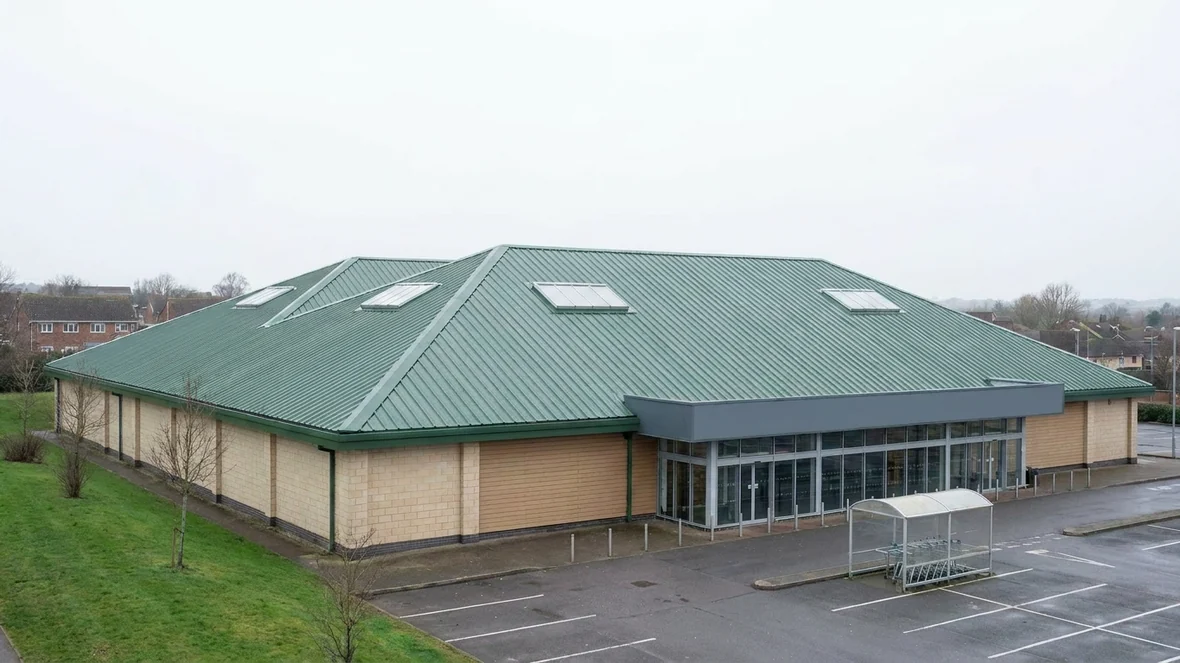
Nobody looks at a supermarket roof until it starts costing money. The store in this project, on the edge of Exeter, had a wide twin span metal roof that customers never see and the facilities team saw far too often: patchy, chalked, streaked with rust at the sheet laps, and flagged in two consecutive condition reports as heading for trouble. The walls below were fine. The trading floor was fine. The roof was the whole problem, and the operator wanted it dealt with without closing the store for a single day. That is the job our commercial roof coating service exists for, and this Devon store is a textbook example of it.
The building and the brief: a supermarket roof near Exeter
The building is a modern single storey supermarket of the type on the edge of every large town in Devon: steel portal frame, buff blockwork and timber look cladding to the walls, full height glazing along the entrance, and a wide, shallow pitch hipped profiled steel roof carrying rows of rooflights, with a box gutter running the length of the eaves. It is the standard construction for large format food retail, chosen for span and speed, and its one long term weakness is the one this store had reached: the factory coating on the profiled steel gives out before the steel does, and the roof starts writing itself into condition reports.
The brief had one requirement worth flagging early: the store backs onto open Devon countryside, and the operator’s estates team wanted the recoated roof to sit quietly in that landscape rather than flash pale grey at every hill around Exeter. They chose moorland green from our range, a deep natural green that planning officers tend to smile on, and one we apply on rural commercial and agricultural buildings across the South West. You can see it with the rest of the palette on our coating colours page.
What the survey found
The roof sheets were structurally sound but the factory finish on them was gone. The coating had chalked and eroded back to bare zinc in patches, rust bloom was tracking out of the fixings, and cut edge corrosion had started along the sheet laps, which is the point in a metal roof’s life where a coating decision becomes urgent. Caught now, cut edge corrosion is treated and sealed for the cost of preparation and paint. Left alone, it eats the sheet ends until the only options are sheet replacement or a new roof over a trading store, with all the disruption and cost that carries.
The survey mapped the roof in detail before the price was agreed, walking every slope, photographing the laps, probing the worst of the corrosion and checking the gutters, rooflights and penetrations. The report gave the operator a sheet by sheet picture of what was sound, what needed treatment and what the coating system would be asked to do, shaped throughout by what sits underneath: a food retail environment that cannot take dust, water ingress or interruption.
The work, stage by stage
The sequence below follows the roof from the state the condition reports kept flagging to the finished moorland green.
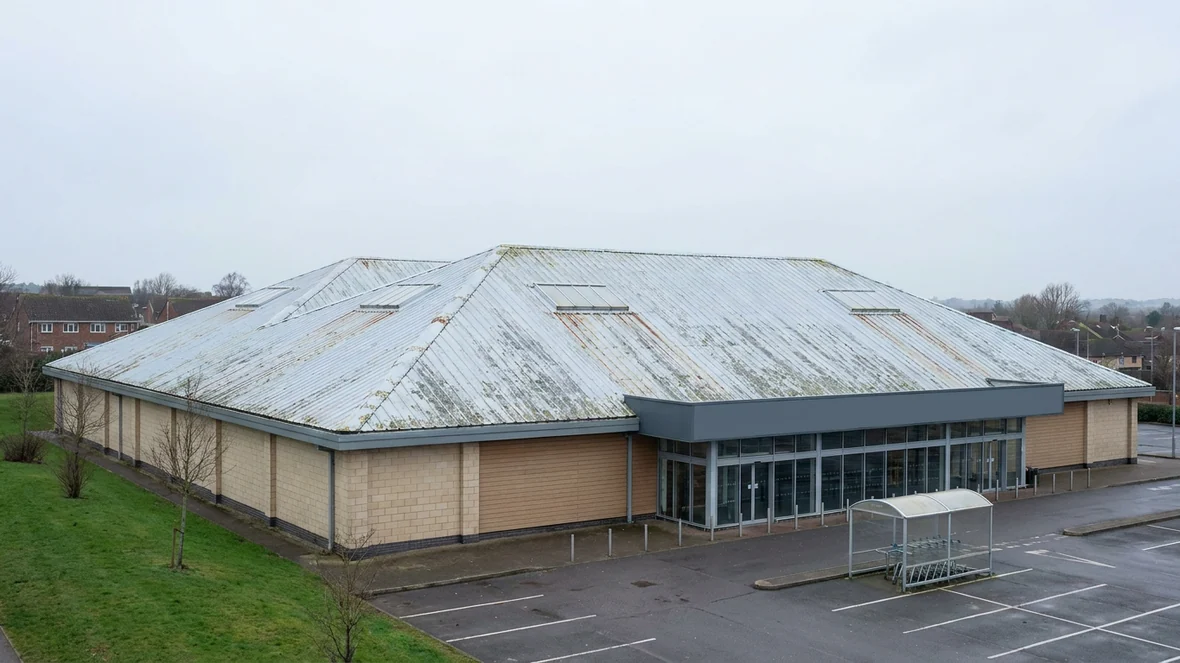
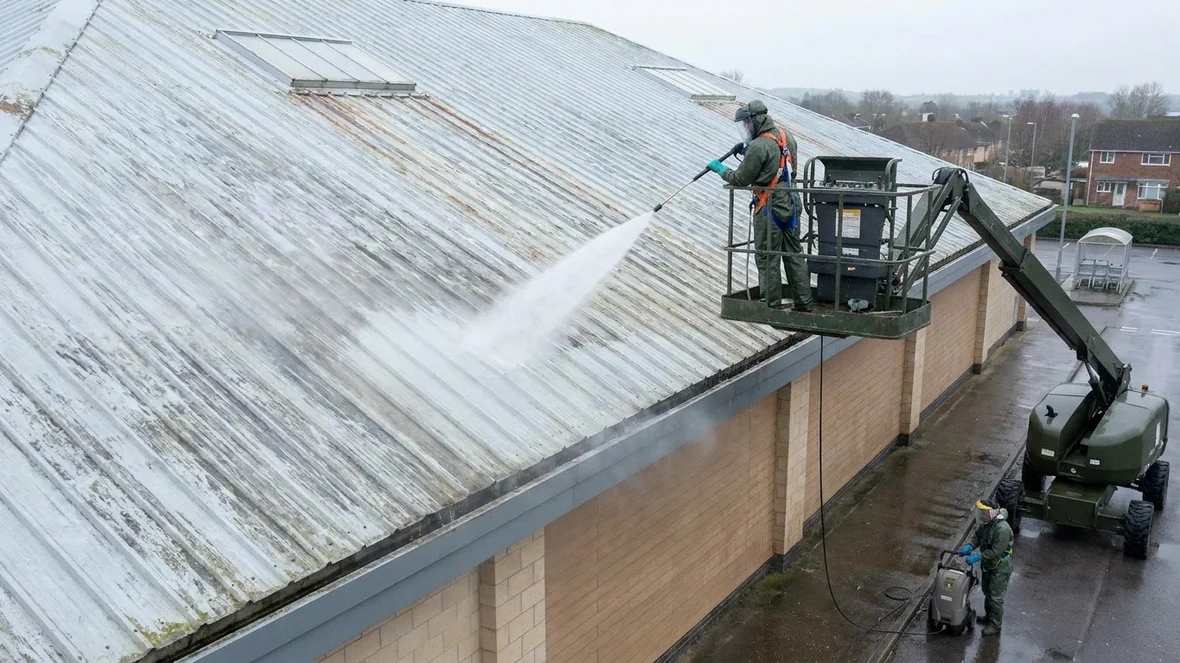
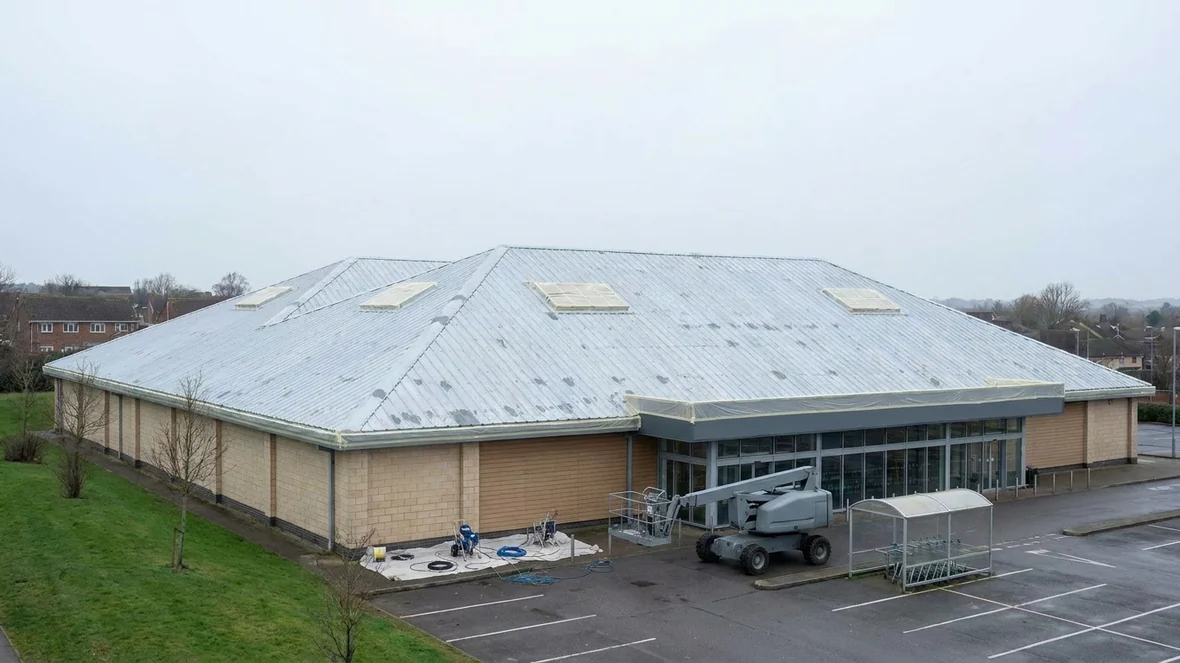
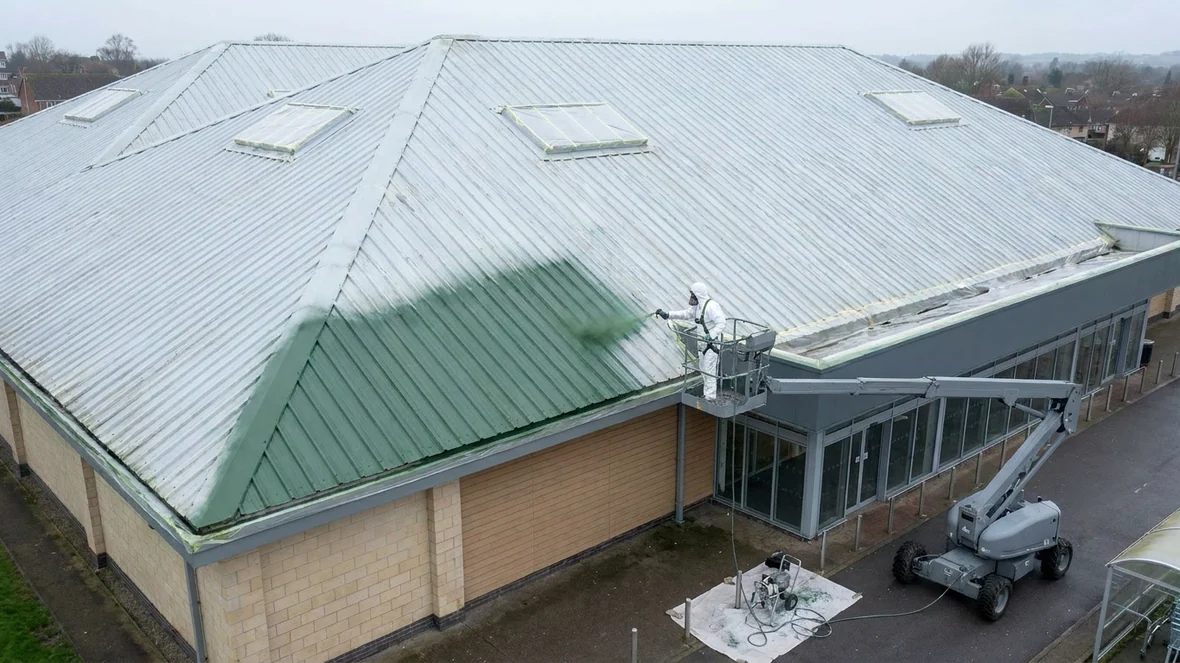

Preparation started with a full pressure wash of the whole roof, working from access equipment at the eaves and moving methodically across the roof, stripping off chalked coating, moss and grime. Wash water was managed and the gutters cleared as we went, because sending a tide of dirty water through a supermarket’s downpipes during trading hours is the kind of mistake you only make once. Then came the treatment stage that decides whether a roof coating lasts: every rusted fixing was treated and sealed, corroded lap edges were wire brushed back to sound metal and primed with a rust inhibiting primer, and the worst runs got a reinforcing lap seal before any colour went near them. On this roof that meant hundreds of individual repairs, all invisible in the finished photographs and all doing more for the roof’s future than the topcoat that covers them.
A supermarket roof carries more glass than people expect. The rooflight runs that light the aisles below had to stay clear, so every run was masked full length with film and taped along the trims, along with the box gutters, the roof edge flashings and the top of the entrance fascia. At ground level the work was planned around the store’s day: deliveries kept their yard slots, the car park kept its spaces outside a small secured zone under the access positions, and trolleys kept moving. The store traded every hour of the programme, which was the operator’s only non negotiable and the measure we planned the whole job against, in Devon as on every retail site we coat.
The coating system was built for metal roofs in coastal counties like Devon: a rust inhibiting primer across the treated areas, then a high build elastomeric topcoat in moorland green, spray applied by airless gun in two coats. The elastomeric film does three jobs at once on a roof like this. It seals the treated cut edges and fixings against Devon’s salt carrying weather, it bridges the fine movement that a wide roof like this makes through every heat cycle, and it puts a thick, waterproof, UV stable colour over sheets that had none of those properties left. Application ran slope by slope, from the eaves to the ridge with a live wet edge, cutting clean against the masked rooflights and gutter trims, and spraying stopped whenever the wind lifted past our limits, because overspray on a car park full of customer cars is not a risk anyone prices cheaply.
The finished supermarket roof
From the same elevated viewpoint as the first photograph, the roof reads as one unbroken sweep of deep moorland green, the rooflight runs sitting in it as clean clear lines and the buff walls below completely untouched. Against the Devon fields behind the store, the building now recedes into the landscape the way the estates team wanted, and from the hills around Exeter the largest building on its road went from an eyesore to almost invisible.
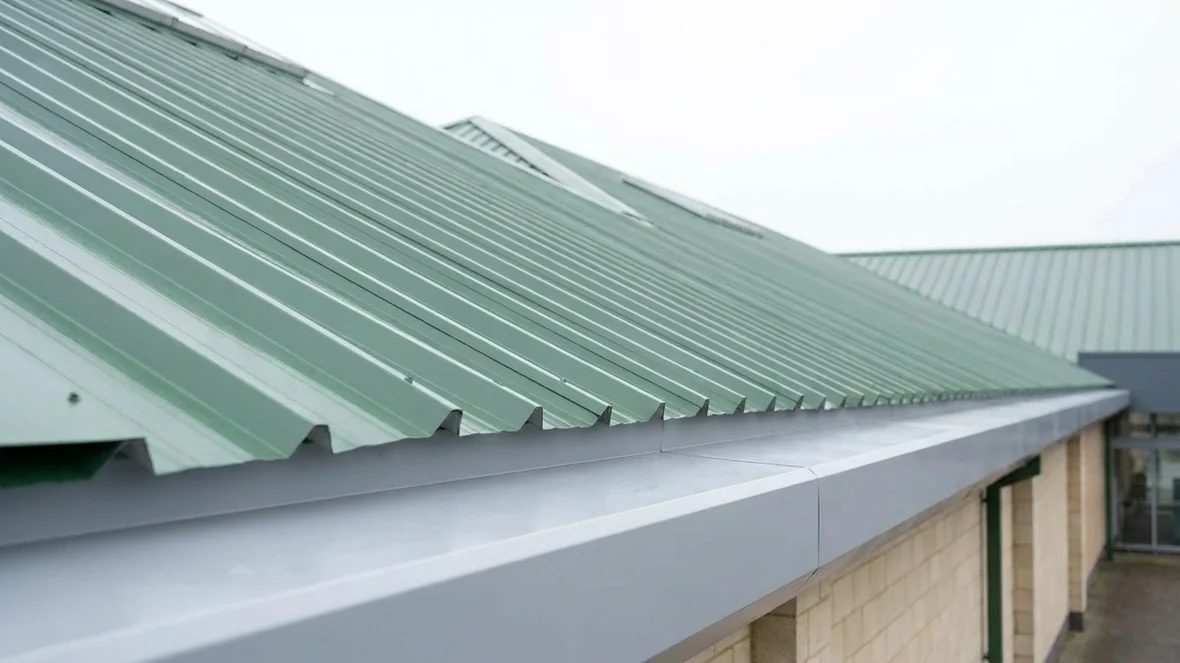
The detail at the eaves shows what the whole system was for: the coating turns the corrugation ends, the former rust staining at the laps is sealed under an even film, and the box gutter below runs clean and free. The facilities team traded a roof that appeared in every condition report for one that will sit quietly in the file for a long time, and they did it without losing an hour of trading. The store’s customers never knew we were there, which on this kind of project is the highest compliment available. The rooflights came out of the programme cleaner than we found them, the eaves gutter runs free, and the next condition survey will read the way the facilities team wants it to read.
Commercial roof coating across Devon and the UK
Devon’s commercial roofs work hard. Salt air comes in off two coasts, the weather arrives sideways for half the year, and the retail parks and stores around Exeter, Newton Abbot, Tiverton and Torquay all carry the same profiled steel roofs quietly rusting at the laps. We provide commercial roof coating in Exeter and across Devon, and the same crews run west to Plymouth and east into Somerset around Taunton on the same specification.
Nationally, our teams coat supermarket, retail and distribution roofs across the UK with the system used on this store. If a condition report has started mentioning your roof, the economics are simple: coating a sound roof now is a fraction of the cost and disruption of replacing a failed one later. Book a free site survey and we will walk the roof, photograph every lap and fixing, and give you an honest written picture of where it stands. For the same approach on walls rather than roofs, see our case study of a car showroom cladding respray near Norwich.
Project completed in late spring 2026.