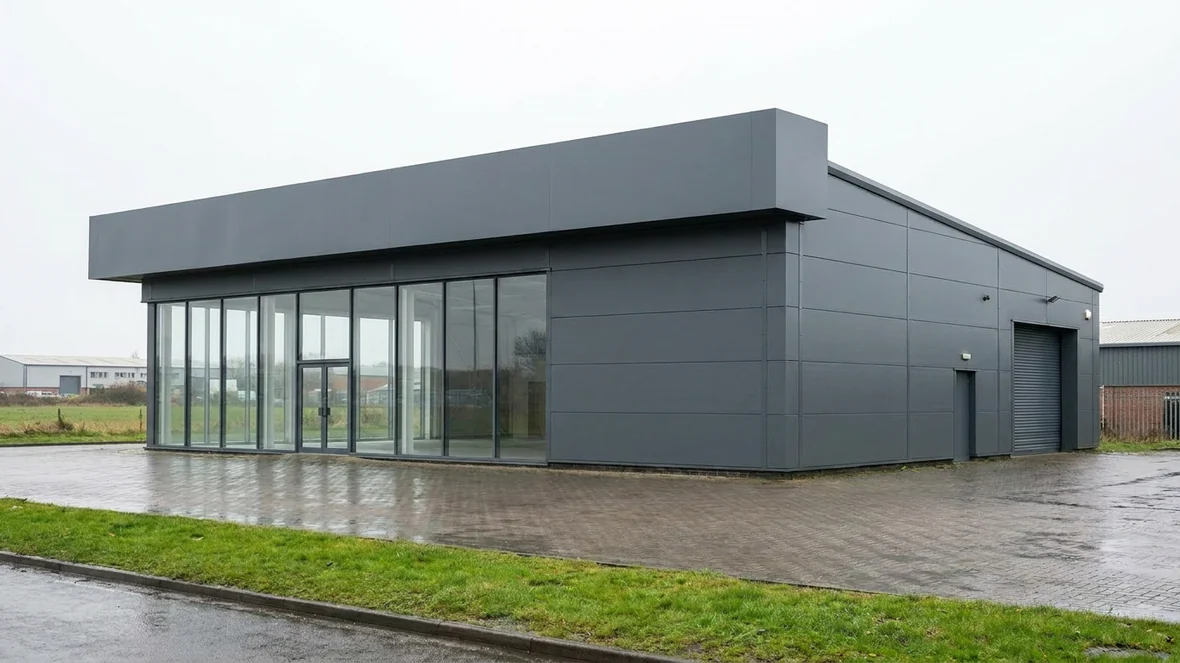
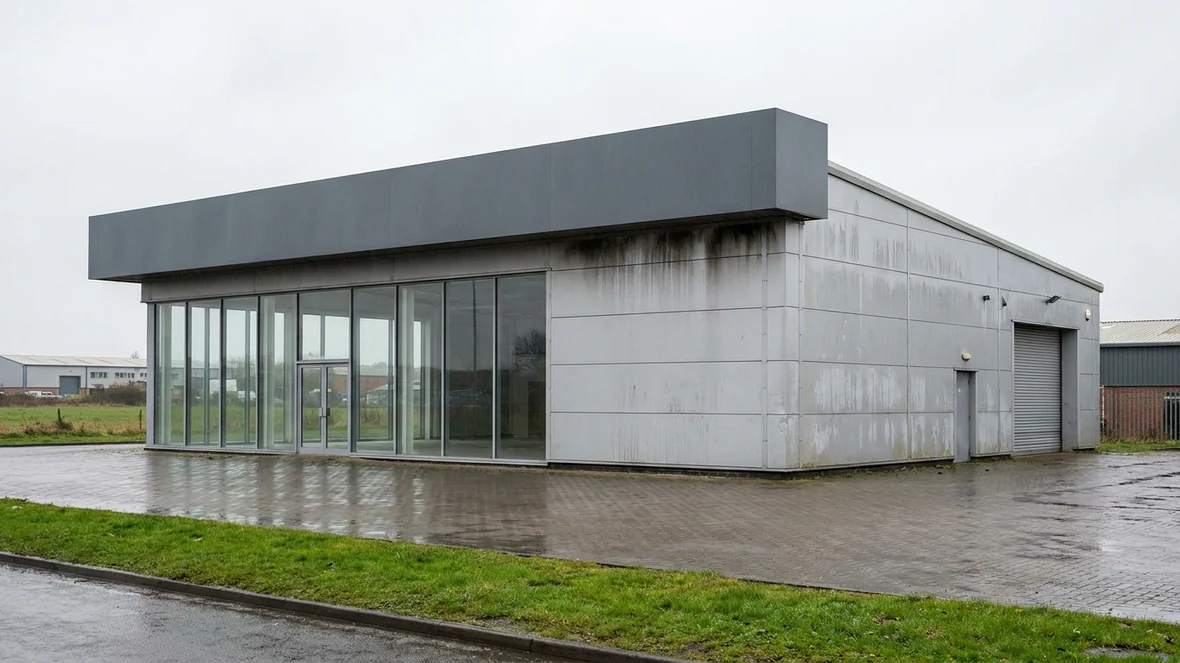
A car showroom has one job before anyone walks through the door: make the stock on the forecourt look worth the money. The dealership in this project, on a main road on the outskirts of Norwich, had the opposite problem. The building’s silver grey composite panels had faded and chalked, dirt was bleeding from every panel joint, and the deep fascia over the glass carried the stains of a leaking box gutter behind it. The cars were new. The building said otherwise. Ahead of a franchise refresh, the operator asked us to respray the cladding in anthracite grey and reline the failing gutter in the same programme of works.
The building and the brief: a car showroom near Norwich
The showroom is a modern single storey building of a type every dealership operator in Norfolk will recognise: full height glazing across the front under a deep projecting fascia, smooth flat composite cladding panels to the return and rear elevations, a shallow mono pitch roof falling away behind, and a workshop entrance with a roller shutter on the side elevation. Glass sells the cars, the fascia frames the glass, and the panels do the quiet work of keeping the weather out of the workshop and offices behind. It is a construction built for image, which is exactly why it shows its age so publicly: a farmer can live with a faded barn, but a dealership cannot sell aspiration from a chalked box.
The brief matched the franchise’s new look: anthracite grey, RAL 7016, across all the cladding and the fascia band. Anthracite has become the default colour of the modern motor trade for a reason, in Norfolk and everywhere else. It reads as architectural rather than industrial, it flatters glass and aluminium, and it hides road film far better than the pale silver it replaced. The work sits inside our commercial cladding spraying service, with the gutter lining running as a second workstream on the same access.
What the survey found
Composite panel is a good material with one weakness: its factory finish fades long before the panel fails. This building’s silver grey had gone milky with chalking, and because the panels are perfectly smooth, every streak and shadow showed. The box gutter behind the fascia had a harder problem. Years of standing water had found the joints, and the resulting staining down the fascia face was the most visible defect on the whole building. Our survey put both issues in one report: panels sound but tired, gutter sound in structure but failed in its lining, with photographs of every joint so the operator could see the case for lining rather than replacement. Doing the gutter and the cladding from the same access saved the operator the cost of standing the platform twice, which is exactly the kind of sequencing a survey is supposed to find.
The work, stage by stage
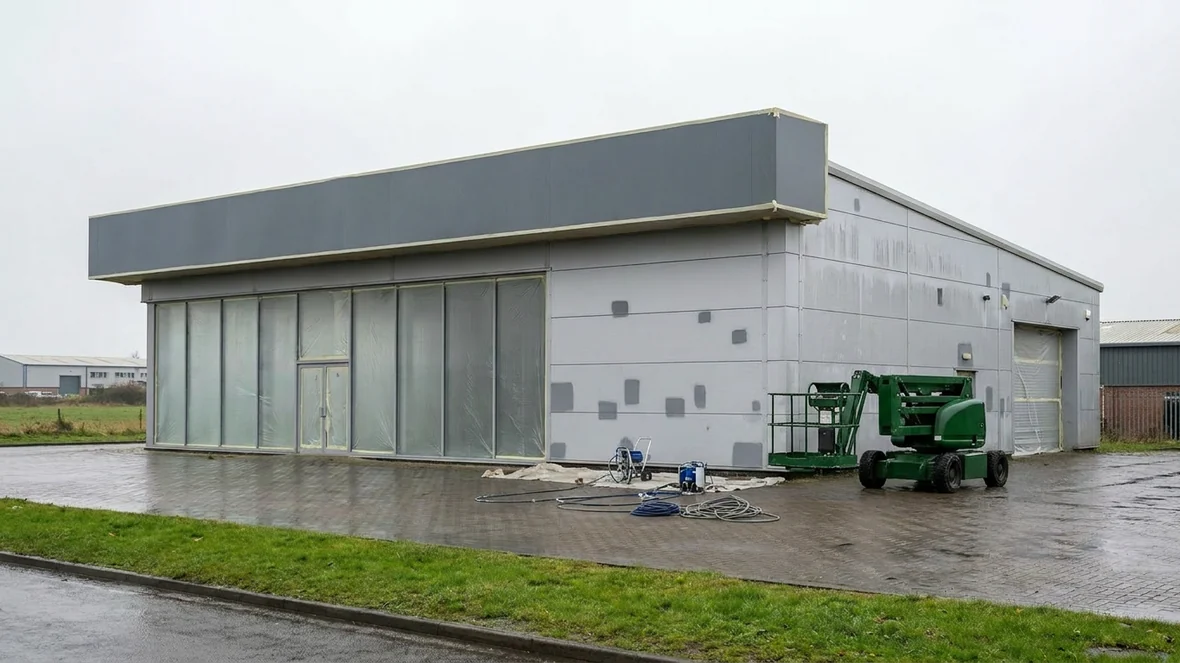
The photographs below follow the building through the programme, planned backwards from the franchise deadline with the general manager before anything else was booked.
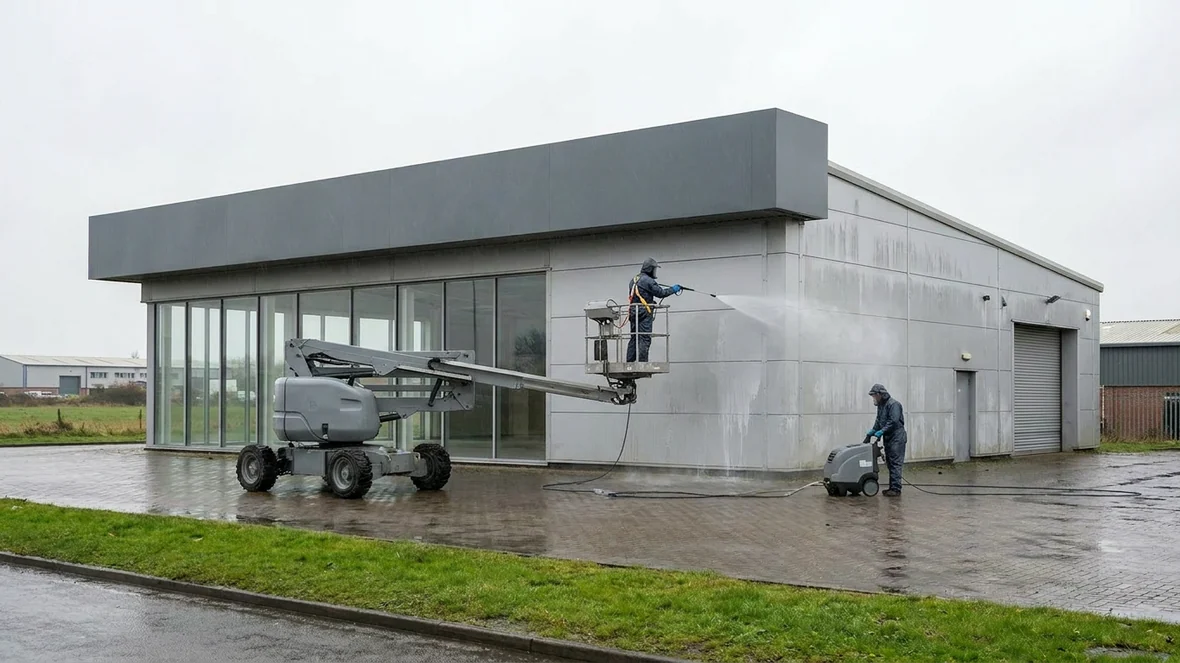
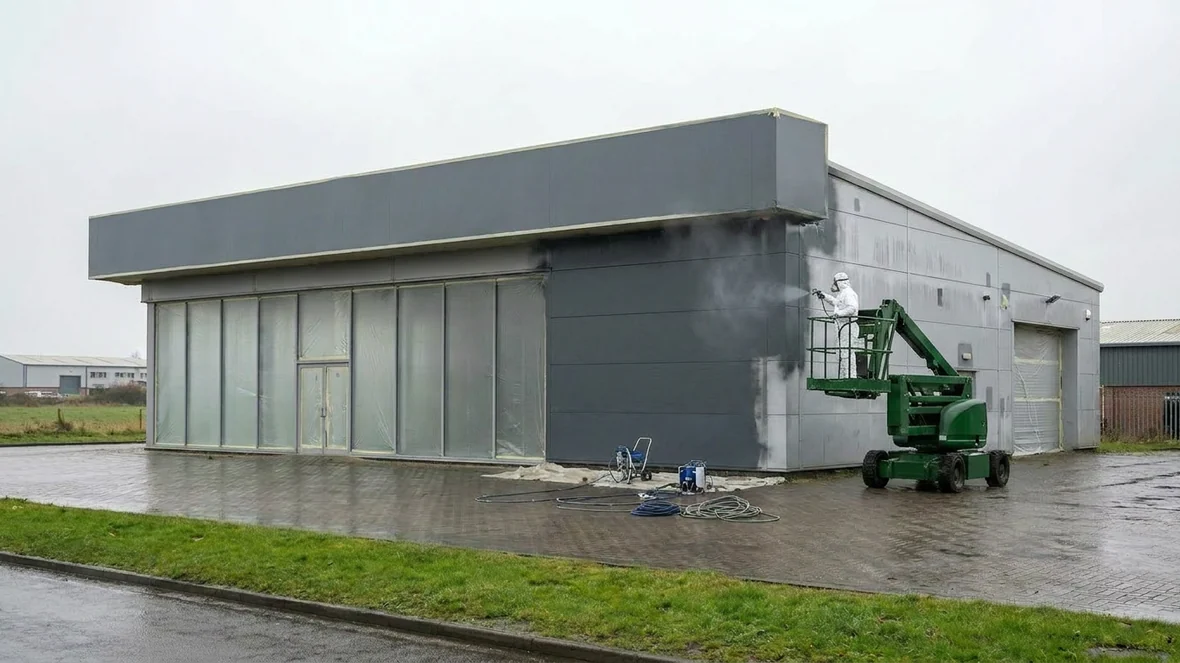

The display stock came off the forecourt into the compound for the duration, which gave us a clean, empty apron to work from and removed the single biggest risk on any showroom respray: overspray, or even the suspicion of it, near customer and stock vehicles. Preparation then followed the sequence that makes coatings last. Every elevation was pressure washed from a mobile elevated platform, taking the chalked pigment and years of Norfolk road film off the panels. The panel joints were washed out individually, corroding fixings were treated and spot primed, and two damaged panel corners at the workshop entrance, the scars of a decade of deliveries, were filled and faired so the new colour would not shadow them. The box gutter got its own preparation: cleared, washed, dried and abraded back to a sound surface along its full run, with the failed joints raked out ready for the lining system.
Most buildings we spray have windows. A showroom is a window. The full height glazing was masked floor to fascia in protective film, taped crisp along every frame line, with the entrance doors, the roller shutter and the personnel door following. The showroom stayed open throughout. Customers bought cars all week behind film covered glass, which sounds strange and worked fine: the masking passes daylight, the doors stayed clear on a protected route, and the noisiest work was sequenced away from launch and delivery days. In the Norfolk motor trade as anywhere, the building cannot close just because it is being improved.
The coating system ran as an adhesion primer keyed to the prepared factory finish, then two spray applied coats of the anthracite grey topcoat. Dark colours are the hardest test of an applicator. On a smooth panel, anthracite shows every thin pass, every touch of dry spray and every speck of dust in the film, and the low Norfolk light rakes across a showroom elevation all afternoon looking for them. Our sprayers work a continuous wet edge with overlapping passes at a fixed gun distance, which is the unglamorous discipline that produces the flat, even, almost machined finish the colour demands. The fascia band was coated in the same anthracite, turning the most stained element of the old building into the strongest line of the new one. Behind it, the gutter lining went in while the coatings cured: a cold applied liquid membrane laid across the prepared gutter in a continuous run, sealing the joints that had been feeding the stains down the fascia. One access programme, two systems, and both finished before the masking came off the glass.
The finished car showroom
The finished building does what a showroom should: it gets out of the way of the cars while making everything around them look sharper. The anthracite panels and fascia read as one continuous dark frame around the glass, the staining is gone from the fascia face, and the whole elevation carries an even satin sheen from end to end. When the display stock rolled back onto the forecourt, the same cars looked more expensive than they had the week before, which the sales team noticed before anyone had unpacked the new franchise signage. The new signage itself went onto a coated fascia rather than a stained one, so the franchise identity landed on a surface that matches the standard the brand expects from its network.
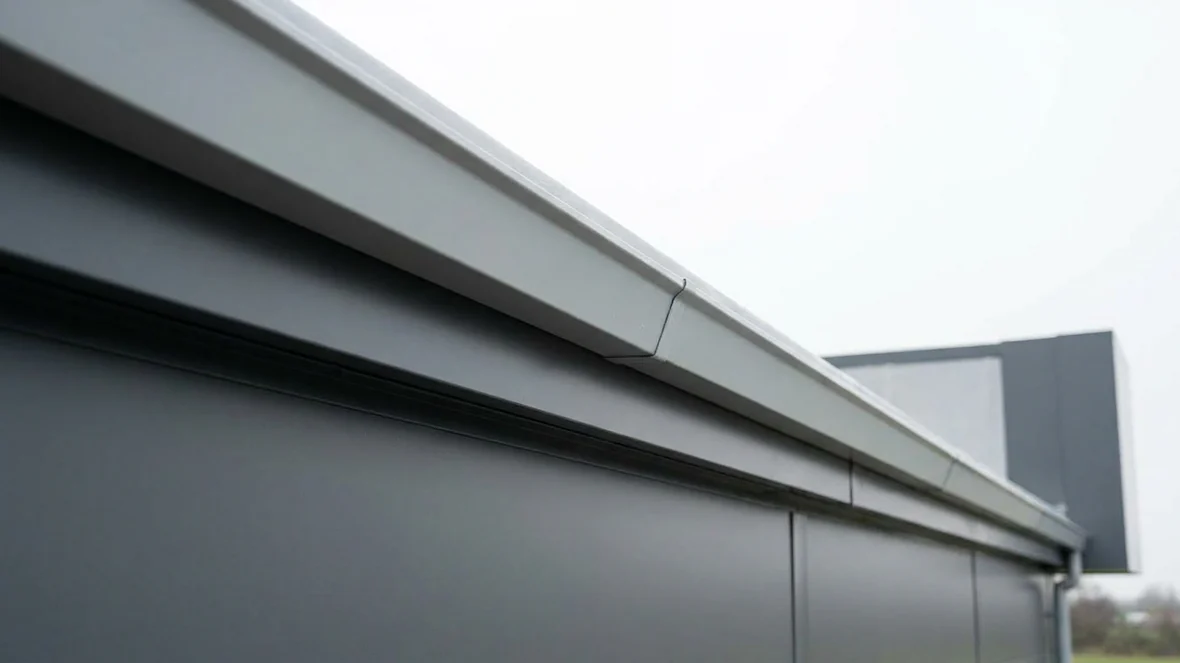
The detail photograph shows the part of the job the forecourt never sees: the new lining membrane running smooth and continuous through the box gutter, turned down over the treated joints, above a dead straight coated edge on the panels below. The gutter now sheds Norfolk rain instead of storing it, the panels are sealed against the chalking that dulled them, and the operator has a building that will hold this standard through Norfolk’s winters and the life of the franchise agreement with nothing more than routine washing.
Cladding respray across Norfolk and the UK
Norwich anchors a motor trade corridor that runs the length of the A47, and the showrooms, dealerships and trade units along it all share this building’s construction and this building’s ageing. We carry out cladding spraying in Norwich and across Norfolk, with the same teams covering Great Yarmouth, King’s Lynn, Dereham and Thetford, and reaching over the county line to Ipswich and the rest of East Anglia on the same specification.
Our national crews take the identical system to commercial buildings across the UK. If your showroom, dealership or trade counter in Norfolk has started underselling its own stock, book a free site survey: we will inspect the panels, check the gutters while we are there, and report with photographs on what a respray would involve. To see the same disciplines applied to a coastal public building, read our case study of a leisure centre wall coating near Blackpool.
Project completed in early summer 2026.