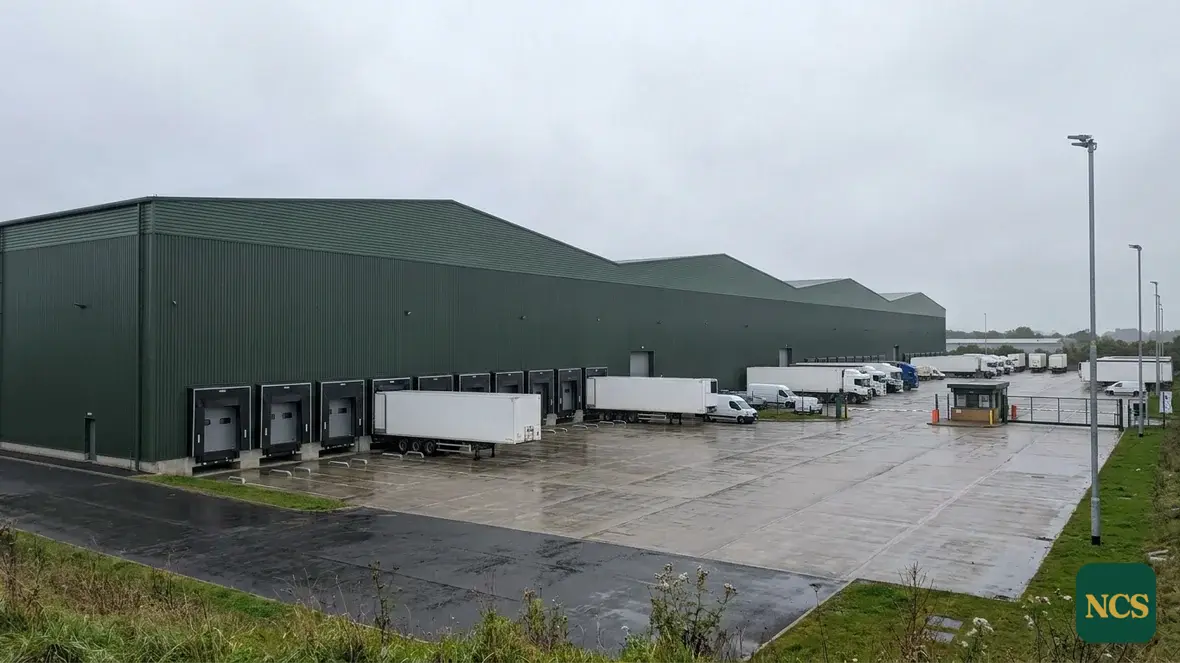
That rust line creeping along the gutter edge of your profiled steel roof isn’t just a bit of discolouration you can ignore. It’s the first sign of cut edge corrosion. Around Newark-on-Trent, on the industrial units and Trent-side warehouses, we tend to see it hitting roofs that have otherwise behaved themselves for twenty years or more. Catch it when it’s just staining, and it’s a manageable repair. Leave it until water’s coming through the laps, and the bill changes shape entirely.
The defect, in plain terms
Coated steel sheets turn up from the mill protected on both faces. But they’re cut to length on site or at the rollformer, and that cut leaves a thin band of bare steel along each end. On the finished roof, those bare edges sit at the sheet ends, the side laps, and the gutter line. Those are precisely the spots where rainwater pools and dries slowest. The exposed steel rusts, and that rust then works its way back underneath the factory coating, lifting and peeling it from the edge inward.
Why a small rust line refuses to stay small
Cut edge corrosion spreads because moisture gets drawn into the lap by capillary action and then can’t escape. The corrosion front advances back from the edge, the coating delaminates ahead of it, and the steel quietly thins. The mix of older market-town stock and newer distribution sheds around Newark sees the same accelerants we find across the East Midlands: shallow roof pitches that hold water, gutters clogged with debris pressing damp against the sheet ends, and freeze-thaw cycles prising at any coating that’s already started to lift.
The case for treating it now
Treat it early and the work is contained. We wire-clean the affected edges back to sound steel, prime them with a corrosion inhibitor, and seal them with a flexible edge coating along the laps and gutter runs. Your building stays in use, the existing sheets keep their remaining service life, and we set up access once. Treat it late, and that same roof needs sheets stripped and replaced, with all the disruption to whatever sits beneath. That gap between a sealed edge and a torn-up roof is the entire argument for acting while the corrosion is confined to the edges. Worth a look this week:
- Orange or brown staining along the gutter edge or sheet ends
- Coating bubbling, lifting or peeling where sheets overlap
- Damp marks inside along the fixing lines after heavy rain
- Gutters holding standing water or filled with rust flakes
- Daylight visible at sheet ends when you look up from inside
Our repair crews cover Newark-on-Trent and Nottinghamshire for cut edge corrosion, failed laps and fixings, the faults that let water in first.
The cases where we will not coat
We’d rather lose the job than sell you the wrong fix. If your sheets have already perforated, if corrosion has driven deep into the laps over large areas, or if the factory coating is failing across the whole sheet face and not just the edges, an edge treatment is money spent on steel that’s past saving. In Newark-on-Trent, as anywhere else, that means an honest conversation about replacement or over-roofing. We’ll tell you that after the survey, rather than coating a roof that can’t hold.

Survey first, scope second
Every job opens with a proper roof survey: laps, edges, gutters, fixings and the coating condition, all photographed and reported so you see exactly what we saw. Where the factory finish is chalking and tired across the whole roof, it often makes sense to bring cut edge treatment and a full roof coating together in one visit. You’ll share one set of access costs and be left with one finished roof. We’re based in the South East and work across the UK. Newark-on-Trent and the wider Nottinghamshire area are comfortably inside our normal range. Send us the building details and we’ll arrange a date.
Recently — July 2026
We survey before we recommend anything, and the recommendation goes in writing, including the times the honest answer is to repair or replace rather than coat.
Long daylight and warm, dry days are when a coating cures and bonds best, so summer is a sensible time to get the work booked in.