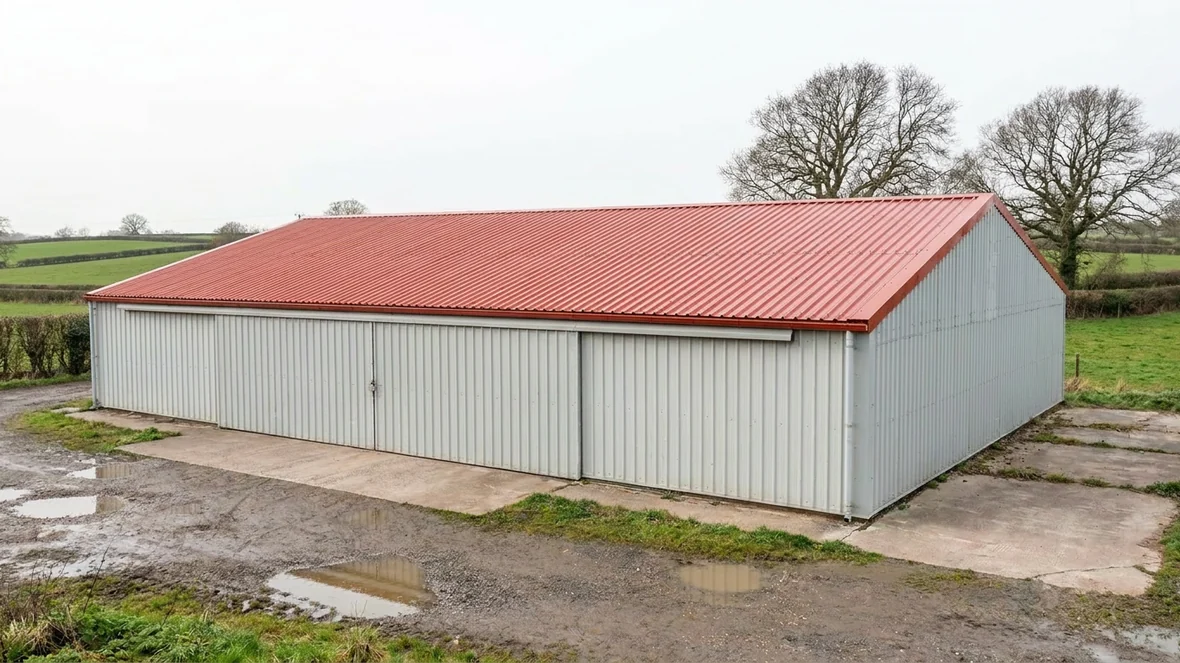
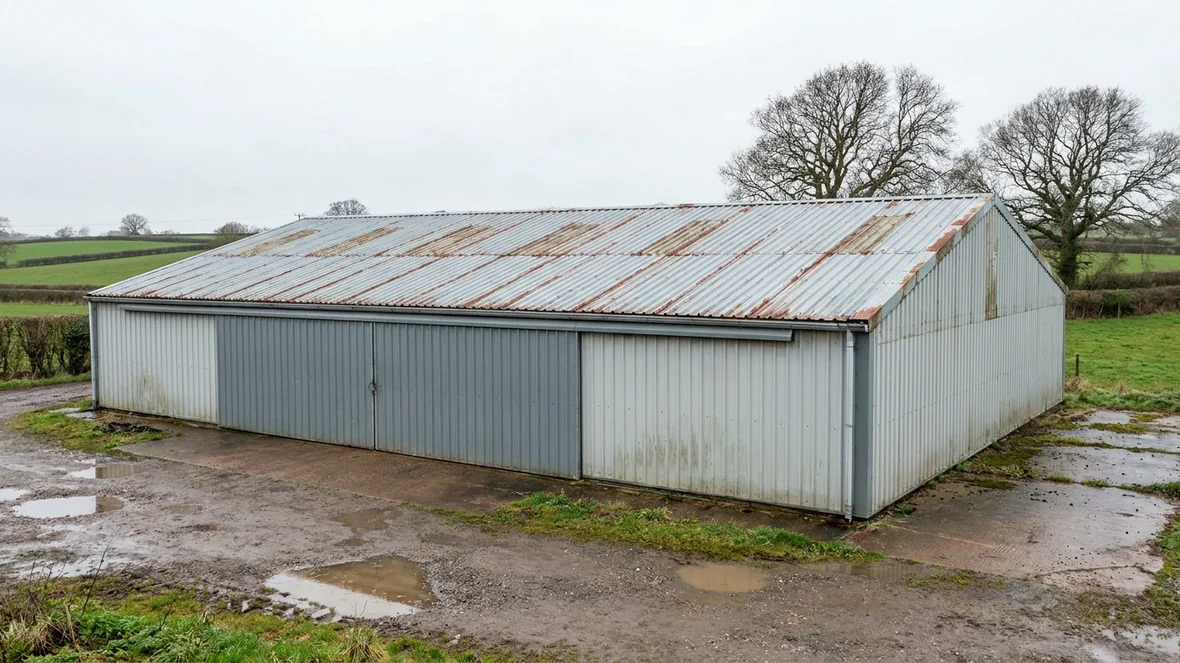
From the yard, this machinery store near Hereford looked like a building with a rash. Thin red brown lines ran across the roof in neat rows, tracking every sheet end and the full length of the eaves, with rust staining bleeding a little way down the slope from each one. The farmer, whose combine, drill, sprayer and loader all live under this roof through the Herefordshire winter, read it the way most people do: the roof is rusting, it probably needs replacing. It did not. What his store had was cut edge corrosion, the most common and most fixable disease of profiled steel roofing, and catching it at the lines-on-the-roof stage is precisely what saves a roof from the skip. Corrosion repairs first, then roof painting over the top, and the same sheets carry on.
Cut edge corrosion on a Herefordshire machinery store
The building is a wide steel portal frame store of the kind every serious arable and fruit holding in Herefordshire owns: a shallow pitched profiled steel roof, pale grey cladding, and a run of tall sliding doors across the front so the biggest kit can come and go. It stands on a rise with hedges and old oaks behind it, in the kind of rolling Herefordshire country where a red roof looks like it grew there, and it does one job all year round, which is keeping a very expensive fleet of machinery out of the weather.
Cut edge corrosion happens because a coated steel sheet is only fully protected where the factory finish is unbroken. Wherever a sheet is cut to length, at the end laps where sheets overlap and at the eaves where they meet the gutter, the raw steel core is exposed in a thin line. Water sits in exactly those overlaps by design, the protective zinc sacrifices itself first, and then the exposed edge starts to rust, creeping back under the coating as it goes. It shows up as tidy horizontal lines because the laps are tidy horizontal lines, and it is usually worst on the weather side, which in this part of Herefordshire means the slope that faces the prevailing south westerlies. Left alone it delaminates the finish around every lap and eventually eats into the sheet ends; treated in time, the sheets are perfectly good and the roof carries on for the long term.
This roof was firmly in the treatable window. The survey found active corrosion along the end laps and the eaves edge, chalking across the whole faded grey surface, and nothing structural anywhere. The plan: wash, treat every cut edge, then coat the whole roof, and since the whole roof was being painted anyway, the farm made the choice we quietly hoped for and picked Poppy Red, the classic strong red of British farm roofs. In a county of red soil, red cattle and red brick, it belongs.
What the survey settled on the Herefordshire farm
The store stayed full for the whole job, which is the first thing worth saying about how work like this is planned. Nothing needed to come out from under the roof: the sliding doors stayed shut, the machinery stayed dry, and all the access came from outside via the MEWP. For a farmer, that is the practical difference between coating and recladding in one sentence. Recladding this store would have meant finding winter housing for a fleet of machinery in the middle of Herefordshire with the maize still to drill. Coating meant the kit never moved.
It is worth being honest about why jobs like this get left. A machinery store is nobody’s favourite building; it does not house stock, it does not store a crop, and in a busy Herefordshire season it only gets looked at when something on the drill needs a spanner. Rust lines on its roof feel like a next-year problem for year after year. The economics say otherwise. Treating cut edge corrosion while it is still a line is a maintenance job; treating it after it has eaten the sheet ends is a re-roofing project with a machinery fleet to rehouse. The gap between those two bills is the largest sum of money most farm buildings will ever save their owner by being looked at in time.
The work, stage by stage
The sequence below follows the same view of the machinery store from survey to handover, from rust lined grey sheets to a finished Poppy Red roof.
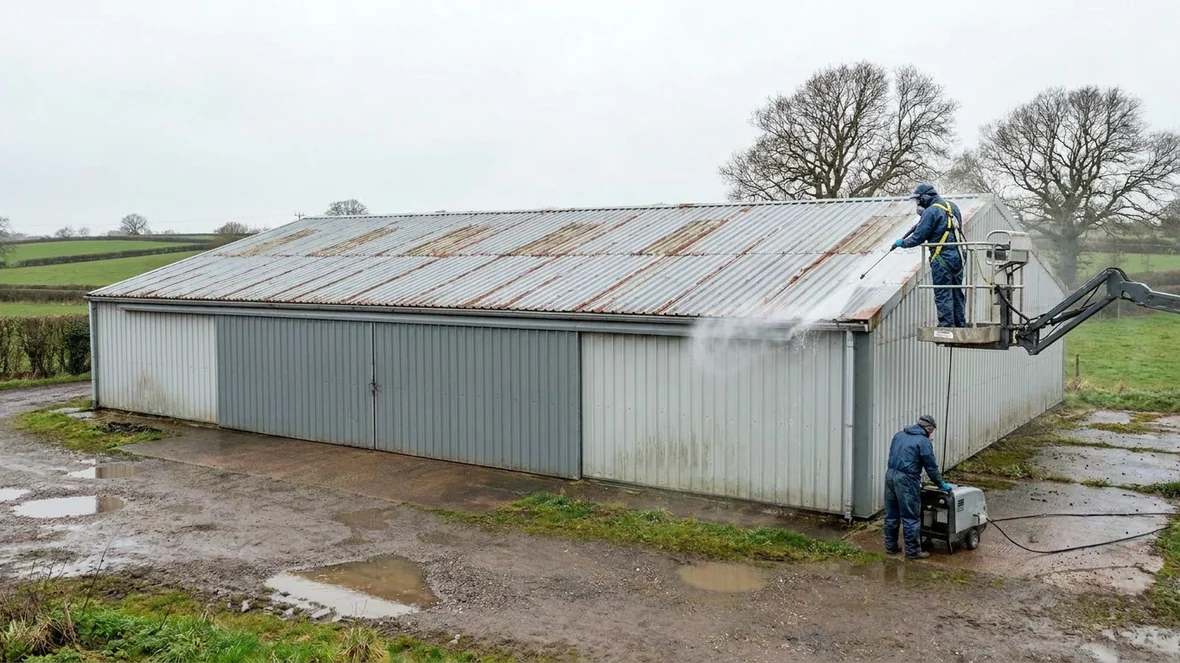
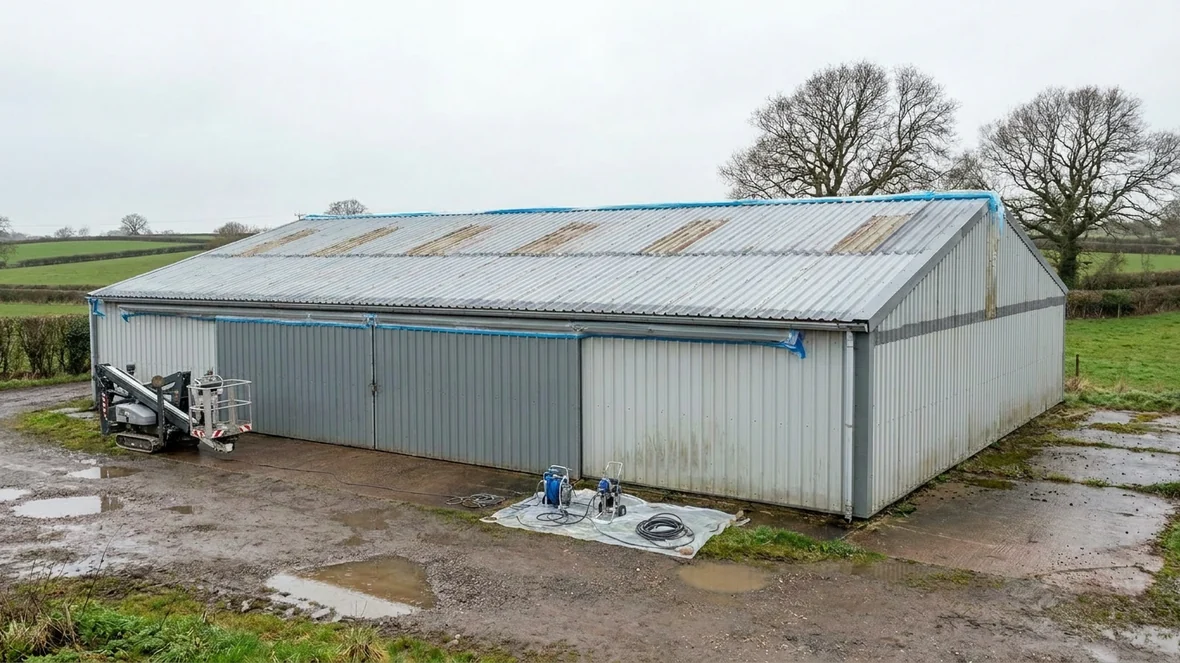
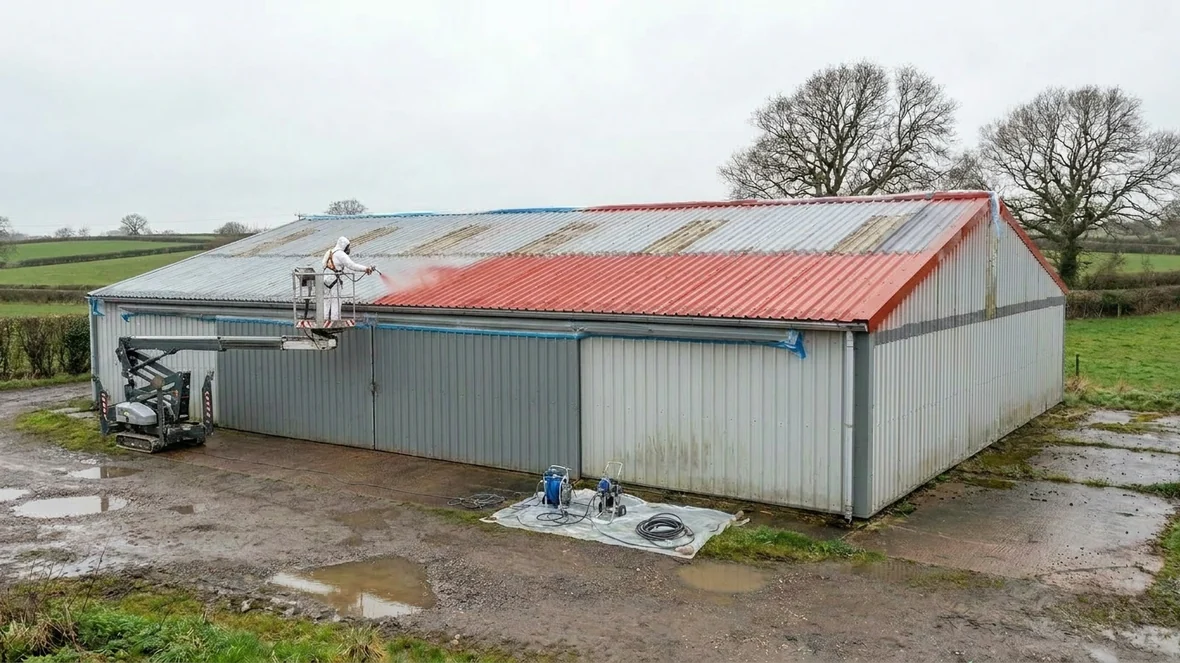

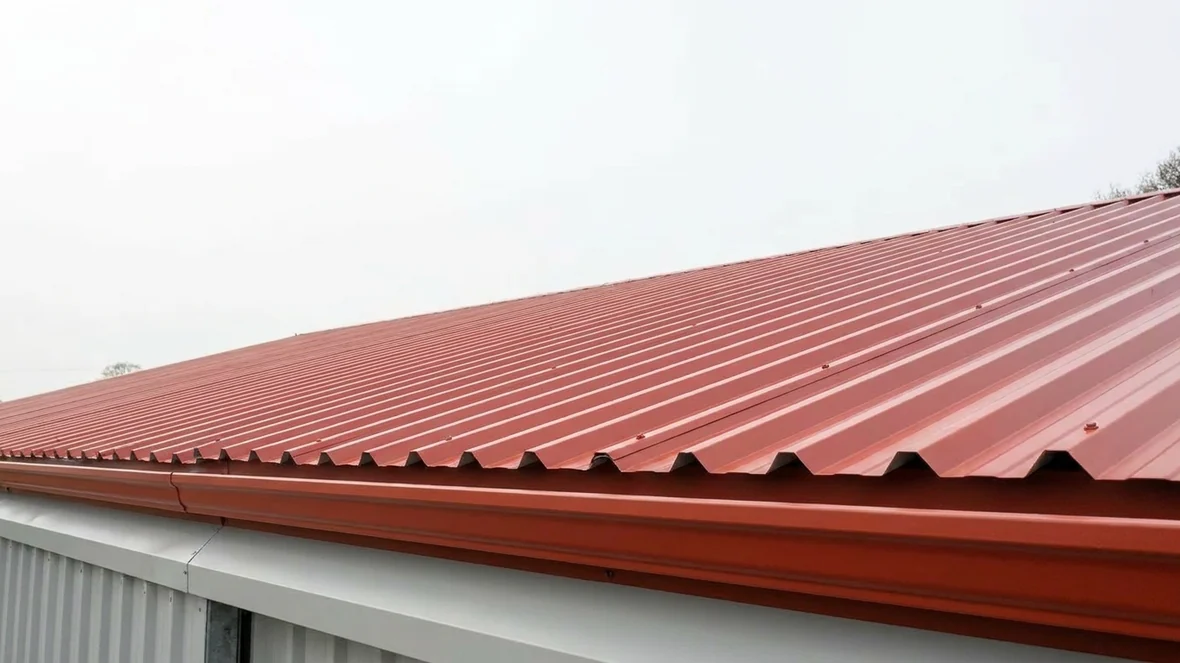
The finished Herefordshire machinery store
The treatment stage is where a cut edge job is won, so it is worth spelling out. After the wash proved the surface and left every metre of affected edge cleanly visible, each sheet end lap and the full eaves edge were worked over mechanically to remove the active rust, then primed with a rust converting, corrosion inhibiting primer, brushed in along each edge so it penetrates the lap rather than just bridging it. Where sealant in the laps had failed it was cut out and replaced, so water can no longer sit against the treated edges. On the washed grey roof the result looked almost surgical: neat, straight bands of fresh primer running across the slope exactly where the red brown lines used to be. The finish system then went on by airless spray, a continuous elastomeric film over the whole roof that seals the treated laps and fixings under one membrane and takes the weather from now on, so no cut edge is ever exposed again.
Handover on a machinery store is refreshingly simple to judge. There is no herd to settle back in and no crop to move; the test is whether the farm got its building back exactly as it lent it to us, minus the corrosion. It did. Nothing under the roof moved all week, the hardstanding was swept behind the last hose, and the only evidence we had been in that corner of Herefordshire was the roof itself.
The rash is gone. The roof is a single, even plane of satin Poppy Red from ridge to gutter, with no rust lines, no primer bands and no memory of the corrosion that was quietly shortening its life. Poppy Red earns its keep on a building like this: a strong, honest agricultural colour with a long history on British farm roofs, it hides organic staining better than pale greys, and against pale walls and a green Herefordshire hillside it makes a working building look looked after rather than loud. Half the farms in Herefordshire carry a red roof somewhere in the yard already; this one simply joined them properly. The doors rolled open the morning after handover exactly as they had every morning of the job, with everything underneath them dry and untouched. Project completed in the autumn window before the winter servicing season filled the store’s workbench.
Cut edge corrosion repairs across Herefordshire and the UK
If your roof shows the same neat rust lines, you are looking at cut edge corrosion, and the earlier it is treated the cheaper the answer is. It is endemic on profiled steel roofs across Herefordshire, from the fruit and arable holdings around Hereford itself to the mixed farms towards Leominster, the hop country around Bromyard, and south through Ross-on-Wye towards the Monmouthshire border. Our crews handle the corrosion repairs and the roof painting as one visit across the county, over into Worcestershire and Ledbury way, and UK wide through the same teams.
The local starting point is our cut edge corrosion treatment in Hereford page, and the method is described on our agricultural cut edge corrosion treatment service page, with agricultural roof coating completing the system. Every colour we spray, including Poppy Red, is on the coating colours page, and the same catch-it-early logic applied to a gutter is in our case study of a livestock building near York. To have a Herefordshire roof surveyed before the lines get any longer, get in touch.